Commerce Exam > Commerce Notes > Mathematics (Maths) Class 11 > NCERT Solutions: 6.4 - Permutations And Combinations
NCERT Solutions: 6.4 - Permutations And Combinations

Q1: If


Ans: It is known that,

Therefore, substituting this known relation into the required expression gives

Hence, after simplification we obtain

This shows the required value obtained directly by replacing
Therefore,
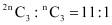
Q2: Determine n if (i)
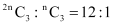
Ans: (i)
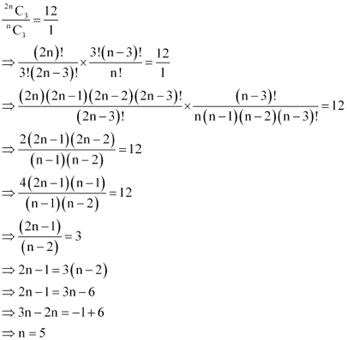
For part (i), equate the two expressions and simplify the equation step by step to solve for n.
(ii)
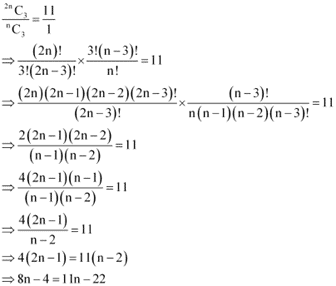
Equate the given expressions and rearrange terms to collect like terms:
⇒ 11n - 8n = - 4 + 22
⇒ 3n = 18
⇒ n = 6
Thus, n = 6 for part (ii).
Q3: How many chords can be drawn through 21 points on a circle?
Ans: For drawing one chord on a circle, only 2 points are required.
To know the number of chords that can be drawn through the given 21 points on a circle, the number of combinations have to be counted.
Therefore, there will be as many chords as there are combinations of 21 points taken 2 at a time.
Thus, required number of chords =

C(21, 2) = (21 × 20) ÷ 2 = 21 × 10 = 210.
So, 210 chords can be drawn.
Q4: In how many ways can a team of 3 boys and 3 girls be selected from 5 boys and 4 girls?
Ans: A team of 3 boys and 3 girls is to be selected from 5 boys and 4 girls.
3 boys can be selected from 5 boys in

3 girls can be selected from 4 girls in

Therefore, by multiplication principle, number of ways in which a team of 3 boys and 3 girls can be selected
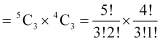
Compute the values: C(5, 3) = (5 × 4 × 3) ÷ (3 × 2 × 1) = 10 and C(4, 3) = 4.
Number of ways = 10 × 4 = 40.

Q5: Find the number of ways of selecting 9 balls from 6 red balls, 5 white balls and 5 blue balls if each selection consists of 3 balls of each colour.
Ans: There are a total of 6 red balls, 5 white balls, and 5 blue balls.
9 balls have to be selected in such a way that each selection consists of 3 balls of each colour.
Here,
3 balls can be selected from 6 red balls in

3 balls can be selected from 5 white balls in

3 balls can be selected from 5 blue balls in

Thus, by multiplication principle, required number of ways of selecting 9 balls
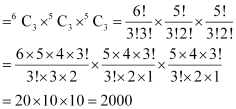
Now compute the numerical values: C(6, 3) = (6 × 5 × 4) ÷ (3 × 2 × 1) = 20 and C(5, 3) = 10.
Required number = 20 × 10 × 10 = 2000.
Q6: Determine the number of 5 card combinations out of a deck of 52 cards if there is exactly one ace in each combination.
Ans: In a deck of 52 cards, there are 4 aces. A combination of 5 cards have to be made in which there is exactly one ace.
Then, one ace can be selected in


Thus, by multiplication principle, required number of 5 card combinations
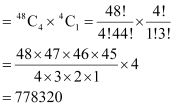
Compute the values: C(4, 1) = 4 and C(48, 4) = (48 × 47 × 46 × 45) ÷ (4 × 3 × 2 × 1) = 194,580.
Required number = 4 × 194,580 = 778,320.
Q7: In how many ways can one select a cricket team of eleven from 17 players in which only 5 players can bowl if each cricket team of 11 must include exactly 4 bowlers?
Ans: Out of 17 players, 5 players are bowlers.
A cricket team of 11 players is to be selected in such a way that there are exactly 4 bowlers.
4 bowlers can be selected in


Thus, by multiplication principle, required number of ways of selecting cricket team

Compute the values: C(5, 4) = 5 and C(12, 7) = C(12, 5) = 792.
Required number = 5 × 792 = 3,960.
Q8: A bag contains 5 black and 6 red balls. Determine the number of ways in which 2 black and 3 red balls can be selected.
Ans: There are 5 black and 6 red balls in the bag.
2 black balls can be selected out of 5 black balls in


Thus, by multiplication principle, required number of ways of selecting 2 black and 3 red balls
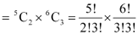

Compute the values: C(5, 2) = 10 and C(6, 3) = 20.
Required number = 10 × 20 = 200.
Q9: In how many ways can a student choose a programme of 5 courses if 9 courses are available and 2 specific courses are compulsory for every student?
Ans: There are 9 courses available out of which, 2 specific courses are compulsory for every student.
Therefore, every student has to choose 3 courses out of the remaining 7 courses. This can be chosen in

Thus, required number of ways of choosing the programme

Compute the value: C(7, 3) = (7 × 6 × 5) ÷ (3 × 2 × 1) = 35.
Therefore, the student can choose the programme in 35 ways.
The document NCERT Solutions: 6.4 - Permutations And Combinations is a part of the Commerce Course Mathematics (Maths) Class 11.
All you need of Commerce at this link: Commerce
FAQs on NCERT Solutions: 6.4 - Permutations And Combinations
| 1. How do permutations and combinations differ from each other? |  |
Ans. Permutations refer to the arrangement of objects in a specific order, while combinations refer to the selection of objects without considering the order.
| 2. What is the formula for calculating permutations of objects? | |
Ans. The formula for calculating permutations of objects is given by nPr = n! / (n - r)!, where n is the total number of objects and r is the number of objects being arranged.
| 3. How can permutations and combinations be applied in real-life scenarios? | |
Ans. Permutations and combinations are commonly used in various fields such as probability, statistics, and computer science to solve problems related to arrangements and selections of objects.
| 4. What are the key differences between a permutation and a combination problem? | |
Ans. In a permutation problem, the order of objects matters, while in a combination problem, the order does not matter. Permutations involve arrangements, while combinations involve selections.
| 5. Can permutations and combinations be used interchangeably in all situations? | |
Ans. No, permutations and combinations cannot be used interchangeably in all situations. It is important to identify whether the problem involves arranging objects in a specific order (permutations) or selecting objects without considering the order (combinations) before applying the appropriate formula.
About this Document

4.73/5 Rating

Apr 21, 2026 Last updated
Related Exams
Document Description: NCERT Solutions: 6.4 - Permutations And Combinations for Commerce 2026 is part of Mathematics (Maths) Class 11 preparation. The notes and questions for NCERT Solutions: 6.4 - Permutations And Combinations have been prepared according to the Commerce exam syllabus. Information about NCERT Solutions: 6.4 - Permutations And Combinations covers topics like and NCERT Solutions: 6.4 - Permutations And Combinations Example, for Commerce 2026 Exam. Find important definitions, questions, notes, meanings, examples, exercises and tests below for NCERT Solutions: 6.4 - Permutations And Combinations.
Introduction of NCERT Solutions: 6.4 - Permutations And Combinations in English is available as part of our Mathematics (Maths) Class 11 for Commerce & NCERT Solutions: 6.4 - Permutations And Combinations in Hindi for Mathematics (Maths) Class 11 course. Download more important topics related with notes, lectures and mock test series for Commerce Exam by signing up for free. Commerce: NCERT Solutions: 6.4 - Permutations And Combinations
Description
NCERT Solutions: 6.4 of Maths Class 11 provides all the questions of NCERT textbook with detailed solutions. Download free PDF from EduRev.
Information about NCERT Solutions: 6.4 - Permutations And Combinations
In this doc you can find the meaning of NCERT Solutions: 6.4 - Permutations And Combinations defined & explained in the simplest way possible. Besides explaining types of NCERT Solutions: 6.4 - Permutations And Combinations theory, EduRev gives you an ample number of questions to practice NCERT Solutions: 6.4 - Permutations And Combinations tests, examples and also practice Commerce tests



Related Searches
video lectures, shortcuts and tricks, Extra Questions, NCERT Solutions: 6.4 - Permutations And Combinations, MCQs, Viva Questions, NCERT Solutions: 6.4 - Permutations And Combinations, pdf , Sample Paper, past year papers, practice quizzes, Important questions, Previous Year Questions with Solutions, mock tests for examination, ppt, NCERT Solutions: 6.4 - Permutations And Combinations, Free, Objective type Questions, study material, Summary, Semester Notes, Exam;