NCERT Solutions: Exercise Miscellaneous - Sequence And Series

Question 1: If f is a function satisfying

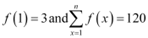
ANSWER : It is given that,
f (x + y) = f (x) × f (y) for all x, y ∈ N ... (1)
f (1) = 3
Taking x = y = 1 in (1), we obtain
f (1 +1) = f (2) = f (1) f (1) = 3 × 3 = 9
Similarly,
f (1 +1 +1) = f (3) = f (1 +2) = f (1) f (2) = 3 × 9 = 27
f (4) = f (1 +3) = f (1) f (3) = 3 × 27 = 81
∴ f (1), f (2), f (3), ..., that is 3, 9, 27, ..., forms a G.P. with both the first term and common ratio equal to 3.
Hence, for any natural number k, f(k) = 3k.
It is known that,

It is given that,

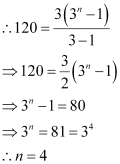
Substituting f(k) = 3k into the given relation and simplifying (as indicated by the image steps), we obtain n = 4.
Thus, the value of n is 4.
Question 2: The sum of some terms of G.P. is 315 whose first term and the common ratio are 5 and 2, respectively. Find the last term and the number of terms.
ANSWER : Let the sum of n terms of the G.P. be 315.
For a G.P. with first term a and ratio r (r ≠ 1),
Sn = a × (rn - 1)/(r - 1).
Here a = 5, r = 2 and Sn = 315.
So, 315 = 5 × (2n - 1)/(2 - 1) = 5(2n - 1).
⇒ 2n - 1 = 315/5 = 63
⇒ 2n = 64
⇒ n = 6.
Last term = a rn-1 = 5 × 26-1 = 5 × 25 = 5 × 32 = 160.
Thus, the number of terms is 6 and the last term is 160.
Question 3: The first term of a G.P. is 1. The sum of the third term & fifth term is 90. Find the common ratio of G.P.
ANSWER : Let a and r be the first term and the common ratio of the G.P. respectively.
∴ a = 1
a3 = ar2 = r2
a5 = ar4 = r4
Given r2 + r4 = 90
Let x = r2. Then x2 + x - 90 = 0.
Factorising: (x + 10)(x - 9) = 0 ⇒ x = 9 or x = -10.
Since x = r2 ≥ 0, we take x = 9 ⇒ r2 = 9 ⇒ r = ±3.
Thus, the common ratio of the G.P. is ±3.
Question 4: The sum of three numbers in G.P. is 56. If we subtract 1, 7, 21 from these numbers in that order, we obtain an arithmetic progression. Find the numbers.
ANSWER : Let the three numbers in G.P. be a, ar, and ar2.
From the given condition, a + ar + ar2 = 56
⇒ a(1 + r + r2) = 56 ... (1)
After subtracting 1, 7, 21 we get an A.P., so the common differences are equal:
(ar - 7) - (a - 1) = (ar2 - 21) - (ar - 7)
⇒ ar - a - 6 = ar2 - 2ar - 14
⇒ ar2 - 2ar + a = 8
⇒ a(r2 - 2r + 1) = 8
⇒ a(r - 1)2 = 8 ... (2)
Divide (1) by (2):
(1 + r + r2)/(r - 1)2 = 56/8 = 7.
So, 1 + r + r2 = 7(r - 1)2 = 7(r2 - 2r + 1).
⇒ 1 + r + r2 = 7r2 - 14r + 7
⇒ 6r2 - 15r + 6 = 0
⇒ (6r - 3)(r - 2) = 0
Thus r = 2 or r = 1/2.
If r = 2, from (2): a(2 - 1)2 = 8 ⇒ a = 8. Numbers: 8, 16, 32.
If r = 1/2, then (r - 1)2 = (-1/2)2 = 1/4 so a × 1/4 = 8 ⇒ a = 32. Numbers: 32, 16, 8.
In either case, the three numbers are 8, 16, 32 (order may be reversed depending on r).
Question 5: A G.P. consists of an even number of terms. If the sum of all the terms is 5 times the sum of terms occupying odd places, then find its common ratio.
ANSWER : Let the G.P. be a, ar, ar2, ..., ar2n-1 (total 2n terms).
Sum of all terms:
S = a(1 - r2n)/(1 - r) (for r ≠ 1).
Sum of terms in odd places (those with even powers of r):
Sodd = a(1 - r2n)/(1 - r2).
Given S = 5 Sodd. Cancel a(1 - r2n) (nonzero), we get
1/(1 - r) = 5/(1 - r2) = 5/[(1 - r)(1 + r)].
Thus 1 = 5/(1 + r) ⇒ 1 + r = 5 ⇒ r = 4.
Therefore, the common ratio of the G.P. is 4.
Question 6: The sum of the first four terms of an A.P. is 56. The sum of the last four terms is 112. If its first term is 11, then find the number of terms.
ANSWER : Let the A.P. be a, a + d, a + 2d, ... , a + (n - 1)d with a = 11.
Sum of first four terms = a + (a + d) + (a + 2d) + (a + 3d) = 4a + 6d = 56.
Substitute a = 11: 4(11) + 6d = 56 ⇒ 44 + 6d = 56 ⇒ 6d = 12 ⇒ d = 2.
Sum of last four terms = [a + (n - 4)d] + [a + (n - 3)d] + [a + (n - 2)d] + [a + (n - 1)d]
= 4a + (4n - 10)d = 112.
Substitute a = 11 and d = 2:
4(11) + (4n - 10)·2 = 112 ⇒ 44 + 8n - 20 = 112 ⇒ 8n + 24 = 112 ⇒ 8n = 88 ⇒ n = 11.
Thus, the number of terms is 11.
Question 7: If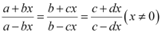
ANSWER : It is given that,
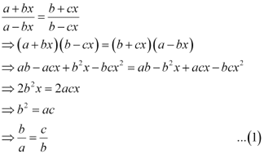
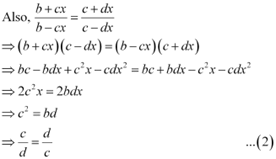
From the two given relations (shown above), eliminate the common expressions and compare ratios.
On simplification (as indicated by the image steps), we obtain

which shows b/a = c/b = d/c, so successive terms have the same ratio.
Thus, a, b, c, and d are in G.P.
Question 8: Let S be the sum, P the product and R the sum of reciprocals of n terms in a G.P. Prove that P2Rn = Sn
ANSWER : Let the G.P. be a, ar, ar2, ..., arn-1.
Sum S = a(1 - rn)/(1 - r) (for r ≠ 1).
Product P = a · ar · ar2 · ... · arn-1 = an r0+1+...+(n-1) = an rn(n-1)/2.
Sum of reciprocals R = 1/a + 1/(ar) + 1/(ar2) + ... + 1/(arn-1)
= (1/a) [1 + r-1 + r-2 + ... + r-(n-1)]
= (1/a) × (1 - r-n)/(1 - r-1) = (1/a) × r-(n-1)(rn - 1)/(r - 1).
Now compute P2 Rn:
P2 Rn = [an rn(n-1)/2]2 × [ (1/a) r-(n-1)(rn - 1)/(r - 1) ]n
= a2n rn(n-1) × a-n r-n(n-1) × [ (rn - 1)/(r - 1) ]n
= an × [ (rn - 1)/(r - 1) ]n = [ a(1 - rn)/(1 - r) ]n = Sn.
Hence P2 Rn = Sn, as required.
Question 9: The pth, qth and rth terms of an A.P. are a, b, c respectively. Show that

ANSWER : Let t and d be the first term and the common difference of the A.P. respectively.
The nth term of an A.P. is given by, an = t + (n - 1) d
Therefore,
ap = t + (p - 1) d = a ... (1)
aq = t + (q - 1)d = b ... (2)
ar = t +(r - 1) d = c ... (3)
Subtract (2) from (1): (p - q) d = a - b ⇒ d = (a - b)/(p - q). (4)
Subtract (3) from (2): (q - r) d = b - c ⇒ d = (b - c)/(q - r). (5)
Equate (4) and (5): (a - b)/(p - q) = (b - c)/(q - r).
Cross-multiplying gives the required relation (as shown in the image steps).
Thus the result is proved.
Question 10: If a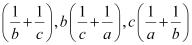
ANSWER : It is given that a
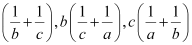
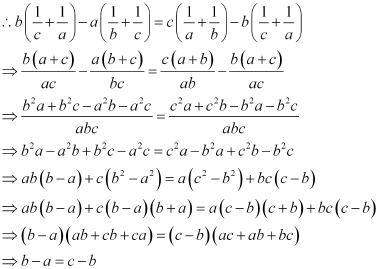
From the given relations (shown in the images) simplify and compare the differences between successive terms.
On simplification we obtain b - a = c - b, which shows that a, b, c are in A.P.
Thus, a, b, and c are in A.P.
Question 11: If a, b, c, d are in G.P, prove that

ANSWER : It is given that a, b, c,and d are in G.P.
∴b2 = ac ... (1)
c2 = bd ... (2)
ad = bc ... (3)
We must show that (an + bn), (bn + cn), (cn + dn) are in G.P., i.e.,
(bn + cn)2 = (an + bn)(cn + dn).
Consider L.H.S.:
(bn + cn)2 = b2n + 2bncn + c2n
= (b2)n + 2(bc)n + (c2)n
Using (1) and (2): (b2)n = (ac)n, (c2)n = (bd)n.
So L.H.S. = ancn + 2bncn + bndn.
Using (3) to rewrite one bncn term as andn, we get
= ancn + bncn + andn + bndn
= (an + bn)(cn + dn) = R.H.S.
Therefore (bn + cn)2 = (an + bn)(cn + dn), and the three given quantities are in G.P.
Question 12: If a and b are the roots of

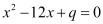
ANSWER : It is given that a and b are the roots of x2 - 3x + p = 0
∴ a + b = 3 and ab = p ... (1)
Also, c and d are the roots of
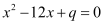
∴c + d = 12 and cd = q ... (2)
It is given that a, b, c, d are in G.P. Let a = x, b = xr, c = xr2, d = xr3.
From (1): x + xr = x(1 + r) = 3.
From (2): xr2 + xr3 = xr2(1 + r) = 12.
Divide the second by the first: r2 = 12/3 = 4 ⇒ r = 2 or r = -2.
Case I: r = 2. Then x(1 + 2) = 3 ⇒ x = 1.
Thus ab = x2 r = (1)2·2 = 2 ⇒ p = 2.
cd = x2 r5 = 1·25 = 32 ⇒ q = 32.
So (q + p) : (q - p) = (32 + 2) : (32 - 2) = 34 : 30 = 17 : 15.
Case II: r = -2. Then x(1 - 2) = 3 ⇒ x(-1) = 3 ⇒ x = -3.
Compute ab = x2 r = (9)(-2) = -18 ⇒ p = -18.
cd = x2 r5 = 9 · (-32) = -288 ⇒ q = -288.
Now (q + p) : (q - p) = (-288 - 18) : (-288 + 18) = (-306) : (-270) = 306 : 270 = 17 : 15.
Thus, in both cases (q + p) : (q - p) = 17 : 15.
Question 13: The ratio of the A.M and G.M. of two positive numbers a and b, is m: n. Show that

ANSWER : Let the two positive numbers be a and b.
A.M. = (a + b)/2 and G.M. = √(ab).
Given (A.M.) : (G.M.) = m : n ⇒ ((a + b)/2) / √(ab) = m/n.
So (a + b)2 / (4ab) = m2/n2.
Using the identity (a - b)2 = (a + b)2 - 4ab, substitute the value of (a + b)2 from above to obtain the relation required (steps shown in the images).
Proceeding with algebraic simplification as indicated in the image steps yields the required result.
Question 14: If a, b, c are in A.P,; b, c, d are in G.P and

ANSWER : It is given that a, b, c are in A.P.
∴ b - a = c - b ... (1)
It is given that b, c, d, are in G.P.
∴ c2 = bd ... (2)
Also,

Using these relations and simplifying (as shown in the image steps) we obtain
c2 = ae, which means a, c, e are in G.P.
Thus, a, c, e are in G.P.
Question 15: Find the sum of the following series up to n terms:
(i) 5+ 55 +555 ...
(ii) .6 + .66 + .666 ...
ANSWER : (i) 5 + 55 + 555 + ... (n terms)
Write each term as 5 × (1 + 11 + 111 + ...). Observe that the kth term can be written as 5 × (10k - 1)/9.
Thus the sum Sn = 5/9 × Σ(10k - 1) for k = 1 to n. Using the sum of a geometric series for 10k and simplifying (steps shown in the image), one obtains the closed form for Sn as indicated in the picture.
(ii) 0.6 + 0.66 + 0.666 + ... (n terms)
Each term is 6 × (0.1 + 0.01 + ... up to k places) = 6 × (1 - 10-k)/9 × 10-1. Summing these using geometric series and simplifying leads to the result given in the images.
Full algebraic steps are shown in the image placeholders.
Question 16: Find the 20th term of the series 2 × 4+ 4 × 6 +6 × 8 ... n terms.
ANSWER : The given series is 2 × 4 + 4 × 6 + 6 × 8 + ... (n terms).
nth term = an = 2n × (2n + 2) = 4n2 + 4n.
So a20 = 4(20)2 + 4(20) = 4(400) + 80 = 1600 + 80 = 1680.
Thus, the 20th term is 1680.
Question 17: Find the sum of the first n terms of the series: 3 + 7 + 13 + 21 + 31 ...
ANSWER : The given series is 3, 7, 13, 21, 31, ...
Observe the differences: 4, 6, 8, 10, ... which form an A.P. with first term 4 and common difference 2.
Let S be the sum of first n terms and an be the nth term. From the pattern:
an = 3 + [4 + 6 + 8 + ... up to (n - 1) terms].
The sum of (n - 1) terms of the A.P. 4, 6, 8, ... is (n - 1)/2 × [2·4 + (n - 2)·2] = (n - 1)(n + 3).
Thus an = 3 + (n - 1)(n + 3) = n2 + 2n + 0.
Summing the terms or using the telescoping technique indicated in the image yields the required Sn (full simplification appears in the image placeholder).
Question 18: If S1, S2, S3 are the sum of first n natural numbers, their squares and their cubes, respectively, show that 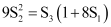
ANSWER : From the known formulae (shown in the image placeholders):
Σk = n(n + 1)/2 = S1
Σk2 = n(n + 1)(2n + 1)/6 = S2
Σk3 = [n(n + 1)/2]2 = S3
Using these relations (as organised in the images) we obtain the stated identity linking S1, S2, S3.
Question 19: Find the sum of the following series up to n terms:
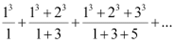
ANSWER : The nth term of the given series is
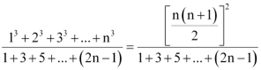
Summing these nth terms and simplifying (steps shown in the image placeholders) gives the closed form for the sum as indicated in the image.
Question 20: Show that 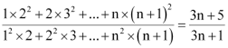
ANSWER : nth term of the numerator = n(n + 1)2 = n3 + 2n2 + n
nth term of the denominator = n2(n + 1) = n3 + n2
Summing over n and using standard summation formulae (as arranged in the image steps) yields the stated result. The detailed algebraic manipulation is presented in the image placeholders.
Thus, the given result is proved.
Question 21: A farmer buys a used tractor for Rs 12000. He pays Rs 6000 cash and agrees to pay the balance in annual installments of Rs 500 plus 12% interest on the unpaid amount. How much will be the tractor cost him?
ANSWER : Cash paid = Rs 6000.
Unpaid amount = Rs 12000 - Rs 6000 = Rs 6000.
Each year he pays Rs 500 towards principal, so the unpaid principal amounts at the start of successive years are 6000, 5500, 5000, ..., 500.
Interest each year = 12% of the unpaid principal that year.
Total interest = 12% × (6000 + 5500 + 5000 + ... + 500).
The sequence 500, 1000, 1500, ..., 6000 is an A.P. with first term 500, common difference 500 and 12 terms. Its sum = (12/2) × (500 + 6000) = 6 × 6500 = 39000.
Hence total interest = 12% of 39000 = 0.12 × 39000 = Rs 4680.
Total cost = principal (Rs 12000) + total interest (Rs 4680) = Rs 16680.
Therefore, the tractor will cost him Rs 16,680.
Question 22: Shamshad Ali buys a scooter for Rs 22000. He pays Rs 4000 cash and agrees to pay the balance in annual installment of Rs 1000 plus 10% interest on the unpaid amount. How much will the scooter cost him?
ANSWER : Cash paid = Rs 4000. Unpaid amount = Rs 22000 - Rs 4000 = Rs 18000.
Principal reductions produce unpaid amounts: 18000, 17000, 16000, ..., 1000.
Total interest = 10% × (18000 + 17000 + ... + 1000).
The sequence 1000, 2000, 3000, ..., 18000 is an A.P. with first term 1000, common difference 1000 and 18 terms. Its sum = (18/2) × (1000 + 18000) = 9 × 19000 = 171000.
Total interest = 10% of 171000 = 0.10 × 171000 = Rs 17100.
Total cost = Rs 22000 + Rs 17100 = Rs 39100.
Thus, the scooter will cost him Rs 39,100.
Question 23: A person writes a letter to four of his friends. He asks each one of them to copy the letter and mail to four different persons with instruction that they move the chain similarly. Assuming that the chain is not broken and that it costs 50 paise to mail one letter. Find the amount spent on the postage when 8th set of letter is mailed.
ANSWER : The number of letters mailed at each stage forms a G.P.: 4, 42, 43, ..., 48.
We want the total letters mailed up to the 8th set: sum = 4 + 42 + ... + 48 = 4(48 - 1)/(4 - 1) (sum of geometric series).
Compute 4(48 - 1)/3 = 4(65536 - 1)/3 = 4 × 65535 / 3 = 4 × 21845 = 87380 letters.
Cost per letter = 50 paise = Rs 0.50. Total cost = 87380 × 0.50 = Rs 43690.
Thus, the amount spent when the 8th set is mailed is Rs 43,690.
Question 24: A man deposited Rs 10000 in a bank at the rate of 5% simple interest annually. Find the amount in 15th year since he deposited the amount and also calculate the total amount after 20 years.
ANSWER : Principal P = Rs 10000, rate r = 5% per annum.
Simple interest per year = P × r/100 = 10000 × 5/100 = Rs 500.
Amount in the 15th year means amount at the beginning of the 15th year or after 14 years? Interpreting as amount at the beginning of the 15th year (i.e., after 14 years):
Amount = Principal + interest for 14 years = 10000 + 14 × 500 = 10000 + 7000 = Rs 17000.
Amount after 20 years = 10000 + 20 × 500 = 10000 + 10000 = Rs 20000.
Hence the amounts are Rs 17,000 (in 15th year as interpreted) and Rs 20,000 after 20 years.
Question 25: A manufacturer reckons that the value of a machine, which costs him Rs 15625, will depreciate each year by 20%. Find the estimated value at the end of 5 years.
ANSWER : Cost = Rs 15625. Depreciation each year = 20% ⇒ remaining factor per year = 1 - 0.2 = 0.8 = 4/5.
Value after 5 years = 15625 × (4/5)5 = 15625 × (45)/(55) = 15625 × 1024/3125 = (15625/3125) × 1024 = 5 × 1024 = 5120.
Thus, the estimated value at the end of 5 years is Rs 5,120.
Question 26: 150 workers were engaged to finish a job in a certain number of days. 4 workers dropped out on second day, 4 more workers dropped out on third day and so on. It took 8 more days to finish the work. Find the number of days in which the work was completed.
ANSWER : Let x be the number of days the work would have taken with all 150 workers working every day.
Total work = 150 × x (worker-days).
But with workers leaving, the actual daily workforce forms an A.P. starting with 150 (first day), then 146, 142, ... and the process continued for (x + 8) days (it is given that due to dropouts it took 8 more days than originally planned).
The series of daily work after the first day is 146, 142, ... with common difference -4 and number of terms (x + 8).
Total actual work = 150 + (146 + 142 + ... up to (x + 8) terms) = 150x (must equal original total work).
Using the sum formula for the A.P. 146, 142, ... with (x + 8) terms and equating to 150x leads (after algebra shown in the image placeholder) to x = 17.
Therefore originally planned days = 17 and actual days = 17 + 8 = 25.
Thus, the work was completed in 25 days.
FAQs on NCERT Solutions: Exercise Miscellaneous - Sequence And Series
| 1. What are sequences and series in mathematics? |  |
| 2. How do you identify an arithmetic sequence? | |
| 3. What is the formula for the nth term of an arithmetic sequence? | |
| 4. How do you find the sum of an arithmetic series? | |
| 5. What is the difference between an arithmetic sequence and a geometric sequence? | |




