Q1: Show that the function given by f(x) = 3x 17 is strictly increasing on R.
Ans: Let be any two numbers in R.
Then, we have:
Let x1 be x2 any two numbers in R.
Then, we have:

Hence, f is strictly increasing on R.
Q2: Show that the function given by/(x) = e2x is strictly increasing on R.
Ans: Let x1 and x2 be any twro numbers in R.
Then, we have: 
Hence, f is strictly increasing on R.
Q3: Show that the function given by f(x) = sin x is
(a) strictly increasing in 
(b) strictly decreasing in 
(c) neither increasing nor decreasing in (0, π)
Ans: The given function is f(x) = sinx.
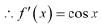
(a) Since for each 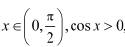 we have
Hence,/is strictly increasing in 
(b) Since for each 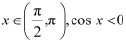 , we have
Hence,f is strictly decreasing in
(c) From the results obtained in (a) & (b), it is clear that f is neither increasing nor decreasing in (0, π)
Q4: Find the intervals in which the function f given by f(x) = 2x2 - 3x is
(a) strictly increasing
(b) strictly decreasing
Ans: The given function is f(x) = 2x2 - 3x.
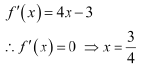
Now. the point 3/4 divides the real line into two disjoint intervals i.e.. 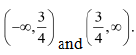
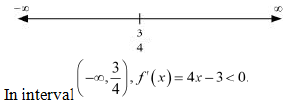
Hence, the given function (f) is strictly decreasing in interval 
In interval 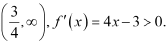
Hence, the given function (J) is strictly increasing in interval 
Q5: Find the intervals in which the function/given by/x) = 2x3 - 3x2 - 36x+ 7 is
(a) strictly increasing
(b) strictly decreasing
Ans: The given function is 

The points x = -2 andx = 3 divide the real line into three disjoint intervals i.e..
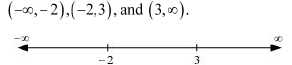
In intervals (-∞, -2) and (3, ∞) , f'(x) is positive while in interval (-2,3), f'(x) is negative.
Hence, the given function (f) is strictly increasing in intervals (-∞, -2) and (3, ∞) , while function if) is strictly decreasing in interval (-2,3).
Q6: Find the intervals in which the following functions are strictly increasing or decreasing:
(a) x2 + 2x- 5
(b) 10 - 6x- 2x2
(c) -2x3 - 9x2 - 12x+ 1
(d) 6 - 9x -x2
(e) (x + 1)3 (x - 3)3
Ans: (a) We have,
f(x) = x2 +2x-5
∴ f'(x) = 2x+2
Now,
f'(x) = 0 ⇒ x = -1
Point x = -1 divides the real line into two disioint. intervals i.e.. (-∞, -1) and (-1, ∞)
In interval 
∴ f is strictly decreasing in interval (-∞, -1).
Thus, f is strictly decreasing for x < -1.
In interval 
∴ f is strictly increasing in interval (-1, ∞)
Thus, f is strictly deere asing for x < - 1.
(b) We have,
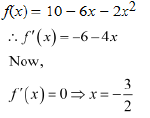
The point x = -3/2 divides the real line into two disjoint intervals i.e., (-∞, -3/2) and (-3/2, ∞)
In interval (-∞, -3/2) i.e , when x < -3/2, f'(x) = -6-4x<0
∴ f is strictly increasing for x< -3/2
In interval (-3/2, ∞) i.e , when x > -3/2, f'(x) = -6-4x<0
∴ f is strictly decreasing for x> -3/2
(c) We have
f(x) = -2x3 - 9x2 - 12x +1
∴ f'(x) = -6x2 - 18x - 12 = -6(x2+3x+2) = -6(x+1)(x+2)
Now,
f'(x) = 0 ⇒ x = -1 and x = -2
Points x = - 1 and x = -2 divide the real line into three disjoint intervals i.e...
(-∞, -2),(-2, -1) and (-1, ∞)
In intervals (-∞, -2) and (-1, ∞) he., when x < - 2 and x > - 1,
f'(x) = -6(x+1)(x+2) < 0
∴ f is strictly de ere as ing for x < - 2 and x > -1.
Now. in interval (-2, -1) i.e.. when - 2 < x < - 1.
f'(x) = -6(x+1)(x+2) > 0
∴ f is strictly increasing for 2 < x < 1
(d) We have.
f(x) = 6-9x = x2
∴ f'(x) = -9 -2x
Now, f'
(x) = 0 gives x = -9/2
The point x = -9/2 divides the real line into two disjoint intervals i.e., (-∞, -9/2) and (-9/2,∞ )
In interval (-∞, -9/2) i.e., for 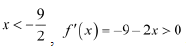
∴ f is strictly increasing for x < -9/2
In interval (-9/2,∞ ) i.e. for 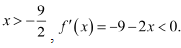
∴ f is strictly decreasing for 
(e) We have.
f(x) = (x+1)3 (x-3)3
f'(x) = 3(x+1)2(x-3)3 +3(x-3)2 (x+1)3
= 3(x+1)2(x-3)2 [x-3+x+1]
=3(x+1)2(x-3)2(2x-2)
=6 (x+1)2(x-3)2 (x-1)
The points x = -1,x = 1. and x = 3 divide the real line into four disjoint intervals i.e., (-∞, -1) (-1,1), (1,3), and (3, ∞)
In intervals (-∞, -1) and (-1,1), f'(x) = 6(x+1)2(x-3)2(x-1) <0
∴ f is strictly decreasing in intervals (-∞, -1) and (-1,1)
In intervals 
∴ f is strictly increasing in intervals (1,3), and (3, ∞)
Q7: Show that 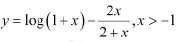 , is an increasing function of x throughout its domain.
Ans: We have.
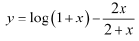

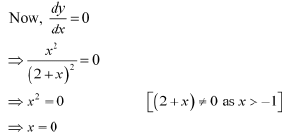
Since x > - 1. point x =0 divides the domain (-1 ∞) in two disjoint intervals i.e.. -1 < x < 0 & x > 0.
When -1 < x < 0. we have:
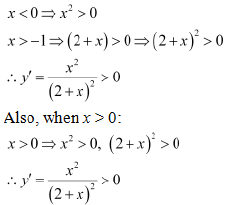
Hence, function f is increasing throughout this domain.
Q8: Find the values of x for which y = [x(x-2)]2 is an increasing function.
Ans: We have.
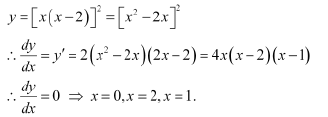
The points x = 0.x = 1. andx = 2 divide the real line into four disjoint intervals
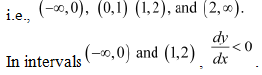
∴ y is strictly decreasing in intervals (-∞ , 0) and (1,2)
However, in intervals (0. 1) and (2, ∞), dy/dx > 0
∴ y is strictly increasing in intervals (0,1) and (2, ∞).
∴ y is strictly increasing for 0 < x < 1 and x > 2.
Q9: Prove that 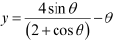 is an increasing function of θ in [0, π/2]
Ans: We have.
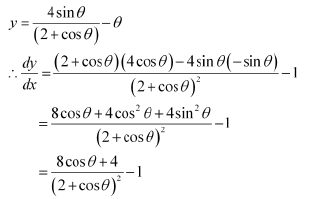
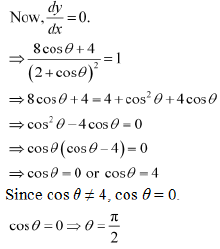

In interval  we have cos
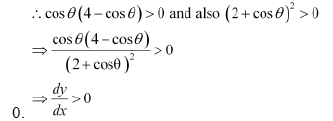
Tli ere fore.}' is strictly increasing in interval (0, π/2)
Also, the given function is continuous at x=0 and x = π/2
Hence, is increasing in interval [0, π/2].
Q10: Prove that the logarithmic function is strictly increasing on (0, ∞).
Ans: The given function is f (x) = log x.
∴ f'(x) = 1/x
It is clear that for x > 0, f'(x) = 1/x >0 .
Hence f(x) = log x is strictly increasing in interval (0;∞).
Q11: Prove that the function/given by f(x) = x2 - x + 1 is neither strictly increasing nor strictly decreasing on (-1. 1).
Ans: The given function is f(x) = x2 - x + 1.
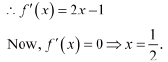
The point 1/2 divides the interval (-1. 1) into two disjoint intervals i.e.. 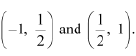
Now. in interval 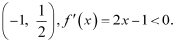
Therefore, f is strictly decreasing in interval (-1, 1/2)
However, in interval 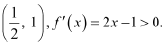
Therefore, f is strictly increasing in interval (1/2,1)
Hence. f is neither strictly increasing nor decreasing in interval (-1.1).
Q12: Which of the following functions are strictly decreasing on (0,π/2) ?
(A) cos x
(B) cos2x
(C) cos 3x
(D) tan x
Ans:

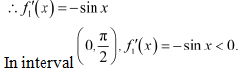
 is strictly decreasing in interval
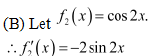
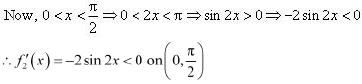
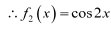 is strictly decreasing in interval
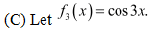
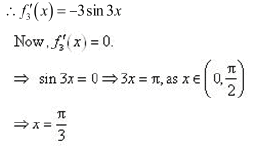
The point  divides the interval
  1 into two disjoint intervals i.e., 0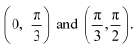
Now, in interval 
f3 is strictly decreasing in interval 
However, in interval 
∴ f3 is strictly increasing in interval 
Hence, f3 is neither increasing nor decreasing in interval  .
.
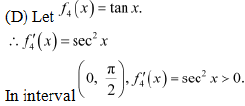
∴ f4 is strictly increasing in interval 
Therefore, functions cos x and cos 2.x are strictly decreasing in
Hence, the correct answers are A and B.
Question 13: On which of the following intervals is the function f given by  strictly decreasing?


(D) ) None of these
Ans: We have,
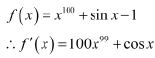
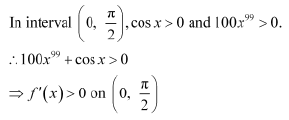
In interval 

Thus, function fis strictly increasing in interval (0,1).
In interval 
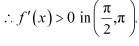
Thus, function f is strictly increasing in interval 
∴ f is strictly increasing in interval .
.
Hence, function f is strictly decreasing in none of the intervals.
The correct answer is D.
Q14: Find the least value of a such that the function f given f(x) = x2 + ax+ 1 is strictly increasing on (1, 2).
Ans: We have
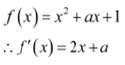
Now, function f will be increasing in 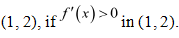
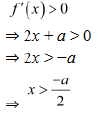
Therefore, we have to find the least value of a such that
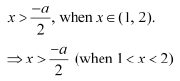
Thus, the least value of a for/to be increasing on (1? 2) is given by.
-a/2 =1
-a/2 =1 ⇒ a = -2
Hence, the required value of a is -2.
Q15: Let I be any interval disjoint from (-1, 1). Prove that the function f given by f(x) = x 1/x. is strictly increasing on I.
Ans: We have,
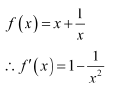
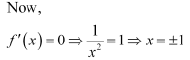
The points x = 1 andx = -1 divide the real line in three disjoint intervals i.e., 
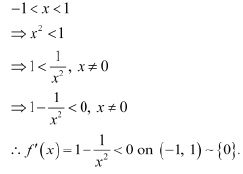
In interval (-1,1). it is observed that:
In intervals  , it is observed that:
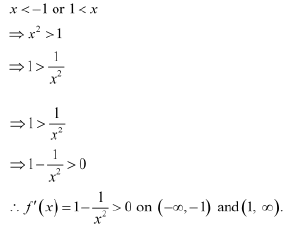
∴ f is strictly increasing on (-∞, 1) and (1, ∞)
Q16: Prove that the function f given by f(x) = log sin x is strictly increasing on (0,π/2) and strictly decreasing on (π/2, π)
Ans:-
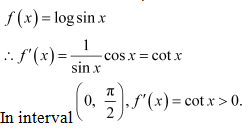
In interval 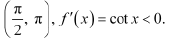
∴ f is strictly decreasing in 
Q17: Prove that the function f given by f (x) = log cos x is strictly decreasing on  and strictly increasing on
Ans: We have,
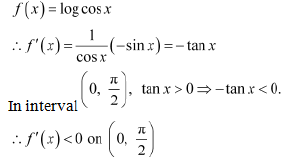
∴ f is strictly decreasing on 
In interval 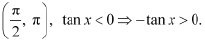
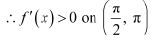
∴ f is strictly increasing on
Q18: Prove that the function given by  is increasing in R.
ANS: We have,
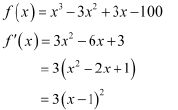

Thus, f'(x) is always positive in R.
Hence, the given function (f) is increasing in R.
Q19: The interval in which y= x2 e-x is increasing is
(A) (-∞,∞)
(B) (-2,0)
(C) (2,∞)
(D) (0,2)
Ans: We have.
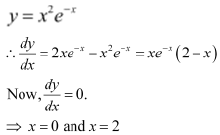
The points x = 0 and x = 2 divide the real line into three disjoint intervals i.e.;

In intervals  is always positive.
∴ f is decreasing on (-∞,0) and (2, ∞)
In interval (0,2), 
∴ f is strictly increasing on (0.2).
Hence f is strictly increasing in interval (0,2).
The correct answer is D.





