Q1: Find the maximum and minimum values,, if any, of the following functions given by
(i) f(x) =(2x- 1)2+ 3
(ii) f(x) = 9x2 + 12x+2
(iii) f(x) = -(x - 1)2+ 10
(iv) g(x) = x3 + 1
Ans: (i) The given function is f(x) = (2x- 1)2 + 3.
It can be observed that (2x- 1)2 > 0 for every x ∈ R.
There fore ,f(x)= (2x - 1)2 + 3 > 3 for every x ∈ R.
The minimum value of/is attained when 2x - 1 = 0.
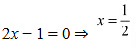
∴ Minimum value of 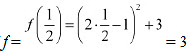
Hence, function f does not have a maximum value.
(ii) The given function is f(x) = 9x2 + 12x + 2 = (3x+2)2- 2.
It can be observed that (3x+2)2 > 0 for every x ∈ R.
There fore f = (2x - 1)2 + 3 > 3 for every x ∈ R.
The minimum value of fis attained when 2x - 1 = 0.
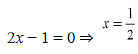
∴ Minimum value of 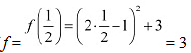
Hence, function f does not have a maximum value.
(ii) The given function is f(x) = 9x2 + 12x + 2 = (3x + 2)2 - 2
It can be observed that (3x + 2)2 > 0 for every x ∈ R.
Therefore, f(x) = (3x + 2)2 - 2 ≥ -2 for every x ∈ R.
The minimum value of f is attained when 3x + 2 = 0.
Hence, function f does not have a maximum value.
(iii) The given function is f(x) = - (x - 1)2 10.
It can be observed that (x - 1)2 ≥ 0 for every x ∈ R.
Therefore, f(x) = - (x - 1)2 10 ≤ 10 for every x ∈ R.
The maximum value of f is attained when (x - 1) = 0.
(x - 1) = 0 ⇒ x = 0
∴ Maximum value of f = f(1) = - (1 - 1)2 10 = 10
Hence, function f does not have a minimum value.
(iv) The given function is g(x) = x3 1.
Hence, function g neither has a maximum value nor a minimum value.
Q2: Find the maximum and minimum values, if any, of the following functions given by
(i) f(x) = |x + 2| - 1
(ii) g(x) = - |x + 1| + 3
(iii) h(x) = sin(2x) 5
(iv) f(x) = |sin 4x + 3|
(v) h(x) = x +1, x ∈ (-1, 1)
Ans : 
We know that  for every x ∈ R.Therefore,
 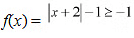 for every x ∈ R.
The minimum value of/is attained when 

∴ Minimum value of 
Hence: function f does not have a maximum value.
(ii) 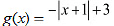 We know that
  for every x ∈ R.Therefore,
 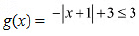 for every x ∈ R.
The maximum value of g is attained when 

∴ Maximum value of g = g(-1) 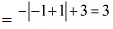
Hence, function g does not have a minimum value.
(iii)h(x) = sin2x+ 5
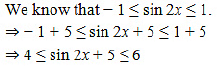
Hence, the maximum and minimum values of h are 6 and 4 respectively.
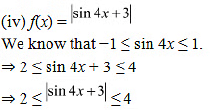
Hence, the maximum and minimum values of f are 4 and 2 respectively.

Here, if a point x0 is closest to 
Also, if x1 is closest to 1. then 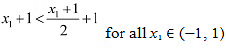
Hence, function h(x) has neither maximum nor minimum value in (-1. 1).
Q3: Find the local maxima and local minima,, if any, of the following functions. Find also the local maximum and the local minimum values, as the case may be:

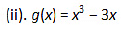



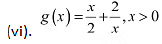
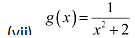

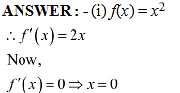
Thus.x = 0 is the only critical point which could possibly be the point of local maxima or local minima of f.
We have f''(0) = 2 which is positive.
Therefore, by second derivative test.x = 0 is a point of local minima and local minimum value of f at x = 0 is f (0) = 0.
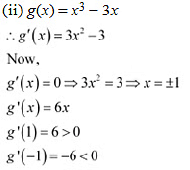
By second derivative test. x= 1 is a point of local minima and local minimum value ofg atr = 1 is g(l) = l3 - 3 = 1 - 3 = -2.
However. x = -1 is a point of local maxima and local maximum value of g at

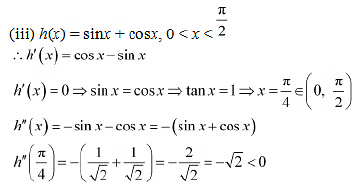
Therefore, by second derivative test.  is a point: of local maxima and the local maximum value
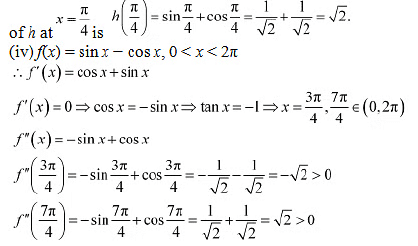
Therefore, by second derivative test,  is a point of local maxima and the local maximum value of
 However,
  is a point of local minima and the local minimum value of f at
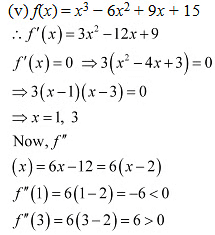
Therefore, by second derivative test.x = 1 is a point of local maxima and the local maximum value of f at x = 1 is f(1) = 1-6-9-15=19. However, x = 3 is a point of local minima and the local minimum value of f at x = 3 is f (3) = 27- 54+ 27+ 15 = 15.
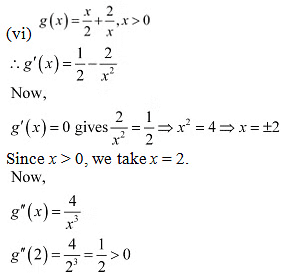
Therefore, by second derivative test. x = 2 is a point of local minima and the local minimum value of g at 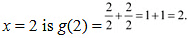
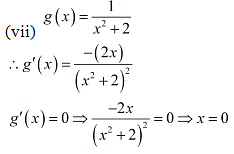
Now, for values close to x = 0 and to the left of 0, g (x) > 0. Also, for values close to x = 0 and to thi right of 0, g'(x) < 0
Therefore, by first derivative test, x = 0 is a point of local maxima and the local maximum value of 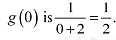
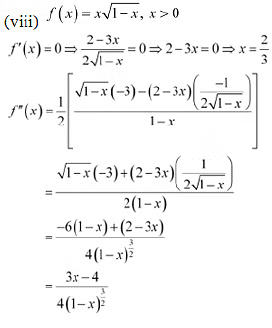
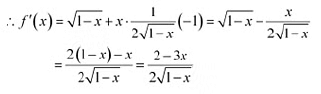
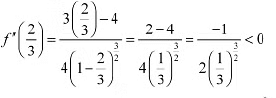
Therefore, by second derivative test.  is a point of local maxima and the local maximum value off at

Q4: Prove that the following functions do not have maxima or minima:
(i) f(x) = ex
(ii) g(x) = logx
(iii) h(x) = x3 + x2 + x+ 1
Ans: 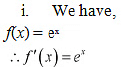
Now., if 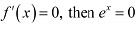 . But. the exponential function can never assume 0 for any value of x.
Therefore, there does not exist 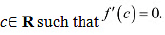
Hence, function f does not have maxima or minima.
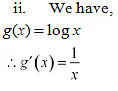
Therefore, there does not exist c ∈ R such that .
Hence, function g does not have maxima or minima.
iii. We have,
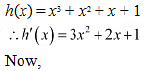
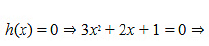
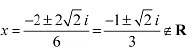
Therefore, there does not exist c∈ R such that h'(c)=0.
Hence, function h does not have maxima or minima.
Q5: Find the absolute maximum value and the absolute minimum value of the following functions in the given intervals:
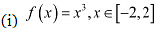

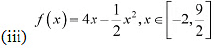

Ans: (i) The given function is f (x) = x3.
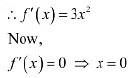
Then, we evaluate the value of/ at critical point x = 0 and at endpoints of the interval [-2,2].
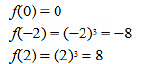
Hence, we can. conclude that the absolute maximum value off on [-2. 2] is 8 occurring at x = 2. Also, the absolute minimum value off on [-2,2] is -8 occurring at x = -2.
(ii) The given function is f(x) = sin x + cosx
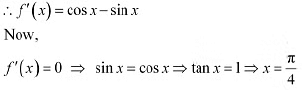
Then, we evaluate the value of/at critical point  and at the end points of the interval [0, π] .
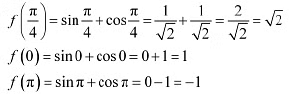
Hence, we can conclude that the absolute maximum value of 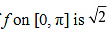 occurring at
  and the absolute minimum value of
 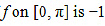 occurring at x = π
(iii) The given function is 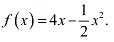
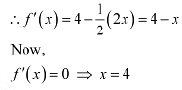
Then, we evaluate the value of/at critical point x = 4 and at the end points of the interval 
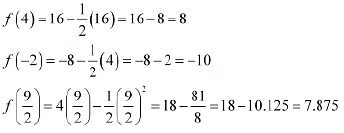
Hence, we can conclude that the absolute maximum value off on  is 8 occurring at x = 4 and the absolute minimum value of f or
  is -10 occurring at x = -2.
(iv) The riven function is
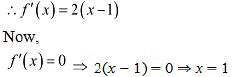
Then, we evaluate the value off at critical point x = 1 and at the endpoints of the interval [3,1].
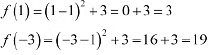
Hence, we can conclude that the absolute maximum value of/on [-3,1] is 19 occurring at x = -3 and the minimum value of f on [-3. 1] is 3 occurring at x = 1.
Q6: Find the maximum profit that a company can make, if the profit function is given by p(x) = 41 - 24x - 18x2
Ans: The profit function is riven as p(x) = 41 - 24x - 18x2
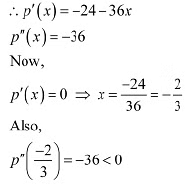
By second derivative test.  is the point of local maxima of p.
∴ Maximum profit 
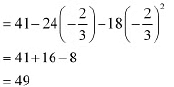
Hence, the maximum profit that the company can make is 49 units.
Q7: Find both the maximum value and the minimum value of  on the interval [0, 3]
Ans: 
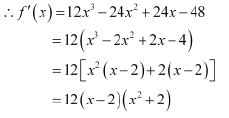
Now,  for which there are no real roots.
Therefore, we consider only x= 2 ∈[0,3].
Now, w:e evaluate the value off at critical pointx = 2 and at. the end points ofthe interval [0,3].
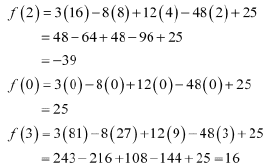
Hence, we can conclude that the absolute maximum value of f on [0, 3] is 25 occurring at x = 0 and the absolute minimum value of f at [0. 3] is - 39 occurring at x = 2.
Q8: At what points in the interval [0, 2π], does the function sin 2x attain its maximum value?
Ans: -Let f(x) = sin 2x.
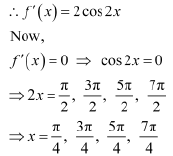
Then, we evaluate the values of/at critical points 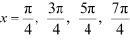 and at the end points of the
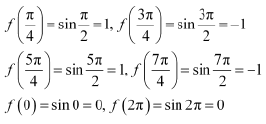
Hence, we can conclude that the absolute maximum value of f on [0, 2π] is occurring at  and
and 
Q9: What is the maximum value of the function sinx + cos x?
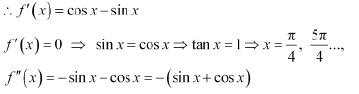
Ans: Let f (x) = sin x- cos x.
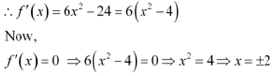
We first consider the interval [1, 3].
Then, we evaluate the value of f at the critical point x = 2 ∈ [1, 3] and at the end points of the interval [1, 3].
f(2) = 2(8) - 24(2) 107 = 16 - 48 107 = 75
f(1) = 2(1) - 24(1) 107 = 2 - 24 107 = 85
f(3) = 2(27) - 24(3) 107 = 54 - 72 107 = 89
Hence, the absolute maximum value of f(x) in the interval [1, 3] is 89 occurring at x = 3.
Next, we consider the interval [-3, -1].
Evaluate the value of f at the critical point x = -2 ∈ [-3, -1] & at the end points of the interval [1, 3].
f(-3) = 2 (-27) - 24(-3) 107 = -54 72 107 = 125
f(-1) = 2(-1) - 24 (-1) 107 = -2 24 107 = 129
f(-2) = 2(-8) - 24 (-2) 107 = -16 48 107 = 139
Hence, the absolute maximum value of f(x) in the interval [-3, -1] is 139 occurring at x = -2.
Q10: It is given that at x = 1, the function x4- 62x2 ax 9 attains its maximum value, on the interval [0, 2]. Find the value of a.
Ans: Let f(x) = x4 - 62x2 ax 9.
It is given that function f attains its maximum value on the interval [0, 2] at x = 1.
Now,  will be negative when (sin x + cos x) is positive i.e,, when sin x ana cos x are both positive. Also, we knowe that sin x and cos x both are positive in the first quadrant. Then, will be negative when
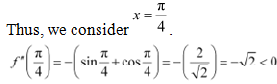
∴ By second derivative test./will be the maximum at  and the maximum value of f is

Q11: Find the maximum value of 2x3 - 24x + 107 in the interval [1, 3]. Find the maximum value of the same function in [-3, -1].
Ans: Let f(x) = 2x3 - 24x + 107.
Q12: Find the maximum and minimum values of x + sin 2x on [0, π].
Ans: Let f(x) = x + sin 2x.
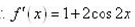

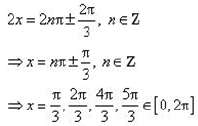
Then, we evaluate the value of f at critical points 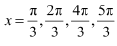 and at the end points of the interval [0, 2π].
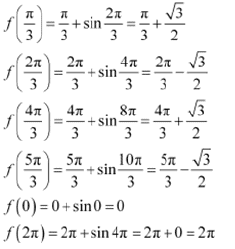
Hence, we can conclude that the absolute maximum value of f(x) in the interval [0, 2π] is 2π occurring at x =2π & the absolute minimum value of f(x) in the interval [0,2π] is 0 occurring at x = 0.
Q13: Find two numbers whose sum is 24 and whose product is as large as possible.
Ans: Let one number be x. Then, the other number is (24 - x).
Let P(x) denote the product of the two numbers. Thus, we have
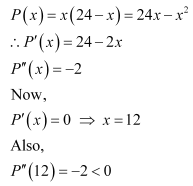
By second derivative test, x = 12 is the point of local maxima of P. Hence, the product of the numbers is the maximum when the numbers are 12 and 24 - 12 = 12.
Q14: Find two positive numbers x and y such that x + y = 60 and xy3 is maximum
Ans: The two numbers are x and y such that x + y = 60.
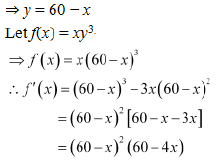
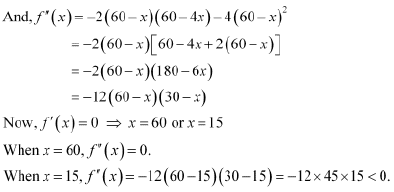
By second derivative test, x = 15 is a point of local maxima of f. Thus, function xy3 is maximum when x = 15 and y = 60 - 15 = 45.
Hence, the required numbers are 15 and 45.
Q15: Find two positive numbers x and y such that their sum is 35 and the product x2y5 is a maximum
Ans: Let one number be x. Then, the other number is y = (35 - x).
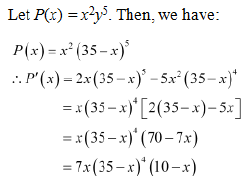

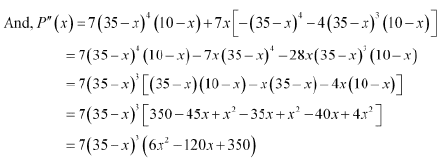
When x = 35, 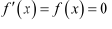 and y= 35 - 35 = 0. This will make the product x2y5 equal to 0.
x = 0 and x =35 cannot be the possible values of x.
When x = 10, we have:
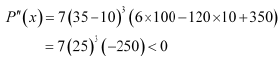
By second derivative test, P(x) will be the maximum when x = 10 and y = 35 - 10 = 25.
Hence, the required numbers are 10 and 25.
Q16: Find two positive numbers whose sum is 16 and the sum of whose cubes is minimum.
Ans: - Let one number be x. Then, the other number is (16 - x).
Let the sum of the cubes of these numbers be denoted by S(x). Then,
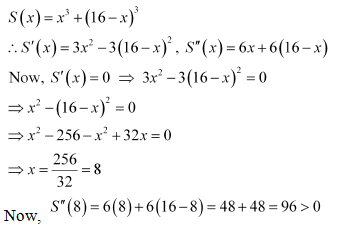
By second derivative test, x = 8 is the point of local minima of S.
Hence, the sum of the cubes of the numbers is the minimum when the numbers are 8 and 16 -8 =8.
Q17: A square piece of tin of side 18 cm is to made into a box without top, by cutting a square from each corner and folding up the flaps to form the box. What should be the side of the square to be cut off so that the volume of the box is the maximum possible?
Ans: Let the side of the square to be cut off be x cm. Then, the length and the breadth of the box will be (18 - 2x) cm each and the height of the box is x cm.
Therefore, the volume V(x) of the box is given by
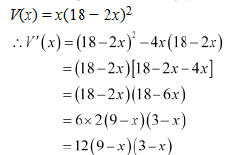
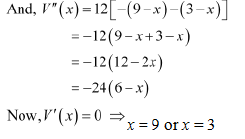
If x = 9. then the length and the breadth will become 0
By second derivative test, x = 3 is the point of maxima of V.
Hence, if we remove a square of side 3 cm from each corner of the square tin and make a box from the remaining sheet, then the volume of the box obtained is the largest possible
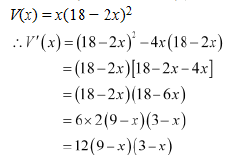
Q18: A rectangular sheet of tin 45 cm by 24 cm is to be made into a box without top, by cutting off square from each corner and folding up the flaps. What should be the side of the square to be cut off so that the volume of the box is the maximum possible?
Ans: Let the side of the square to be cut off be x cm. Then, the height of the box is x, the length is 45 - 2x, and the breadth is 24 - 2x.
Therefore, the volume V(x) of the box is given by,
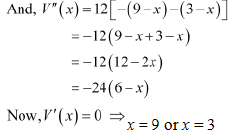
If x = 9. then the length and the breadth will become 0
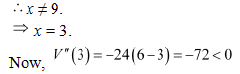
By second derivative test, x = 5 is the point of maxima.
Hence, the side of the square to be cut off to make the volume of the box maximum possible is 5 cm.
Q19: Show that of all the rectangles inscribed in a given fixed circle, the square has the maximum area.
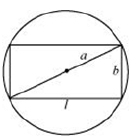
Ans: Let a rectangle of length l and breadth b be inscribed in the given circle of radius a.
Then, the diagonal passes through the centre and is of length 2a cm.
Now, by applying the Pythagoras theorem, we have:
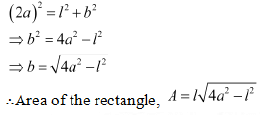
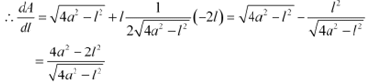
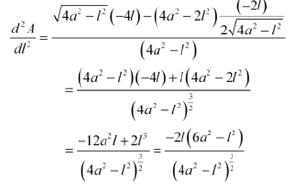
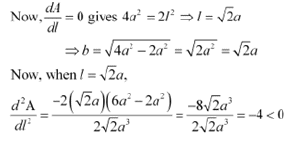
∴ By the second derivative test, when , then the area of the rectangle is the maximum.
Since  , the rectangle is a square.
Hence, it has been proved that of all the rectangles inscribed in the given fixed circle, the square has the maximum area.
Q20: Show that the right circular cylinder of given surface and maximum volume is such that is heights is equal to the diameter of the base.
Ans: Let r and h be the radius and height of the cylinder respectively.
Then, the surface area (S) of the cylinder is given by
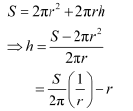
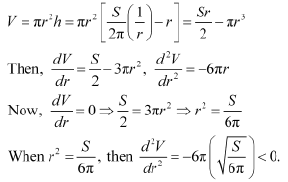
Let V be the volume of the cylinder. Then.
Q21: Of all the closed cylindrical cans (right circular), of a given volume of 100 cubic centimetres, find the dimensions of the can which has the minimum surface area?
Ans: Let r and h be the radius and height of the cylinder respectively.
Then, volume (V) of the cylinder is given by,
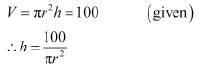
Surface area (S) of the cylinder is given by.
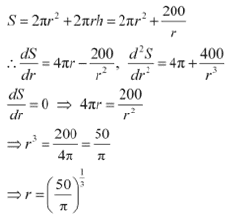
Now, it is observed that when 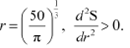
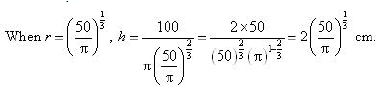
∴ By second derivative test, the surface area is the minimum when the radius of the cylinder is 
Q22: A wire of length 28 m is to be cut into two pieces. One of the pieces is to be made into a square and the other into a circle. What should be the length of the two pieces so that the combined area of the square and the circle is minimum?
Ans: Let a piece of length l be cut from the given wire to make a square.
Then, the other piece of wire to be made into a circle is of length (28 - l) m.
Now, side of square = l/4.
Let r be the radius of the circle. Then,
The combined areas of the square and the circle (A) is given by,
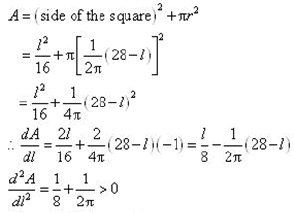
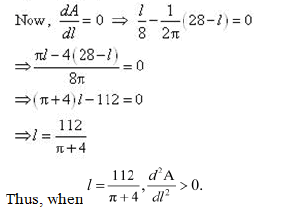
∴ By second derivative test, the area (A) is the minimum when 
Hence, the combined area is the minimum when the length of the wire in making the square is  cm while the length of the wire in making the circle is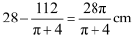
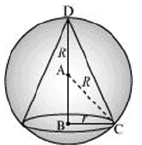
Q23: Prove that the volume of the largest cone that can be inscribed in a sphere of radius R is 8/27 of the volume of the sphere.
Ans: Let r and h be the radius and height of the cone respectively inscribed in a sphere of radius R.
Let V be the volume of the cone.
Then, 
Height of the cone is given by,
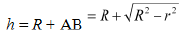 [ABC is a right triangle]
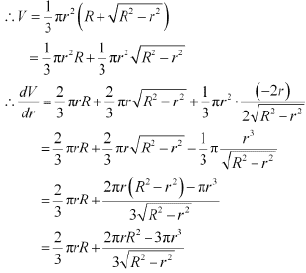
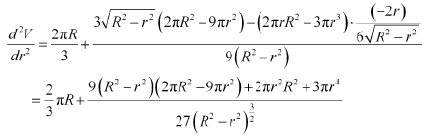
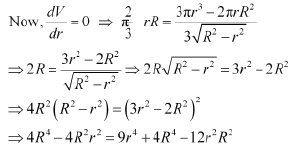
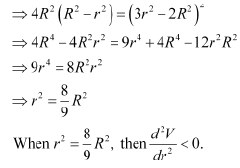
∴ By second derivative test the volume of the cone is die maximum when 
Q24: Show that the right circular cone of least curved surface and given volume has an altitude equal to time the radius of the base.
Ans: Let r and h be the radius and the height (altitude) of the cone respectively.
Then, the volume (V) of the cone is given as:
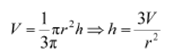
The surface area (S) of the cone is given by.
S = πrI (where l is the slant height)
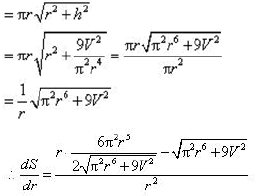
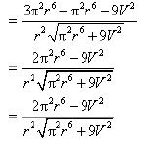

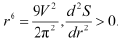
Thus, it. can be easily verified that when 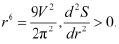
Q25: Show that the semi-vertical angle of the cone of the maximum volume and of given slant height is 
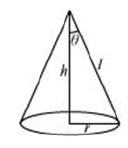
Ans: Let θ be the semi-vertical angle of the cone.
It is clear that 
Let r, h. and 1 be the radius, height, and the slant height of the cone respectively.
The slant height of the cone is given as constant.
Now, r = l sin θ and h = 1 cos θ
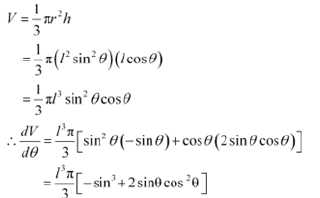
The volume (V) of the cone is given by,
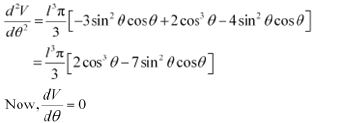
Q26: The point on the curve x2 = 2y which is nearest to the point (0, 5) is
(A) 
(B) 
(C) (0, 0)
(D) (2, 2)
Ans: The given curve is x2 = 2y.
For each value of x. the position of the point will be 
The distance d(x) between the points and (0,5) is given by.
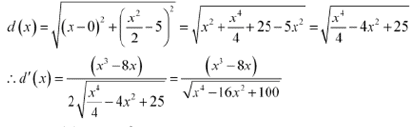
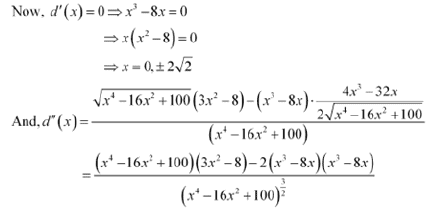
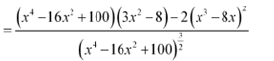
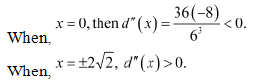
∴ By second derivative test. d(x) is the minimum at 
When 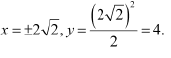
Hence, the point on the curve x2 = 2y which is nearest to the point (0, 5) is 
The correct answer is A.