UPSC Exam > UPSC Notes > Zoology Optional Notes > Population : Dynamics
Population : Dynamics

Patterns of Population Growth
Population dynamics are influenced by births, deaths, and migration. Two common patterns of population growth are exponential and logistic.
Exponential and Logistic Growth
Exponential Growth
- Under ideal conditions, most species, including humans, exhibit exponential growth.
- Exponential growth begins slowly but accelerates as the population size increases.
- Factors like unlimited resources and lack of environmental constraints lead to exponential growth.
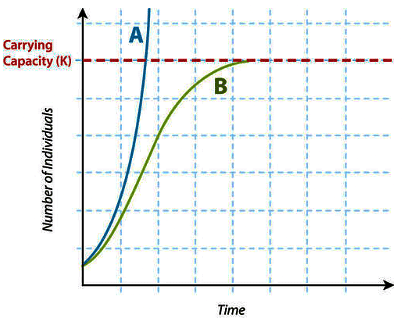
- Exponential growth is represented by Curve A in population graphs.
Logistic Growth
- Most populations don't grow exponentially indefinitely. They eventually encounter limiting factors.
- Logistic growth starts as exponential growth but levels off when environmental limits are reached.
- Density-dependent factors, such as limited resources or disease, often slow population growth.
- Logistic growth is depicted by Curve B in population graphs.
- The carrying capacity (K) represents the maximum population size an environment can sustain without damage. Logistic growth reaches a ceiling at the carrying capacity.
Exponential Growth of the Human Population
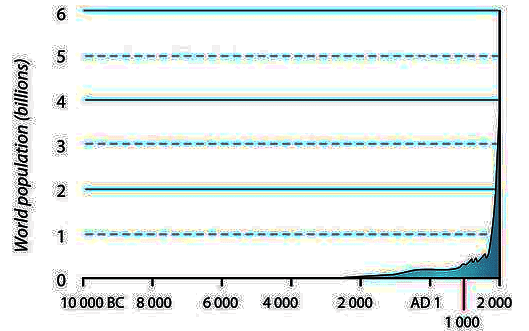
- For much of human history, the global population grew slowly.
- In recent centuries, exponential growth began, leading to a significant population increase.
- The population took thousands of years to reach 1 billion but only a century to reach 2 billion.
- We added another 5 billion in less than a century, reaching 7 billion by 2012.
- Currently, the population is approaching 8 billion, with a growth rate of 1.03 percent in 2021.
- The exponential growth raises concerns about carrying capacity and its consequences, as predicted by Thomas Malthus.
Is the Human Population Overpopulated?
- Calculating human carrying capacity yields varying estimates, but it's suggested to be around 7.7 billion.
- Projections indicate a population of 10.88 billion by 2100.
- Overpopulation concerns are raised due to resource shortages, damage to the environment, and ecological footprint.
- Over-consumption and waste in developed nations are also significant issues, as they use resources at a much higher rate than less-developed nations.
Addressing Human Population Growth
- Slowing population growth is essential to address environmental problems.
- Zero population growth (ZPG) is a widely accepted goal where birth and death rates are equal.
- Achieving ZPG requires reducing fertility rates to replacement levels, which can take time due to the youthful age distribution.
- Policy measures, educational and economic opportunities for females, gender equality, family planning knowledge, and access to contraception all play a role in reducing fertility rates.
Mexico City Policy and Fertility Control
- The Mexico City Policy, also known as the global gag rule, affects international organizations related to abortion.
- President Trump reinstated this policy, which has a history of being revoked and reinstated.
- It withholds U.S. government funding from organizations that promote abortions as family planning.
- It sparks political controversy, as it impacts women in less-developed countries and is viewed as contributing to unintended pregnancies, unsafe abortions, and maternal deaths.
- The policy highlights the political nature of fertility control, which is essential in addressing the overpopulation problem. Promoting family planning is a crucial part of the solution.
The document Population : Dynamics is a part of the UPSC Course Zoology Optional Notes for UPSC.
All you need of UPSC at this link: UPSC
About this Document

4.92/5 Rating

Apr 22, 2026 Last updated
Related Exams
Document Description: Population : Dynamics for UPSC 2026 is part of Zoology Optional Notes for UPSC preparation. The notes and questions for Population : Dynamics have been prepared according to the UPSC exam syllabus. Information about Population : Dynamics covers topics like and Population : Dynamics Example, for UPSC 2026 Exam. Find important definitions, questions, notes, meanings, examples, exercises and tests below for Population : Dynamics.
Introduction of Population : Dynamics in English is available as part of our Zoology Optional Notes for UPSC for UPSC & Population : Dynamics in Hindi for Zoology Optional Notes for UPSC course. Download more important topics related with notes, lectures and mock test series for UPSC Exam by signing up for free. UPSC: Population : Dynamics
Description
Population : Dynamics of Zoology Optional Notes covers all the important topics, helping you prepare for the UPSC exam on EduRev. Start for free!
Information about Population : Dynamics
In this doc you can find the meaning of Population : Dynamics defined & explained in the simplest way possible. Besides explaining types of Population : Dynamics theory, EduRev gives you an ample number of questions to practice Population : Dynamics tests, examples and also practice UPSC tests



Related Searches
Exam, Population : Dynamics, Viva Questions, Objective type Questions, Summary, mock tests for examination, ppt, Previous Year Questions with Solutions, pdf , practice quizzes, MCQs, study material, Extra Questions, Important questions, Semester Notes, past year papers, shortcuts and tricks, video lectures, Population : Dynamics, Population : Dynamics, Sample Paper, Free;