Worksheet Solutions: Financial Statements - II

MCQs
Q1: The object of non-trading concerns ______.
(a) Social service
(b) Profit earning
(c) Both of these
(d) None of the above
Ans: (a)
Explanation: Non-trading concerns are organisations such as clubs, charities and educational institutions that are established to provide services to their members or the public. Their primary objective is social service, not profit earning. Therefore option (a) is correct.
Q2: Which of the following is recorded in income and expenditure accounts?
(a) Revenue items
(b) Capital items
(c) Revenue and capital items
(d) None of the above
Ans: (a)
Explanation: Income and expenditure accounts record revenue items - incomes and expenses relating to the period under review (for example membership fees, subscriptions, salaries). Capital items are not shown in the income and expenditure account but are reflected in the balance sheet. Hence option (a) is correct.
Q3: If the rent of one month is still to be paid, the adjustment entry will be _______.
(a) Debit outstanding rent account and Credit rent account
(b) Debit profit and loss account and Credit rent account
(c) Debit rent account and Credit profit and loss account
(d) Debit rent account and Credit outstanding rent account
Ans: (d)
Explanation: When rent for the period has been incurred but not yet paid, it should be shown as an expense in the current accounting period. The adjustment is to debit rent account (to record the expense) and credit outstanding rent account (a liability), so option (d) is correct.
Q4: If a person fails to pay his debt, such an amount is considered as ______.
(a) Bad debts
(b) Bad debts recovered
(c) Provision for bad debt
(d) None of the above
Ans: (a)
Explanation: When a debtor fails to pay and the debt is irrecoverable, it is written off as bad debts. It is an actual loss and is recorded as an expense. Option (a) is therefore correct.
Q5: If the insurance premium paid Rs. 1,000 and prepaid insurance Rs. 300. The amount of insurance premium shown in the profit and loss account will be ______.
(a) Rs. 1,300
(b) Rs. 1,000
(c) Rs. 300
(d) Rs. 700
Ans: (d)
Explanation: The insurance expense for the period equals the premium paid less the prepaid portion that belongs to a future period. Here, insurance paid = ₹1,000 and prepaid = ₹300. So insurance expense = ₹1,000 - ₹300 = ₹700. Hence option (d) is correct.
Short Answer Questions
Q1: Why do we need adjustments when preparing financial statements?
Ans: Adjustments are required to ensure that incomes and expenses are recognised in the correct accounting period. Some receipts or payments relate to more than one period or haven't been received/paid by the reporting date. Without adjustments for items such as accrued incomes, outstanding expenses, prepaid expenses and depreciation, the profit or loss and the financial position shown in the statements would be incorrect and misleading.
Q2: What is the accrual basis of accounting?
Ans:
Ans: The accrual basis of accounting records income when it is earned and expenses when they are incurred, regardless of when cash is received or paid. This method gives a true and fair view of the financial performance and position of a business for a given period.
Q3: What are outstanding expenses?
Ans:
Ans: Outstanding expenses are expenses that have been incurred in the accounting period but remain unpaid at the reporting date. They are shown as liabilities in the balance sheet and as expenses in the profit and loss account for the period to which they relate.
Q4: What are prepaid expenses?
Ans:
Ans: Prepaid expenses are payments made in advance for goods or services to be received in future accounting periods (for example, prepaid insurance). They are recorded as assets on the balance sheet and expensed over the periods to which they relate.
Q5: What is the effect of not adjusting for accrued incomes?
Ans:
Ans: If accrued incomes are not recorded, the revenue of the period will be understated and profit will be understated. Also, assets (amounts receivable) will be understated in the balance sheet, giving an incomplete picture of the business's financial position.
Numerical Questions Solutions
Q1: Prepare a trading and profit and loss account for the year ending March 31, 2017. from the balances extracted of M/s Rahul Sons. Also prepare a balance sheet at the end of the year.
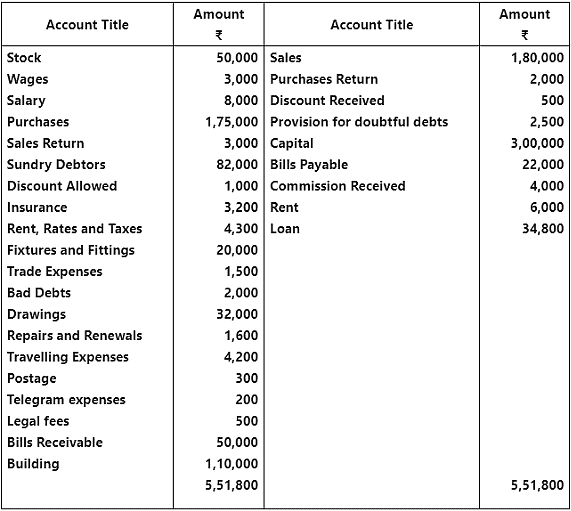
Adjustments:
- Commission received in advance ₹ 1,000.
- Rent receivable ₹ 2,000.
- Salary outstanding ₹ 1,000 and insurance prepaid ₹ 800.
- Further bad debts ₹ 1,000 and provision for doubtful debts @ 5% on debtors and discount on debtors @ 2%.
- Closing stock ₹ 32,000.
- Depreciation on building @ 6% p.a.
Trading and Profit and Loss Account of M/s Rahul Sons for the year ending
Ans:
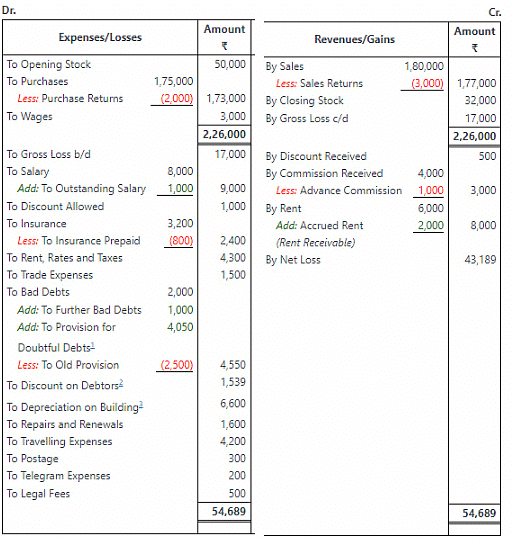
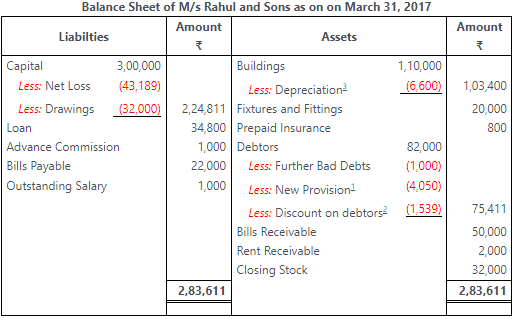
Working Notes:
1. Provision for Doubtful Debts = 5% of (Debtors - Further Bad Debts).
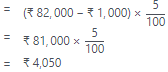
2. Discount on Debtors = 2% of (Debtors - Provision for Doubtful Debts - Further Bad Debts).
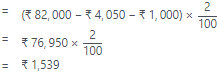
3. Depreciation on Building = ₹1,10,000 × 6/100 = ₹6,600.
Q2: Prepare a trading and profit and loss account of M/s Green Club Ltd. for the year ending March 31, 2017 from the following figures taken from its trial balance :
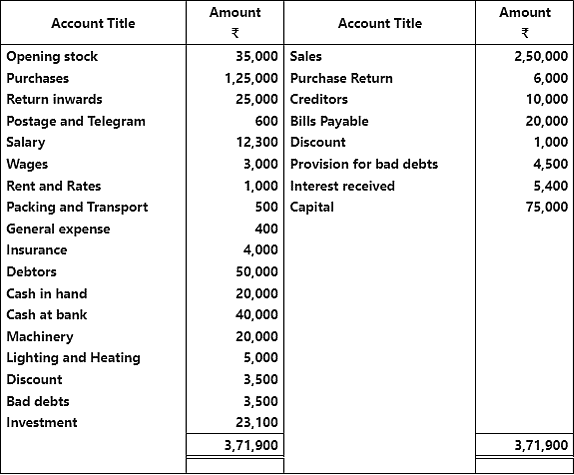
Ajustments:
- Depreciation charged on machinery @ 5% p.a.
- Further bad debts ₹ 1,500, discount on debtors @ 5% and make a provision on debtors @ 6%.
- Wages prepaid ₹ 1,000.
- Interest on investment @ 5% p.a.
- Closing stock ₹ 10,000.
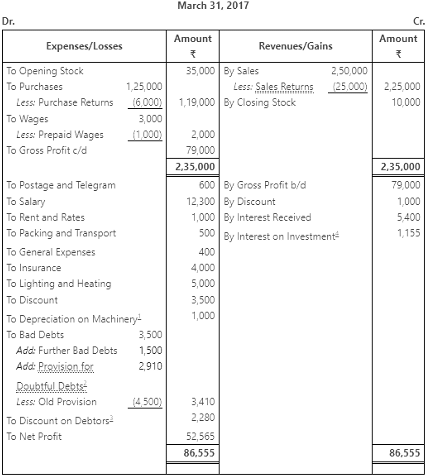
Trading and Profit and Loss Account of M/s Green Club Ltd. for the year ending
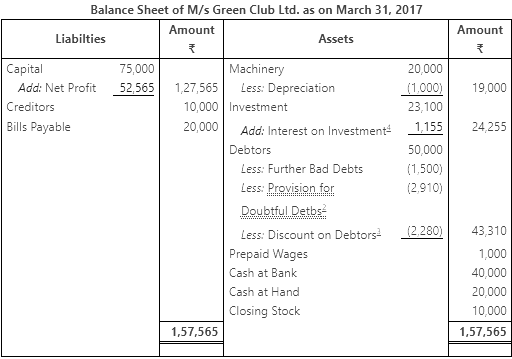
Working Notes:
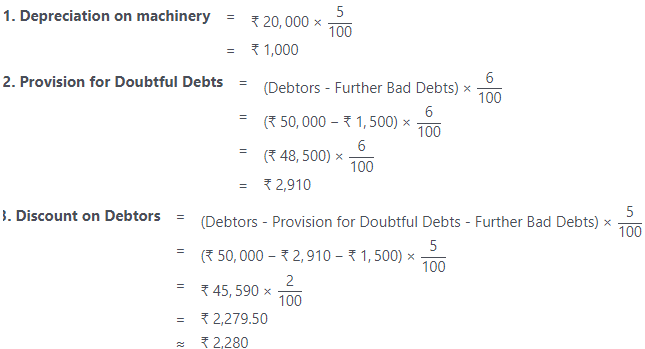
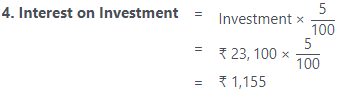
Notes: Depreciation on machinery has been computed at 5% on the opening book value and shown as an expense in the profit and loss account. Provision for doubtful debts and discount on debtors are calculated on adjusted receivables after writing off further bad debts. Interest on investments is taken as income where due.
Q3: The following balances has been extracted from the trial of M/s Runway Shine Ltd. Prepare a trading and profit and loss account and a balance sheet as on March 31, 2017.
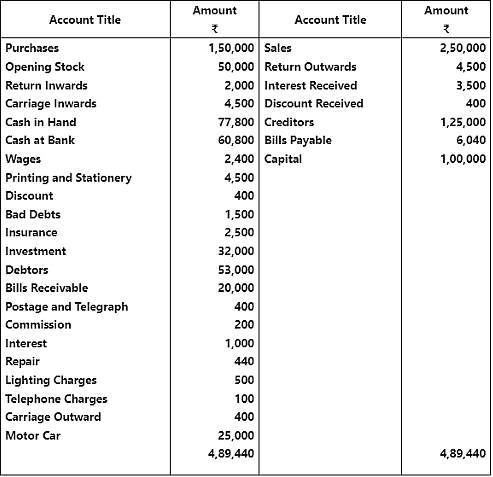
Adjustments:
- Further bad debts ₹ 1,000. Discount on debtors ₹ 500 and make a provision on debtors @ 5%.
- Interest received on investment @ 5%.
- Wages and interest outstanding ₹ 100 and ₹ 200 respectively.
- Depreciation charged on motor car @ 5% p.a.
- Closing Stock ₹ 32,500.
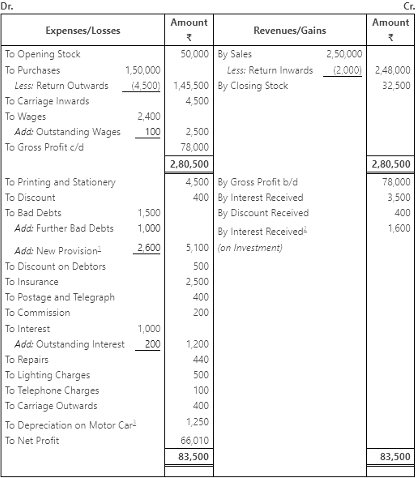
Ans: Trading and Profit and Loss Account of M/s Runway Shine Ltd. for the year ending March 31, 2017
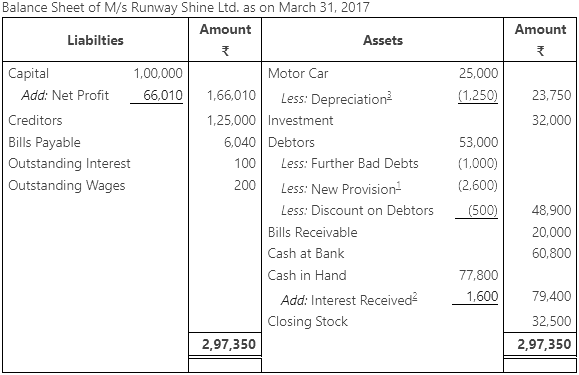
Working Notes:
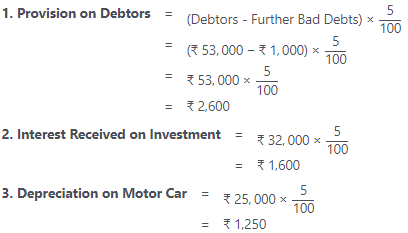
Notes: Further bad debts are written off from debtors before calculating provision @ 5%. Outstanding wages and interest are added to the respective expense heads. Depreciation on motor car is calculated at 5% on its book value and shown as an expense in the profit and loss account.
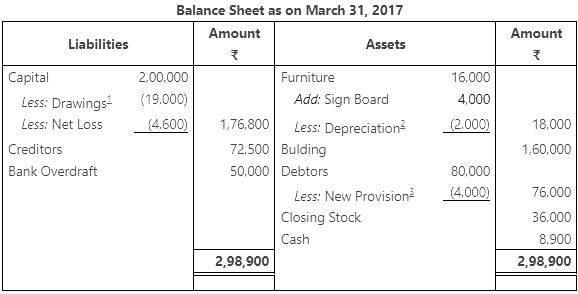
Q4.1: From the following Trial Balance you are required to prepare trading and profit and loss account for the year ending March 31, 2017 and Balance Sheet on that date.
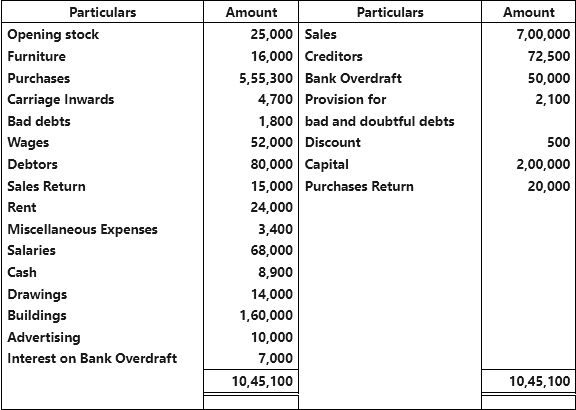
Adjustments
- Closing stock valued at ₹ 36,000.
- Private purchases amounting to ₹ 5,000 debited to purchases account.
- Provision for doubtful debts @ 5% on debtors.
- Sign board costing ₹ 4,000 included in advertising.
- Depreciate furniture by 10%.
Ans: Trading and Profit and Loss Account for the year ending March 31, 2017
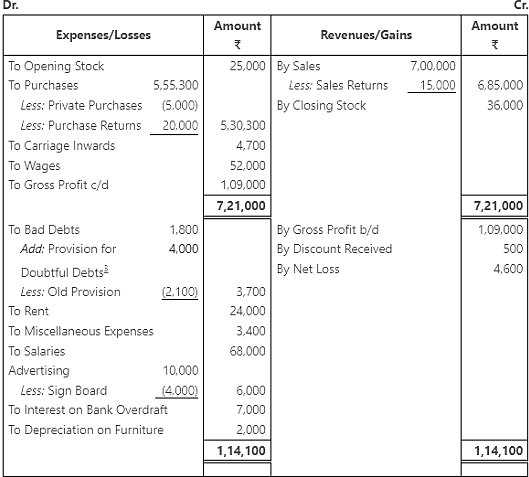
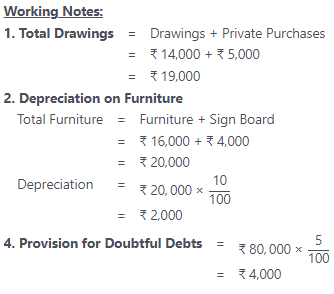
Working Notes:
1. Private purchases of ₹5,000 are deducted from purchases and charged to the proprietor's drawings or capital as appropriate.
2. Provision for doubtful debts @ 5% is created on the adjusted debtors balance after writing off any bad debts.
3. The sign board costing ₹4,000 is a capital item and has been reclassified from advertising to fixed assets; it is not charged to the profit and loss account.
4. Depreciation on furniture is charged at 10% and shown as an expense.
Q4.2: The following balances have been extracted from the trial of M/s Haryana Chemical Ltd. You are required to prepare a trading and profit and loss account and balance sheet as on March 31, 2017 from the given information.
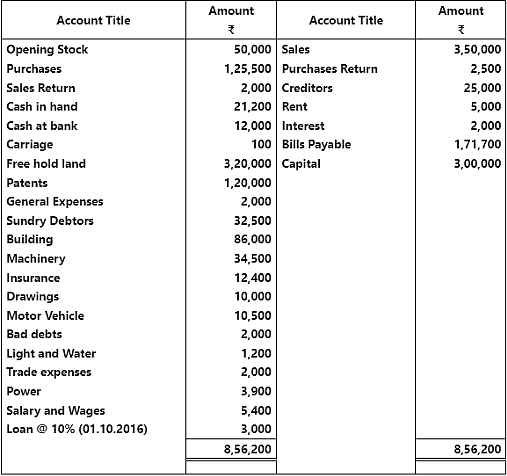
Adjustments:
- Closing stock was valued at the end of the year ₹ 40,000.
- Salary amounting ₹ 500 and trade expense ₹ 300 are due.
- Depreciation charged on building and machinery are @ 4% and @ 5% respectively.
- Make a provision of @ 5% on sundry debtors.
Note:
- If you do not find this problem in the text book, do not worry. This is from an old version of the text book. In the current text book, this problem is replaced with a different one (you can find it above)
- Note: In the text book, it is giving that the Loan @ 15% (01.09.2016) (it has to be calculated for 7 months from 1-Sep-2016 to 31-Mar-2017). However, if we consider that value we're getting the accrued interest on the loan as 262.50 which will make the Net profit as ₹ 1,85,672.50. To make it equal to the answer given in the book i.e. ₹ 1,85,560, we've considered that the Loan @10% (01.10.2016), which will make the accrued interest on loan as ₹ 150 and the answers for net profit and the balance sheet totals match.
Ans: Trading and Profit and Loss Account of M/s Haryana Chemical Ltd. for the year ending March 31, 2017
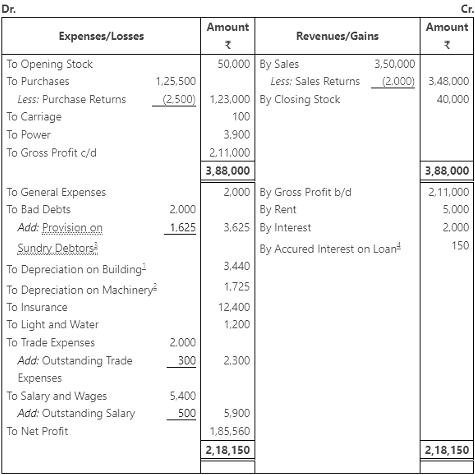
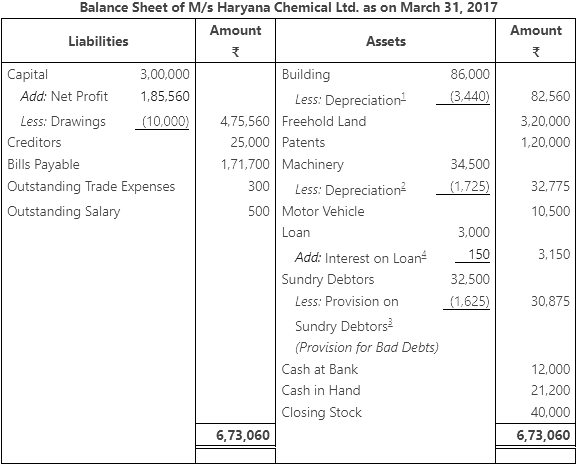
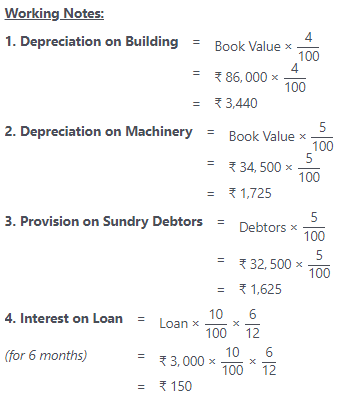
Working Notes:
1. Salaries and trade expenses due are added to the respective expense heads as outstanding items.
2. Depreciation on building = Opening balance of building × 4% and depreciation on machinery = Opening balance of machinery × 5%.
3. Provision on sundry debtors = 5% of adjusted debtors after bad debts have been written off.
4. Accrued interest on loan has been calculated according to the note above to reconcile with the textbook answer; ensure you follow the date used for loan commencement when working the interest.
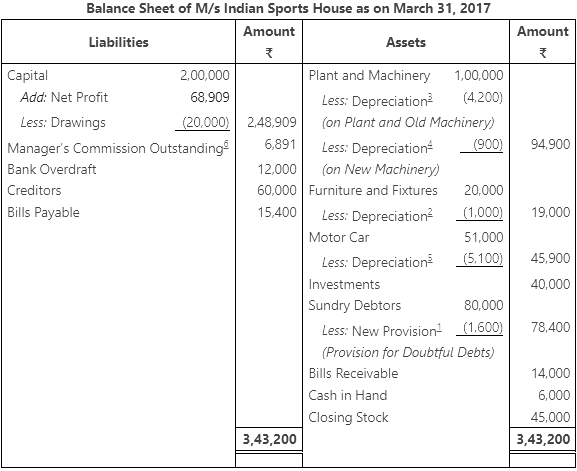
Q5: From the following information prepare trading and profit and loss account of M/s Indian sports house for the year ending March 31, 2017.
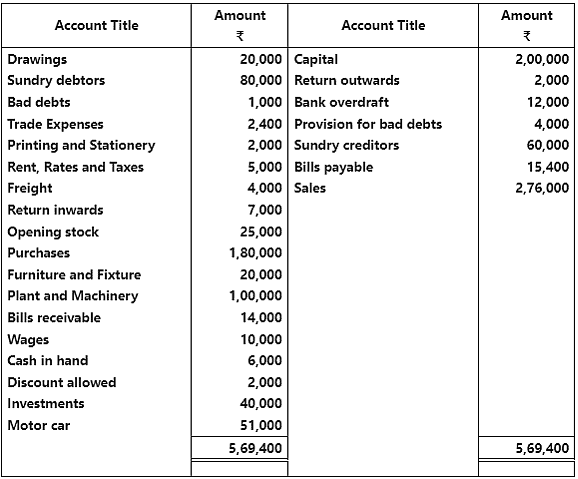
Adjustments:
- Closing stock was ₹ 45,000.
- Provision for doubtful debts is to be maintained @ 2% on debtors.
- Depreciation charged on : furniture and fixture @ 5%, plant and Machinery @ 6% and motor car @ 10%.
- A Machine of ₹ 30,000 was purchased on July 01, 2016.
- The manager is entitled to a commission of @ 10% of the net profit after charging such commission.
Ans: Trading and Profit and Loss Account of M/s Indian Sports House for the year ending March 31, 2017
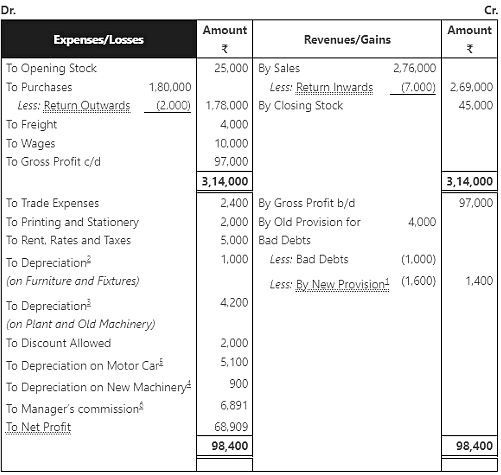
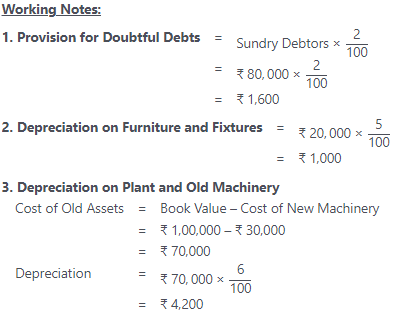
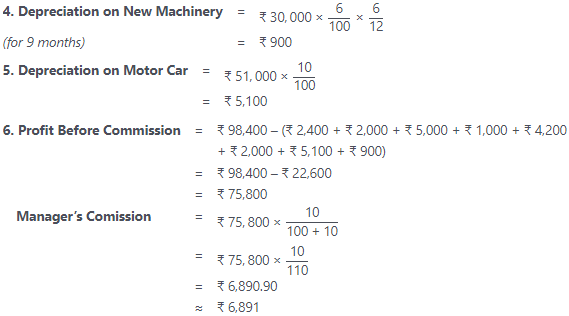
Working Notes and Remarks:
1. Provision for doubtful debts is created @ 2% on closing debtors after writing off further bad debts.
2. Depreciation is charged on each asset at the given rates; for the machine purchased on 01 July 2016, depreciation is charged for 9 months (July-March) unless specified otherwise.
3. Manager's commission is 10% of net profit after charging the commission. To compute the commission correctly, let net profit before commission be X; then commission = 10% of (X - commission). This gives commission = (10/110) of X = X/11. Therefore, divide the profit before commission by 11 to obtain the manager's commission.
4. Note: The textbook shows a typographical error in gross profit as ₹1,01,000; the correct computed gross profit is ₹97,000 as per the calculations shown above.
Note:
- The manager's commission is computed as 10% of net profit after charging such commission. Thus the divisor 110 (i.e. 100 + 10) is used to derive the commission from the net profit before charging commission.
- In this problem, the old provision is greater than the sum of bad debts and the new provision required. The excess is treated as an income (reduction in expense) in the profit and loss account.
FAQs on Worksheet Solutions: Financial Statements - II
| 1. What are the main components of financial statements? |  |
| 2. How do financial statements help in decision-making? | |
| 3. What is the difference between cash basis and accrual basis accounting in financial statements? | |
| 4. Why is the income statement important for businesses? | |
| 5. How often should a company prepare financial statements? | |