Worksheet: Movements of the Earth

Q1: Multiple Choice Questions (MCQs).
(i) What is the Earth's movement on its own axis called?
(a) Revolution
(b) Rotation
(c) Orbit
(d) Tilt
(ii) How long does it take for the Earth to complete one rotation?
(a) 12 hours
(b) 24 hours
(c) 36 hours
(d) 48 hours
(iii) In which direction does the Earth rotate?
(a) East to West
(b) West to East
(c) North to South
(d) South to North
(iv) What causes day and night on Earth?
(a) Revolution
(b) Tilt of the axis
(c) Rotation
(d) Orbit
(v) Who strengthened Copernicus' belief in the Earth's movement and proved the Sun is at the center of the Solar System?
(a) Galileo Galilei
(b) Nicolaus Copernicus
(c) Johannes Kepler
(d) Isaac Newton
Q2: Fill in the Blanks.
(i) Rotation causes the occurrence of __________ and __________.
(ii) The Earth takes ________ hours to complete one rotation.
(iii) Revolution is the Earth's movement around the ________.
(iv) Solstice days mark the times when the Northern Hemisphere is tilted towards or away from the ____.
(v) Equinoxes occur when the Sun's rays fall directly on the ________.
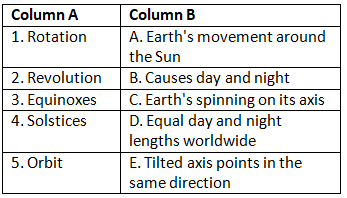
Q3: Match the Column.
Q4: True or False.
(i) The Earth's rotation causes the Sun to rise in the west and set in the east.
(ii) Solstices occur when the Northern Hemisphere has the longest day and shortest night.
(iii) Equinoxes result in unequal day and night lengths globally.
(iv) Rotation is the Earth's movement around the Sun.
(v) The Earth experiences four major seasons due to its tilted axis.
You can access the solutions to this worksheet here.
FAQs on Worksheet: Movements of the Earth
| 1. What are the main movements of the Earth? |  |
| 2. How does the Earth's rotation affect our daily lives? | |
| 3. What is the difference between the Earth's rotation and revolution? | |
| 4. Why do we have seasons on Earth? | |
| 5. What is the significance of the Earth's movements in terms of climate? | |