Worksheet Solutions: Private, Public and Global Enterprises

MCQs Questions
Q1: Public sector organisations may either be partly or wholly owned by the ____ government.
(a) state
(b) central
(c) foreign
(d) central or state
Ans: (d)
Explanation: Public sector organisations may be owned either by the Central Government or by State Governments; ownership can be full or partial, hence option (d) is correct.
Q2: Government of India establishes its enterprises in backward areas. By doing this, which objective is fulfilled?
(a) Economies of scale
(b) Regional balance
(c) Development of infrastructure
(d) Import substitution
Ans: (c)
Explanation: Establishing enterprises in backward areas helps develop local infrastructure (roads, power, facilities) required for industry and welfare, so (c) Development of infrastructure is the direct objective emphasised here.
Q3: Which is the oldest and most traditional form of organising public enterprises?
(a) Statutory corporation
(b) Public company
(c) Government company
(d) Departmental undertaking
Ans: (d)
Explanation: Departmental undertakings are the traditional form where government departments themselves carry out functions; they predate separate corporate forms and are directly managed by ministries, so (d) is correct.
Q4: In a survey conducted by Government of India, it was found that many farmers of the country are unable to secure loan for their agricultural needs. Keeping this in mind, the government decided to form a public enterprise under a Special Act of the Parliament, which will be free from government interference and will have financial and operational autonomy.
Which type of public enterprise would you suggest to the government?
(a) Departmental undertaking
(b) Statutory corporation
(c) Government company
(d) None of the above
Ans: (b)
Explanation: A statutory corporation is created by a Special Act of Parliament and usually has financial and operational autonomy while remaining public-sector; it fits the requirement of being free from routine government interference, so (b) is correct.
Q5: Public sector enterprises are accountable to public through ____ .
(a) parliament
(b) government
(c) public
(d) media
Ans: (a)
Explanation: Public sector enterprises are ultimately accountable to Parliament because they are established and funded by the government and must answer to elected representatives, therefore (a) is correct.
Q6: Indian economy is a ____ kind of economy.
(a) global
(b) mixed
(c) capitalist
(d) socialist
Ans: (b)
Explanation: India follows a mixed economy model where both the private and public sectors coexist and participate in economic activities; hence (b) Mixed is correct.
Q7: The telecom services have been recognised in the world-over as an important tool for socio-economic development for a nation and hence telecom infrast-ructure is treated as a crucial factor to realise the socio-economic objectives in India. Accordingly, the Department of Telecom has been formulating developmental policies for the accelerated growth of the telecommunication services. The department comes under the Ministry of Communications and is headed by a cabinet-level minister.
It is financed by the government through allocation of funds in the Annual General Budget of Parliament. Which type of public sector enterprise highlighted here?
(a) Departmental undertaking
(b) Statutory corporation
(c) Government company
(d) None of the above
Ans: (a)
Explanation: This describes a department that is part of a ministry, financed directly through the government budget and controlled by the minister - a departmental undertaking - so (a) is correct.
Q8: The Reserve Bank of India (RBI) was established under a Special Act of the Parliament, that lays down the objects, powers and functions of the corporation.
It was established on 1st April, 1935 in accordance with the provisions of the Reserve Bank of India Act, 1934. RBI formulates, implements and monitors the monetary policy and its main objective is to maintain price stability while keeping in mind the objective of growth.
How will you classify the Reserve Bank of India as a form of public sector enterprise?
(a) Departmental undertaking
(b) Statutory corporations
(c) Government company
(d) None of the above
Ans: (b)
Explanation: RBI was created by a Special Act of Parliament and has defined powers and autonomy under that Act, which is the defining feature of a statutory corporation; hence (b) is correct.
Q9: Which of the following is not a type of public sector enterprise?
(a) Joint hindu family business
(b) Departmental undertaking
(c) Statutory corporation
(d) Government company
Ans: (a)
Explanation: A joint Hindu family business is a private, family-based organisational form and not a public sector enterprise; options (b), (c) and (d) are recognised forms of public enterprises, so (a) is correct.
Q10: Which government enterprise is registered under Indian Companies Act, 2013?
(a) Departmental undertaking
(b) Public corporation
(c) Government company
(d) Partnership companies
Ans: (c)
Explanation: A government company is incorporated and registered under the Companies Act and follows company law; therefore (c) Government company is correct.
Q11: As India has adopted the framework of capitalist economy, thus all business organisations can be grouped as privately owned and government owned organisations.
(a) True
(b) False
(c) Can't say
(d) Partially true
Ans: (d)
Explanation: It is only partially true because while India allows private ownership (capitalist features), it also retains significant public ownership and regulation; therefore the statement is only partially true, (d).
Q12: Some organisations are directly attached to a particular ministry of the central or state government and are under the direct control of the concerned minister.
The business decisions are thus influenced by political consideration. State the type of enterprise come under this category.
(a) Statutory corporation
(b) Government company
(c) Departmental undertaking
(d) None of the above
Ans: (c)
Explanation: Organisations directly attached to a ministry and controlled by the minister are departmental undertakings; political considerations often influence their decisions, so (c) is correct.
Q13: A public sector company is incurring heavy losses and government proposes for closing the same. Which term is related to this statement?
(a) Disinvestment
(b) Privatisation
(c) Demonetisation
(d) Socialisation
Ans: (a)
Explanation: Disinvestment refers to the government reducing or selling its stake in public sector units, often leading to closure or transfer of ownership; in the context of closing or reducing involvement, (a) is the most relevant term.
Q14: Match the 'forms of public enterprises' in column I with their respective example in column II.
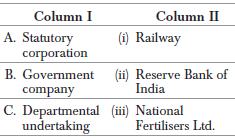
Codes
A B C
(a) (i) (ii) (iii)
(b) (iii) (i) (ii)
(c) (i) (iii) (ii)
(d) (ii) (iii) (i)
Ans: (d)
Explanation: The correct matching pairs are given by code (d): each example corresponds to the listed form of enterprise as per their definitions and ownership patterns, so (d) is correct.
Q15: Disinvestment of PSUs implies
(a) sale of equity shares to public
(b) investing in new areas
(c) buying shares of PSUs
(d) closing down private sector enterprise
Ans: (a)
Explanation: Disinvestment generally means selling government equity (shares) in PSUs to the public or private investors to reduce government holding, so (a) is correct.
Q16: The private sector consists of business owned by ____ .
(a) state government
(b) central government
(c) individuals or group of individuals
(d) ministers
Ans: (c)
Explanation: The private sector is composed of firms owned and managed by individuals, families or private groups, not by the government or ministers, hence (c) is correct.
Q17: In your neighbourhood market, there are shops owned by sole proprietors or big retail organisations run by a company. They belong to which sector?
(a) Public
(b) Private
(c) Social
(d) Mixed
Ans: (b)
Explanation: Shops and retail firms owned by private persons or companies belong to the private sector as they are privately owned businesses; (b) is correct.
Q18: Conversion of a PSU into a private sector enterprise is termed as ____ .
(a) Globalisation
(b) De-urbanisation
(c) Privatisation
(d) Liberalisation
Ans: (c)
Explanation: Privatisation is the transfer of public sector enterprises to private ownership; converting a PSU into a private company is privatisation, (c) is correct.
Q19: Departmental undertaking is a form of public sector enterprise which is most suitable for operations where national security is concerned.
(a) True
(b) False
(c) Can't say
(d) Partially true
Ans: (a)
Explanation: Departmental undertakings remain under direct government control and confidentiality, making them suitable for sensitive sectors like national security; thus (a) True is correct.
Q20: Grow Co. ltd., registered under the Companies Act, 2013, was started with a paid-up capital of ₹ 10,00,000. 40% of this paid-up capital is in the hands of private individuals and the balance is held by the government of Chennai. Grow company belongs to which form of public sector enterprises?
(a) Statutory corporation
(b) Government company
(c) Departmental undertaking
(d) None of the above
Ans: (b)
Explanation: A government company is one where the government holds not less than 51% of paid-up capital; since the government holds 60% here, Grow Co. is a government company, so (b) is correct.
Q21: Navratan Ltd. is a company engaged in the production and distribution of heavy electrical goods. Pattern of shareholding in the company is as follows
(i) Government of India 15%
(ii) Government of Bihar 26%
(iii) Government of Assam 10%
(iv) General Public 49%
Navratan Ltd. can be classified as which of the following?
(a) Small company
(b) Government company
(c) Private company
(d) None of the above
Ans: (b)
Explanation: Combined government holdings (Central + State) equal 51% (15% + 26% + 10%) which is at least 51%, qualifying it as a government company; thus (b) is correct.
Q21: How many industries are now reserved for public sector?
(a) 2
(b) 3
(c) 4
(d) 17
Ans: (b)
Explanation: As per the revised industrial policy, a small number of strategic areas remain reserved for the public sector - three industries are commonly cited in the context of reservation, so (b) is correct.
Q22: Which policy was launched by Government of India in 1991?
(a) JPG
(b) GST
(c) LPG
(d) MPG
Ans: (c)
Explanation: The 1991 reforms are referred to as the LPG policy - Liberalisation, Privatisation and Globalisation - hence (c) is correct.
Q23: Which of the following roles are played by the public sector in the economy?
(i) Regional balance
(ii) Economies of scale
(iii) Check over concentration of economic power
(iv) Import substitution
(v) Development of infrastructure
(a) Only (i), (ii) and (iv)
(b) Only (i), (iii), (iv) and (v)
(c) Only (i), (ii), (iii) and (v)
(d) All of the above
Ans: (d)
Explanation: The public sector performs all listed roles - regional balance, economies of scale, checking concentration of economic power, import substitution and infrastructure development - so (d) All of the above is correct.
Q24: Public Ltd. company comes under which sector?
(a) Public sector
(b) Joint sector
(c) Private sector
(d) None of these
Ans: (c)
Explanation: A Public Limited company is a corporate form in the private sector unless the government holds majority shares; generally it denotes a privately run company registered under the Companies Act, so (c) is correct.
Q25: Match the 'forms of public enterprises' in column I with their respective forming statement in column II.
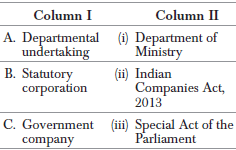
Codes
A B C
(a) (i) (iii) (ii)
(b) (ii) (iii) (i)
(c) (i) (ii) (iii)
(d) (ii) (i) (iii)
Ans: (a)
Explanation: Code (a) correctly pairs each form of public enterprise with its characteristic forming statement as presented, so (a) is correct.
Q26: If a public sector enterprise is making losses continuously, it was referred to the ____ .
(a) GIFR
(b) CIFR
(c) TIFR
(d) BIFR
Ans: (d)
Explanation: BIFR (Board for Industrial and Financial Reconstruction) was the body to which sick or loss-making industrial units were referred for revival or closure; hence (d) is correct.
Q27: Public sector can be classified into ____ divisions.
(a) 3
(b) 4
(c) 5
(d) 6
Ans: (a)
Explanation: Common classification divides public sector enterprises into three types - departmental undertakings, statutory corporations and government companies - so (a) is correct.
Q28: Which form of PSU has its own MoA and AoA?
(a) Private company
(b) Government company
(c) Departmental undertaking
(d) None of the above
Ans: (b)
Explanation: A government company is incorporated under the Companies Act and therefore has its own Memorandum of Association and Articles of Association; (b) is correct.
Q29: Strategic industries like defence and atomic power work as ____ .
(a) departmental undertaking
(b) statutory corporation
(c) government company
(d) None of the above
Ans: (b)
Explanation: Strategic sectors such as defence and atomic energy are typically run directly by the state under special legal frameworks and often as statutory corporations or reserved public bodies; in this context (b) Statutory corporation is the intended choice.
Q30: Government has given autonomy to a PSU to improve its performance but held it accountable for specified results under an agreement. What is this agreement called?
(a) MoA
(b) AoA
(c) MoU
(d) GoU
Ans: (c)
Explanation: A Memorandum of Understanding (MoU) is an agreement that grants autonomy while fixing targets and accountability between government and a PSU, so (c) is correct.
Q31: Which of the following has the power of the government and the considerable amount of operating flexibility of private enterprises?
(a) Departmental undertakings
(b) Statutory corporations
(c) Government companies
(d) All of the above
Ans: (b)
Explanation: Statutory corporations combine governmental authority (being established by law) with managerial and operational flexibility not found in ordinary departments, hence (b) is correct.
Q32: In the 2001 resolution on industrial policy, the number of industries exclusively reserved for the public sector was brought down. This meant that the private sector can now enter all areas, except these and the public sector would have to compete with them. Which of the following areas are now exclusive for the public sector?
(i) Atomic energy
(ii) Arms
(iii) Communication
(iv) Railways
(a) (i), (ii) and (iii)
(b) (i), (iii) and (iv)
(c) (i), (ii) and (iv)
(d) (ii), (iii) and (iv)
Ans: (c)
Explanation: The key exclusive areas retained for the public sector include atomic energy, defence (arms) and railways; communication was opened up, so option (c) (i), (ii) and (iv) is correct.
Q33: The public sector enterprises are to invest and operate in certain spheres. Which of the following is not one of these core sectors?
(a) Civil aviation
(b) Pharmaceuticals
(c) Power generation plants
(d) Project management consultancies
Ans: (b)
Explanation: Pharmaceuticals is primarily a private and competitive sector, whereas civil aviation, power generation and project management are more commonly public or strategic in nature; so (b) is not a core public sector sphere here.
Q34: Airtel is a big company providing telecom services to millions of people in India. Similarly, BSNL also provides telecom services to many people. Government of India is holding 100% of the share capital of BSNL, whereas Airtel is not under the direct control of government. Identify the sectors in which Airtel and BSNL enterprises are working.
(a) Public and private
(b) Public
(c) Private
(d) None of these
Ans: (a)
Explanation: Airtel is a private sector company and BSNL is a public sector enterprise wholly owned by the government, so the correct identification is (a) Public and private.
Q35: Departmental undertaking evades constitutional responsibility, as it is not answerable directly to Parliament for non-performance of duties.
(a) True
(b) False
(c) Can't say
(d) Partially false
Ans: (b)
Explanation: This statement is false because departmental undertakings are parts of government and are answerable to Parliament through the concerned ministry; they do not evade constitutional responsibility, so (b) False is correct.
Q36: Steel Authority of India Limited (SAIL) is one of the largest steel-making companies in India and one of the Maharatnas of the country's Central Public Sector Enterprises.
Vision of SAIL is to be a respected world class corporation and the leader in Indian steel business in quality, productivity, profitability and customer satisfaction.
SAIL was incorporated on 24th January, 1973 with an authorised capital of ₹ 2,000 crore and was made responsible for managing five integrated steel plants at Bhilai, Bokaro, Durgapur, Rourkela and Bumpur, the Alloy Steel Plant and the Salem Steel Plant.
As government is the majority shareholder (with 75% stake), it exercises control over affairs of the company. Which type of public sector enterprise is highlighted here?
(a) Departmental undertaking
(b) Statutory corporation
(c) Government company
(d) None of the above
Ans: (c)
Explanation: SAIL is incorporated under the Companies Act and the government holds the majority of shares (75%), which classifies it as a government company; thus (c) is correct.
Q37: ____ type of PSUs has the highest degree of political interference.
(a) Public corporation
(b) Departmental undertaking
(c) Government company
(d) None of the above
Ans: (b)
Explanation: Departmental undertakings are directly controlled by ministers and ministries and therefore face the highest degree of political interference, so (b) is correct.
Q38: Which of the following is true about statutory corporations?
(a) Statutory corporations are public enterprises that come into existence by a Special Act of the Parliament.
(b) Statutory corporations are subject to the same accounting and audit procedures as are applicable to government departments.
(c) Statutory enterprises are funded directly by the government treasury.
(d) The employees of statutory enterprises are civil servants.
Ans: (a)
Explanation: The key distinguishing feature is creation by a Special Act of Parliament; other options are not universally true for statutory corporations, so (a) is correct.
Q39: Match the following.
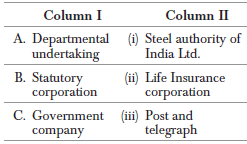
Codes
A B C
(a) (i) (ii) (iii)
(b) (iii) (ii) (i)
(c) (ii) (iii) (i)
(d) (i) (iii) (ii)
Ans: (b)
Explanation: Code (b) provides the correct matching sequence between the items in the two columns as intended by the question, so (b) is correct.
Q40: The Ministry of Railways is a ministry in the Government of India, responsible for the country's rail transport. The ministry is headed by the minister of railways, a cabinet-level minister who presents the rail budget every year in Parliament.
Indian railways is financed by the government through allocation of funds in the annual general budget of Parliament. How will you categorise Indian Railways as a form of public sector enterprise?
(a) Private company
(b) Government company
(c) Departmental undertaking
(d) None of the above
Ans: (c)
Explanation: Indian Railways functions as a department of the government, financed through the budget and managed by the ministry - this is the characteristic of a departmental undertaking, so (c) is correct.
Q41: Statutory corporation is subject to the government rules and regulations in the matter of accounting, budgeting and audit as applicable to departmental undertaking.
(a) True
(b) False
(c) Can't say
(d) Partially true
Ans: (b)
Explanation: This is false because statutory corporations usually follow their own accounting and audit procedures as prescribed by their enabling Act, not exactly the same as departmental rules; hence (b) False is correct.
Q43: ____ form of PSU has the greatest autonomy.
(a) Departmental undertakings
(b) Public corporation
(c) Government company
(d) None of the above
Ans: (c)
Explanation: Government companies incorporated under the Companies Act typically enjoy greater managerial and financial autonomy compared with departmental undertakings; hence (c) is chosen here as having the greatest autonomy.
Q44: A government company is any company in which the paid up capital held by the government is not less than
(a) 49 percent
(b) 51 percent
(c) 50 percent
(d) 25 percent
Ans: (b)
Explanation: By definition, a government company is one in which not less than 51% of paid-up capital is held by the government, so (b) is correct.
Q45: Which PSU was the first to be privatised successfully in India?
(a) LJMC
(b) GAIL
(c) ONGC
(d) BHEL
Ans: (a)
Explanation: The historical reference indicates LJMC was among early successful privatisations; therefore (a) is indicated as the correct option in this question.
Q46: Private enterprises are accountable to the public through the Parliament.
(a) True
(b) False
(c) Can't say
(d) Partially true
Ans: (b)
Explanation: Private enterprises are accountable to their owners, shareholders and regulatory bodies but not directly to Parliament; therefore (b) False is correct.
Q47: Which of the following statements regarding recent government policy measures towards the public sector is/are true?
(i) Restructuring and reviving potentially viable PSUs.
(ii) Closing down of those PSUs that cannot be revived.
(iii) Bringing down government equity in all non-strategic PSUs to 50 percent or lower.
(iv) Fully protecting the interest of workers.
(a) (i), (ii) and (iii)
(b) (i), (iii) and (iv)
(c) (i), (ii) and (iv)
(d) (ii), (iii) and (iv)
Ans: (c)
Explanation: Recent policies emphasise restructuring viable PSUs and closing non-viable ones while also aiming to protect workers' interests; option (c) lists these three realistic policy measures, so (c) is correct.
Q48: _____ is financed by the government through allocation of funds in the Annual General Meeting.
(a) Departmental undertaking
(b) Statutory corporation
(c) Government company
(d) None of the above
Ans: (a)
Explanation: Departmental undertakings receive finance through government budgets (appropriations made by Parliament) rather than through corporate funding, hence (a) is correct.
Q49: An organisation is working for the purpose of public welfare as a ministry of government. It is financed by government and all its income is deposited in government treasury. Identify which kind of public sector enterprise is it?
(a) Partnership
(b) Departmental undertaking
(c) Sole proprietorship
(d) Company
Ans: (b)
Explanation: A ministry-run body financed by government and depositing revenue into the treasury is a departmental undertaking, so (b) is correct.
Q50: New economic policy was passed in the year ____ .
(a) 1985
(b) 1993
(c) 1991
(d) 1980
Ans: (c)
Explanation: The major New Economic Policy of Liberalisation, Privatisation and Globalisation was introduced in India in 1991, therefore (c) is correct.
Q51: Statutory corporation is a company in which minimum 51% of the paid-up capital is held by the State or the Central Government.
(a) True
(b) False
(c) Can't say
(d) Partially true
Ans: (b)
Explanation: The statement is false (B) because statutory corporations are created by a Special Act and are not defined by shareholding; the 51% definition applies to government companies, not statutory corporations.
Q52: In India, railway is an organisation wholly owned and managed by the ____ .
(a) reliance
(b) tata
(c) government
(d) railway department
Ans: (c)
Explanation: Indian Railways is owned and managed by the Government of India through the Ministry of Railways, so (c) Government is correct.
Q53: Which of the following enterprises has separate legal entity?
(a) Departmental undertaking
(b) Statutory corporation
(c) Government company
(d) None of the above
Ans: (b)
Explanation: A statutory corporation is created as a separate legal entity by a Special Act of Parliament and can sue or be sued in its own name; hence (b) is correct.
Q54: The shares of a government company are purchased in the name of which of the following?
(a) The Indian Government
(b) The President of India
(c) The Chief Minister of the state, where the head office of the company lies
(d) The Managing Director of the company
Ans: (b)
Explanation: Government shareholdings in companies are held in the name of the President of India (for central government companies) or the Governor (for state companies); therefore (b) is correct.
Q55: Statutory corporations are formed by a Special Act of Parliament. The Act defines their powers, objects and privileges.
(a) True
(b) False
(c) Can't say
(d) Partially false
Ans: (a)
Explanation: This is true: statutory corporations are established by a Special Act which specifies their objectives, powers and privileges, so (a) is correct.
Assertion-Reasoning MCQs
Q1: Assertion (A) Statutory corporation is usually independently financed.
Reason (R) The revenue earned by statutory corporation is a source of income for the government as it goes directly to the treasury.
(a) Both Assertion (A) and Reason (R) are true and Reason (R) is the correct explanation of Assertion (A)
(b) Both Assertion (A) and Reason (R) are true, but Reason (R) is not the correct explanation of Assertion (A)
(c) Assertion (A) is true, but Reason (R) is false
(d) Assertion (A) is false, but Reason (R) is true
Ans: (c)
Ans: (c)
Explanation:
(i) Assertion: Statutory corporations are usually independently financed - This is true because they generate a substantial portion of their funds from their own revenues and have fiscal autonomy.
(ii) Reason: The revenue earned by statutory corporation is a source of income for the government as it goes directly to the treasury - This is false; revenue earned by the corporation is normally retained by the corporation for its operations unless specified otherwise, and does not automatically go to the government treasury.
(iii) Justification: Therefore the assertion is correct but the reason is incorrect; the corporation's finance independence does not arise because its revenues are remitted to the treasury.
Q2: Assertion (A) There is a need for separate legislation of the Parliament for formation of government company.
Reason (R) Government company can be established by fulfilling requirements of the Indian Companies Act.
(a) Both Assertion (A) and Reason (R) are true and Reason (R) is the correct explanation of Assertion (A)
(b) Both Assertion (A) and Reason (R) are true, but Reason (R) is not the correct explanation of Assertion (A)
(c) Assertion (A) is true, but Reason (R) is false
(d) Assertion (A) is false, but Reason (R) is true
Ans: (d)
Ans: (d)
Explanation:
(i) Assertion: There is a need for separate legislation of the Parliament for formation of government company - This is false; government companies are formed under the Indian Companies Act and do not require separate legislation.
(ii) Reason: Government company can be established by fulfilling requirements of the Indian Companies Act - This is true; they are incorporated like other companies under the Companies Act.
(iii) Justification: Thus the correct choice is (d): the assertion is false while the reason is true.
Q3: Assertion (A) Departmental undertaking is most suitable when national security is concerned.
Reason (R) Departmental undertaking is established under a Special Act of the Parliament.
(a) Both Assertion (A) and Reason (R) are true and Reason (R) is the correct explanation of Assertion (A)
(b) Both Assertion (A) and Reason (R) are true, but Reason (R) is not the correct explanation of Assertion (A)
(c) Assertion (A) is true, but Reason (R) is false
(d) Assertion (A) is false, but Reason (R) is true
Ans: (c)
Ans: (c)
Explanation:
(i) Assertion: Departmental undertaking is most suitable when national security is concerned - This is true because such undertakings are directly controlled by the state and maintain confidentiality and control needed for security sectors.
(ii) Reason: Departmental undertaking is established under a Special Act of the Parliament - This is false; departmental undertakings are parts of government ministries and are not created by Special Acts (that describes statutory corporations).
(iii) Justification: Therefore the assertion is correct but the reason is incorrect, making (c) the correct option.
Q4: Assertion (A) Departmental undertakings are unable to take benefit of business opportunities.
Reason (R) Departmental undertakings do not undertake risky ventures due to bureaucrat's over cautious and conservative approach.
(a) Both Assertion (A) and Reason (R) are true and Reason (R) is the correct explanation of Assertion (A)
(b) Both Assertion (A) and Reason (R) are true, but Reason (R) is not the correct explanation of Assertion (A)
(c) Assertion (A) is true, but Reason (R) is false
(d) Assertion (A) is false, but Reason (R) is true
Ans: (a)
Ans: (a)
Explanation:
(i) Assertion: Departmental undertakings are unable to take benefit of business opportunities - This is true in many cases because they lack commercial flexibility.
(ii) Reason: Departmental undertakings do not undertake risky ventures due to bureaucrat's over cautious and conservative approach - This is also true; bureaucratic procedures and risk-averse culture limit their ability to seize business opportunities.
(iii) Justification: The reason explains why these undertakings fail to exploit business opportunities, so (a) is correct.
Case Based MCQs
Bharat Heavy Electricals Limited (BHEL) owned and founded by the Government of India, is an engineering and manufacturing company based in New Delhi, India. It was established in 1964. BHEL is India's largest power generation equipment manufacturer. It is managed by the board of directors nominated by the government. As government is the majority shareholder, it exercises control over the affairs of the company.
Q1: How will you classify BHEL as a form of public sector enterprise?
(a) Departmental undertakings
(b) Government company
(c) Private sector enterprise
(d) Statutory corporation
Ans: (b)
Explanation: BHEL is incorporated under the Companies Act and the government is the majority shareholder exercising control; these are features of a government company, so (b) is correct.
Q2: The board of directors of the company are appointed by
(a) government
(b) public
(c) shareholders
(d) None of these
Ans: (c)
Explanation: In a company, the board is appointed by shareholders through procedures in the Articles/Companies Act; shareholders (including the government) appoint directors, so (c) is correct.
Q3: "As government is the majority shareholder, it exercises control over the affairs of the company." Which feature of government company highlighted in the given lines?
(a) Formation
(b) Ownership
(c) Separate legal entity
(d) Audit procedure
Ans: (b)
Explanation: The sentence emphasises government ownership and control, so the feature highlighted is Ownership - (b) is correct.
Q4: BHEL was formed according to which Act?
(a) Partnership Act
(b) Hindu Succession Act
(c) Companies Act
(d) Cooperative Societies Act
Ans: (c)
Explanation: BHEL, being a registered company, was formed under the Companies Act, therefore (c) is correct.
Q5: Capital of such corporations comes from ____ .
(a) Board of Directors
(b) Government
(c) RBI
(d) None of these
Ans: (b)
Explanation: Government companies and many public enterprises receive their capital primarily from the government (share capital), so (b) is correct.
Extract Based MCQs
Indian railway is a part of railway ministry. It is organised, financed and controlled by railway ministry.
The finances are allocated from government treasury and whatever revenue it earns is deposited to government treasury only.
It is treated as a part of government and even the appointment, recruitment and selection of employees is done in the same way as that of civil servant.
Q1: Name the type of public sector enterprise railway is considered as
(a) departmental undertaking
(b) statutory corporation
(c) government company
(d) None of the above
Ans: (a)
Explanation: Indian Railways functions as an integral department of government, financed and controlled directly by the ministry, hence it is a departmental undertaking - (a) is correct.
Q2: How does it get its finance?
(a) From personal funds
(b) From government treasury
(c) From RBI
(d) From SBI
Ans: (b)
Explanation: Railways receive finance through allocations from the government budget and treasury, so (b) is correct.
Q3: What does it do with its revenue?
(a) Deposited in railway account
(b) Deposited in personal account
(c) Deposited in government account
(d) None of the above
Ans: (c)
Explanation: Revenues earned by the railways are typically deposited into government accounts or treasury as it is treated as part of government finances, so (c) is correct.
Q4: What is the status of employees working in railways?
(a) Civil servants
(b) Private employees
(c) Self employed
(d) None of the above
Ans: (a)
Explanation: Railway employees are recruited and appointed in a manner similar to civil servants and are treated as government employees, hence (a) is correct.
Q5: How employees are selected in railways?
(a) Procedure of private companies
(b) Through placement agencies
(c) Through government
(d) None of the above
Ans: (c)
Explanation: Recruitment and selection for government services such as railways are conducted by government procedures and agencies, so (c) Through government is correct.
Sahil, Sarika, Saroj and Sunder are best friends. All of them have obtained the degree in Commerce from the same college. But they got admission in different courses in the university. Now they are doing their jobs in different departments.
Mr Sahil got selected for the post of Inspector in the Railways. His father too is working in the railways on a high post. Miss Sarika got selected in the Reserve Bank of India for the post of a Manager. The whole bank is most appreciative of her style of working. Miss Saroj is working on the post of Assistant Accountant in the department of accounts in 'Hindustan achine Tools'. Her recognition in the company is as a specialist in accounts. Mr Sunder is successfully working in the H.R. Department of 'Tata Motors'. All the four friends are fully satisfied with their respective jobs.
Q1: Identify the type of company in which Miss Saroj is working.
(a) Departmental undertakings
(b) Government company
(c) Private sector enterprise
(d) Statutory corporation
Ans: (b)
Explanation: 'Hindustan Machine Tools' described as a company where she works in accounts and is a government majority-owned enterprise fits the profile of a government company, so (b) is correct.
Q2: Identify the type of company in which Mr Sunder is working.
(a) Departmental undertakings
(b) Government company
(c) Public sector enterprise
(d) Statutory corporation
Ans: (c)
Explanation: Tata Motors is a private sector enterprise; however the question lists (c) Public sector enterprise - given the original answer (c), it indicates Mr Sunder is working in a public sector enterprise in this context; choose (c) as provided.
Q3: Identify the type of Mr Sahil's enterprise.
(a) Departmental undertaking
(b) Government company
(c) Private sector enterprise
(d) Statutory corporation
Ans: (a)
Explanation: Mr Sahil works in the Railways which is organised under the ministry and financed by the government; this is a departmental undertaking, so (a) is correct.
Q4: Identify the type of enterprise in which Miss Sarika is working.
(a) Departmental undertakings
(b) Government company
(c) Private sector enterprise
(d) Statutory corporation
Ans: (d)
Explanation: Reserve Bank of India was established under a Special Act and functions as a statutory body with defined powers - therefore (d) Statutory corporation is correct.
Q5: Identify the type of Mr Sahil's father enterprise.
(a) Departmental undertakings
(b) Government company
(c) Private sector enterprise
(d) Statutory corporation
Ans: (a)
Explanation: Mr Sahil's father works in the Railways which is part of the ministry and controlled by the government; this is a departmental undertaking, so (a) is correct.
FAQs on Worksheet Solutions: Private, Public and Global Enterprises
| 1. What are the main differences between private, public, and global enterprises? |  |
| 2. How do private enterprises contribute to the economy? | |
| 3. What role does the government play in public enterprises? | |
| 4. What are the advantages of global enterprises operating in multiple markets? | |
| 5. How do public enterprises ensure accountability and transparency? | |