CBSE Class 4 > Class 4 Notes > Mathematics > Worksheet Solutions: 3D Shapes
Worksheet Solutions: 3D Shapes

Q1: Color the:
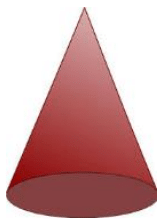
Ans: Colour the cone red. Colour the curved part and the tip evenly red.
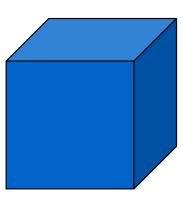
Ans: Colour the cube blue. Colour each square face evenly blue.
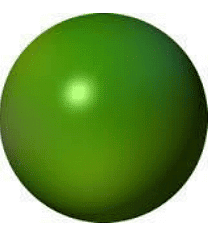
(iii) sphere green, and
Ans: Colour the sphere green. Colour the whole round surface evenly green.
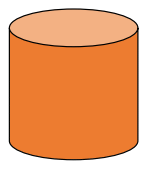
(iv) cylinder orange.
Ans: Colour the cylinder orange. Colour the curved side and the top circle orange.
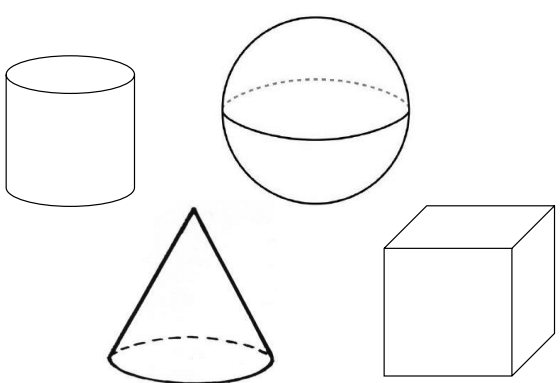
Q2: Draw a line from each name to the picture that best represents it.
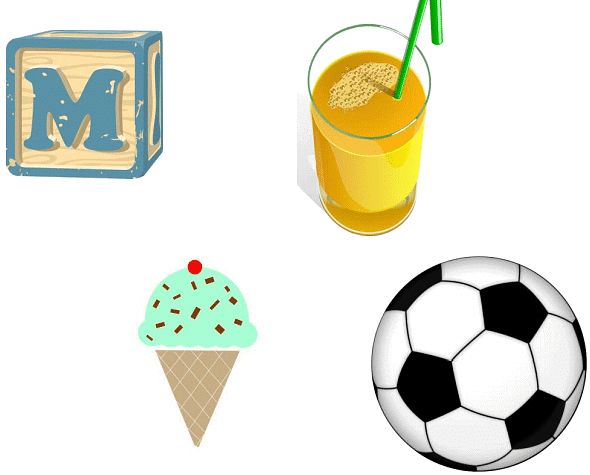
(ii) cube
(iii) sphere
(iv) cylinder
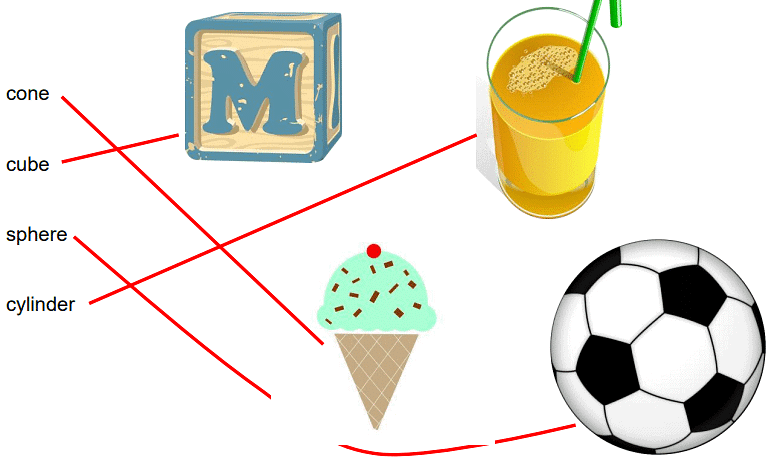
Ans: Draw a line from (i) the word cone to the picture of the cone, (ii) cube to the picture of the cube, (iii) sphere to the picture of the sphere and (iv) cylinder to the picture of the cylinder.
The document Worksheet Solutions: 3D Shapes is a part of the Class 4 Course Mathematics for Class 4.
All you need of Class 4 at this link: Class 4
FAQs on Worksheet Solutions: 3D Shapes
| 1. What are 3D shapes? |  |
Ans. 3D shapes, also known as three-dimensional shapes, are objects that have length, width, and height. They are solid shapes that occupy space and can be touched and felt in real life. Examples of 3D shapes include cubes, spheres, cylinders, cones, and pyramids.
| 2. How are 3D shapes different from 2D shapes? | |
Ans. The main difference between 3D shapes and 2D shapes is the presence of depth. While 2D shapes only have length and width, 3D shapes have an added dimension of height, giving them a three-dimensional appearance. 2D shapes can be represented on a flat surface, such as a piece of paper, while 3D shapes cannot be completely represented on a flat surface.
| 3. What is the importance of learning about 3D shapes? | |
Ans. Learning about 3D shapes is important as it helps develop spatial awareness and visualization skills. It also lays the foundation for understanding geometry and mathematical concepts related to volume, surface area, and symmetry. Additionally, knowing about 3D shapes is crucial in everyday life, as we encounter various objects and structures that are three-dimensional.
| 4. How can I identify different 3D shapes? | |
Ans. You can identify different 3D shapes based on their unique characteristics. For example, a cube has six square faces of equal size, while a sphere is perfectly round with no edges or vertices. A cylinder has two circular faces and a curved surface, and a cone has a circular base that tapers to a point. By observing the number of faces, edges, and vertices, you can distinguish between different 3D shapes.
| 5. What is the formula to calculate the volume of 3D shapes? | |
Ans. The formula to calculate the volume of different 3D shapes varies based on their shape. For example, the volume of a cube is calculated by multiplying the length of one side by itself three times (V = side length x side length x side length). The volume of a sphere is given by (4/3)πr³, where "r" represents the radius. Similarly, the volume of a cylinder is calculated by multiplying the area of the base by the height (V = πr²h).
About this Document

4.84/5 Rating

Apr 20, 2026 Last updated
Related Exams
Document Description: Worksheet Solutions: 3D Shapes for Class 4 2026 is part of Mathematics for Class 4 preparation. The notes and questions for Worksheet Solutions: 3D Shapes have been prepared according to the Class 4 exam syllabus. Information about Worksheet Solutions: 3D Shapes covers topics like and Worksheet Solutions: 3D Shapes Example, for Class 4 2026 Exam. Find important definitions, questions, notes, meanings, examples, exercises and tests below for Worksheet Solutions: 3D Shapes.
Introduction of Worksheet Solutions: 3D Shapes in English is available as part of our Mathematics for Class 4 for Class 4 & Worksheet Solutions: 3D Shapes in Hindi for Mathematics for Class 4 course. Download more important topics related with notes, lectures and mock test series for Class 4 Exam by signing up for free. Class 4: Worksheet Solutions: 3D Shapes
Description
Worksheet Solutions: 3D Shapes of Mathematics - variety of important questions with solutions, helping you prepare for exam. Download free PDF from EduRev.
Information about Worksheet Solutions: 3D Shapes
In this doc you can find the meaning of Worksheet Solutions: 3D Shapes defined & explained in the simplest way possible. Besides explaining types of Worksheet Solutions: 3D Shapes theory, EduRev gives you an ample number of questions to practice Worksheet Solutions: 3D Shapes tests, examples and also practice Class 4 tests



Related Searches
MCQs, Semester Notes, Previous Year Questions with Solutions, Objective type Questions, practice quizzes, Exam, Free, Worksheet Solutions: 3D Shapes, study material, Worksheet Solutions: 3D Shapes, Summary, video lectures, mock tests for examination, Sample Paper, Viva Questions, Worksheet Solutions: 3D Shapes, Important questions, pdf , Extra Questions, ppt, past year papers, shortcuts and tricks;