Q1: What is meant by gaining ratio on retirement of a partner.
Ans: The ratio in which the continuing partners acquire the outgoing partner’s share is called as gaining ratio.
Q2: Aman, Yatin and Uma were partners and were sharing profits and losses in the ratio of 5 : 3 : 2. Uma retired and her share was taken over by Aman and Yatin 5 : 3 in ratio. Calculate gaining ratio of Aman and Yatin.
Ans: Calculation of Gaining Ratio

Gaining ratio of Aman and Yatin = 10 : 6 = 5 : 3.
Q3: X, Y and Z are partners sharing profits in the ratio of Find the new ratio of remaining partners, if Z retires.
Ans: Old ratio of X : Y : Z =
= 5 : 4 : 1
Z retires, after striking of the retiring Parmer’s ratio, remaining ratio will be new profit sharing ratio, i.e. 5 : 4.
Q4: X, Y and Z were partners sharing profits in the ratio of X retired from the firm. Calculate the gaining ratio of the remaining partners.
Ans: Old ratio of X : Y : Z =
= 5 : 3 : 2
X retired, after striking of the retiring partner’s ratio, remaining ratio will be new profit sharing ratio, i.e. 3 : 2,
New profit sharing ratio = Y : Z = 3 : 2
Gaining Ratio = New Share – Old Share
Gaining ratio = 3 : 2.
Q5: Give any one distinction between sacrificing ratio and gaining ratio.
Ans: The difference between sacrificing ratio and gaining ratio is stated below
Sacrificing ratio:
It is the ratio in which old partners agree to sacrifice their share of profit in favour of new partner(s).
Gaining ratio:
It is the ratio in which continuing partners acquire the share of profit from outgoing partner(s).
Q6: (i) K, L and Z are partners sharing profits in the ratio of 4 : 3 : 2 respectively. L retired and surrendered 1/9th of his share of profit to K and remaining in favour of Z. Calculate the new profit sharing ratio of K and Z.
(ii) Arun, Varun and Charan are partners sharing profits in the ratio of 1/2, 3/10, and 1/5 respectively. Varun retired from the firm and Arun and Charan decided to share future profits in 3 : 2 ratio. Calculate gaining ratio of Arun and Charan.
Ans: (i) Old ratio between K, L and Z = 4 : 3 : 2.
Share surrendered in favour of K by L
Share surrendered in favour of Z by L
∴ New ratio = 39 : 42 or 13 : 14
(ii) Old ratio between Arun, Varun and Charan
New ratio between Arun and Charan = 3 : 2
Gaining Ratio = New Share – Old Share
.
Q7: Aman, Bimal and Deepak are partners sharing profits in the ratio of 2 : 3 : 5 . The goodwill of the firm has been valued at ₹ 37,500. Aman retired, Bimal and Deepak decided to share profits equally in future. Calculate gain/sacrifice of Bimal and Deepak on Aman’s retirement and also pass necessary journal entry for the treatment of goodwill.
Ans: Calculation of Sacrificing or Gaining Ratio
Sacrificing Ratio = Old share – New share
Aman’s Share of Goodwill = 37,500 × (2/10) = ₹ 7,500
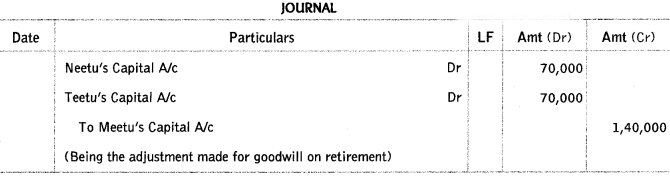
Q8: Neetu, Meetu and Teetu were partners in a firm. On 1st January, 2018, Meetu retired. On Meetu’s retirement, the goodwill of the firm was valued at X 4,20,000. Pass necessary journal entry for the treatment of goodwill on Meetu’s retirement.
Ans:
Working Note:
meetu’s share of goodwill = 4,20,000 × (1/3) = 1,40,000.
Q9: Why are heirs of a retiring/deceased partner entitled to the share of goodwill of the firm?
Ans: The retiring or deceased partner is entitled to his share of goodwill at the time of retirement/death because the goodwill has been earned by the firm at the time when he was a partner.
Q10: P, Q and R were partners in a firm sharing profits in the ratio of 5 : 4 : 3 respectively. Their capitals were ₹ 50,000, ₹ 40,000 and ₹ 30,000 respectively. State the ratio in which the goodwill of the firm, amounting to ₹ 6,00,000, will be adjusted in the capital accounts of the remaining partners on the retirement of Q.
Ans: The goodwill will be adjusted in the gaining ratio of the continuing partners.
Q11: For which share of goodwill, a partner is entitled at the time of his retirement?
Ans: At the time of retirement, a partner is entitled to get an amount equal to his share out of firm’s goodwill.
Q12: P, Q and R were partners in a firm sharing profits in the ratio of 5 : 4 : 3. Their capitals were ₹ 40,000, ₹ 50,000 and ₹ 1,00,000 respectively. State the ratio in which the goodwill of the firm amounting to ₹ 1,20,000 will be adjusted on the retirement of R.
Ans: R’s share of goodwill, i.e. ₹ 30,000 (1,20,000 × 3/12) will be contributed by P and Q in their gaining ratio, i.e. 5 : 4.
Q13: State the need for treatment of goodwill on the retirement of a partner.
Ans: At the time of retirement, retiring partner sacrifices his share of profit in favour of continuing partners, so the remaining partners compensate the retiring partner a share of the firm’s goodwill.
Q14: Kavi, Ravi, Kumar and Guru were partners in a firm sharing profits in the ratio of 3 : 2 : 2 : 1. On 1st February, 2017, Guru retired and the new profit sharing ratio decided between Kavi, Ravi and Kumar was 3 : 1 : 1. On Guru’s retirement, the goodwill of the firm was valued at ₹ 3,60,000. Showing your working notes clearly, pass necessary journal entry in the books of the firm for the treatment of goodwill on Guru’s retirement.
Ans:
Working Notes:
- Calculation of Gaining Ratio
Gaining Ratio = New Share – Old Share
- Calculation of Share of Goodwill
Guru’s share of goodwill = 3,60,000 × (1/8) = ₹ 45,000
Kavi gains = 3,60,000 × (9/40) = ₹ 81,000
Ravi sacrifices = 3,60,000 × (2/40) = ₹ 18,000
Kumar sacrifices = 3,60,000 × (2/40) = ₹ 18,000
Q15: Arjun, Bheem and Nakul are partners sharing profits and losses in the ratio of 14 : 5 : 6 respectively. Bheem retires and surrenders his 5/25th share in favour of Arjun. The goodwill of the firm is valued at 2 years purchase of super profits based on average profits of last 3 years. The profits of the last three years are ₹ 50,000, ₹ 55,000 and ₹ 60,000 respectively. The normal profits of the similar firms are ₹ 30,000. Goodwill already appears in the books of the firm at ₹ 75,000. The profit for the first year after the Bheem’s retirement was ₹ 1,00,000. Give necessary journal entries to adjust goodwill and distribute profits showing your workings.
Ans:
Working Notes:
- Calculation of New Profit Sharing Ratio and Gaining Ratio
Old ratio of Aijun, Bheem and Nakul = 14 : 5 : 6
Bheem surrenders in favour of Arjun = (5/25)th share, Arjun’s new share = (14/25) + (5/25) = (19/25)
New ratio of Aijun and Nakul = 19 : 6
Gaining Ratio = New Share – Old Share
- Calculation of Bheem’s Share of Goodwill
Actual average profit = = ₹ 55,000; Normal profit = ₹ 30,000
Super Profit = Average Profit – Normal Profit = 55,000 – 30,000 = ₹ 25,000
Firm’s goodwill = 25,000 × 2 = ₹ 50,000
Bheem’s share of goodwill = 50,000 × (5/25) = ₹ 10,000 (to be contributed by Arjun alone)
Q16: P, Q and R were partners in a firm. On 31st March, 2018 R retired. The amount payable to R ₹ 2,17,000 was transferred to his loan account. R agreed to receive interest on this amount as per the provisions of Partnership Act, 1932. State the rate at which interest will be paid to R.
Ans: As per the provisions of Partnership Act, 1932, the rate of interest payable to R will be 6% per annum.
Q17: Give the journal entry to distribute ‘workmen compensation reserve of ₹ 60,000 at the time of retirement of Sajjan, when there is no claim against it. The firm has three partners Rajat, Sajjan and Kavita.
Ans:
NOTE Since, the profit sharing ratio is not given, it is distributed equally.
Q18: Give the journal entry to distribute workmen compensation reserve of ₹ 70,000 at the time of retirement of Neeti, when there is a claim of ₹ 25,000 against it. The firm has three partners Raveena, Neeti and Rajat.
Ans:
NOTE Since, the profit sharing ratio is not given, it is distributed equally.
Q19: Ram, Mohan and Sohan were partners in a firm sharing profits in the ratio of 4 : 3 : 2. Mohan retired and his share was taken over equally by Ram and Sohan. In which ratio will the profit or loss on revaluation of assets and liabilities on the retirement of Mohan be transferred to the capital accounts of the partners?
Ans: The profit or loss on revaluation of assets and liabilities on the retirement of Mohan will be transferred to the capital accounts of the partners in their old ratio, i.e. 4 : 3 : 2.
Q20: Banwari, Girdhari and Murari are partners in a firm sharing profits and losses in the ratio of 4 : 5 : 6. On 31st March, 2014, Girdhari retired. On that date the capitals of Banwari, Girdhari and Murari before the necessary adjustments stood at ₹ 2,00,000, ₹ 1,00,000 and ₹ 50,000, respectively. On Girdhari’s retirement, goodwill of the firm was valued at ₹ 1,14,000. Revaluation of assets and re-assessment of liabilities resulted in a profit of ₹ 6,000. General reserve stood in the books of the firm at ₹ 30,000.
The amount payable to Girdhari was transferred to his loan account. Banwari and Murari agreed to pay Girdhari two yearly instalments of ₹ 75,000 each including interest @ 10% per annum on the outstanding balance during the first two years and the balance including interest in the third year. The firm closes its books on 31st March every year.
Prepare Girdhari’s loan account till it is finally paid showing the working notes clearly.
Ans:

 Find the new ratio of remaining partners, if Z retires.
 X retired from the firm. Calculate the gaining ratio of the remaining partners.


 .
.



 = ₹ 55,000; Normal profit = ₹ 30,000