Worksheet Solutions: Transport

Q1: Multiple Choice Questions (MCQs)
(i) What marked the beginning of the story of transport?
(a) Invention of the wheel
(b) Invention of the cart
(c) Building of roads
(d) Introduction of railways
Ans: (a)
The story of transport began with the invention of the wheel.
(ii) Which type of roads connect villages and are made of hardened mud?
(a) Expressways
(b) Pucca roads
(c) Kutcha roads
(d) Highways
Ans: (c)
Kutcha roads connect villages and are paths of hardened mud.
(iii) Which is the oldest metro service in India?
(a) Mumbai Metro Rail
(b) Kolkata Metro Rail
(c) Delhi Metro Rail
(d) Bengaluru Metro Rail
Ans: (b)
Kolkata Metro Rail is the oldest metro service in India.
(iv) What is the longest train route in the world?
(a) Shatabdi Express
(b) Rajdhani Express
(c) Trans-Siberian Railway
(d) Indian Railways
Ans: (c)
Trans-Siberian Railway is the longest train route in the world.
(v) Which port city is considered the most important for India's foreign trade?
(a) Chennai
(b) Kochi
(c) Mumbai
d) Kolkata
Ans: (c)
Mumbai is considered the most important port city for India's foreign trade.
Q2: Fill in the Blanks.
(i) The Grand Trunk Road was a part of the old National Highway ____________.
Ans: 1
The Grand Trunk Road was a part of the old National Highway 1.
(ii) The longest railway route in the world is the ______________ Railway.
Ans: Trans-Siberian
Trans-Siberian Railway is the longest railway route in the world.
(iii) Air India, the national airline, is under the Government of _______________.
Ans: India
Air India is under the Government of India.
(iv) The construction of the Suez Canal reduced distances along sea routes by ____________ of kilometers.
Ans: thousands
Construction of the Suez Canal reduced distances along sea routes by thousands of kilometers.
(v) The Panama Canal reduced the time for ships to travel between the Atlantic and Pacific Oceans from six months to ____________ weeks.
Ans: two
The Panama Canal reduced the time for ships to travel between the Atlantic and Pacific Oceans from six months to two weeks.
Q3: Match the Column.
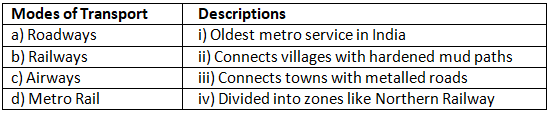 Ans:
Ans: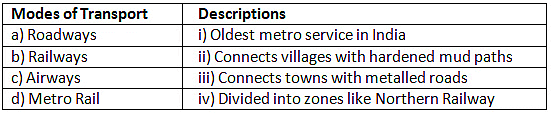
Q4: True or False.
(i) The Indian Railways is the second largest railway network in Asia.
Ans: True
The Indian Railways is the second-largest railway network in Asia.
(ii) The Kolkata Metro Rail uses two sets of tracks to increase its speed.
Ans: False
The Kolkata Metro Rail does not use two sets of tracks; it uses a single track.
(iii) The Shatabdi and Rajdhani train services are known for their slow speeds.
Ans: False
The Shatabdi and Rajdhani train services are super fast trains, indicating that they are known for high speeds.
(iv) The Panama Canal connects the Atlantic and Indian Oceans.
Ans: False
The Panama Canal connects the Atlantic and Pacific Oceans, not the Indian Ocean.
(v) Waterways are the most expensive means of travel.
Ans: False
Waterways are the cheapest means of travel.
FAQs on Worksheet Solutions: Transport
| 1. What are the different modes of transport? |  |
| 2. How does road transport work? | |
| 3. What are the advantages of air transport? | |
| 4. How does water transport work? | |
| 5. What are the challenges faced by the transportation industry? | |