Solved Examples: Volume, Surface Area & Solid Figures


Perimeter
Perimeter denotes the distance around a closed plane figure. It is the total length of the boundary of the shape. The formula for the perimeter depends on the type of polygon or curve.
Area
Area denotes the extent of the two-dimensional region enclosed by a shape. Area is measured in square units. Different plane figures have different area formulas depending on their geometry.
Volume
Volume denotes the amount of three-dimensional space occupied by a solid. Volume is measured in cubic units. Common solids include cuboids, cylinders, cones and spheres; each has a standard volume formula.
Formulas
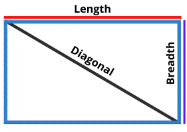
Rectangle
- Area = length × width
- Perimeter = 2 × (length + width)
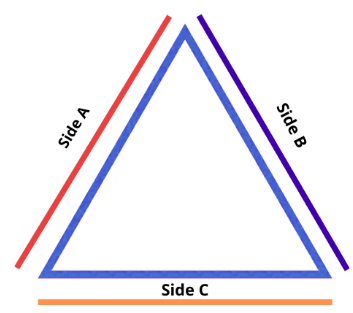
Triangle
- Area = 1/2 × base × height
- Perimeter = a + b + c, where a, b, c are side lengths
- Area using Heron's formula: if s = (a + b + c)/2 then area = √[s(s - a)(s - b)(s - c)]


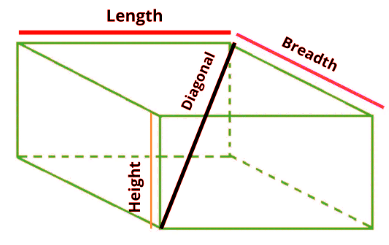
Cuboid (Rectangular Prism)
- Volume = length × width × height
- Total surface area = 2lw + 2lh + 2wh
- Lateral (or curved) surface area = 2h(l + w) - this gives the sum of areas of the vertical faces when height = h
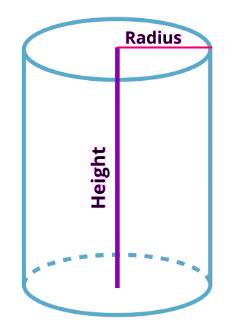
Cylinder
- Volume = π r2 × height
- Total surface area = 2π r h + 2π r2
- Curved (lateral) surface area = 2πrh
Sphere
- Volume = (4/3) π r3
- Surface area = 4 π r2
Examples
Example 1: A cube of 5 cm was cut into as many 1 cm cubes as possible. Find out the ratio of the surface area of the larger cube to that of the surface areas of the smaller cubes?
(a) 1:2
(b) 2:3
(c) 1:5
(d) 1:3
Ans: (c)
Sol.
Volume of the original cube: V large= 53 = 125 cm3
Volume of each smaller cube:
V small = 1^3 = 1cm3
Number of small cubes obtained:
n = V large/{V small = 125/1 = 125
Formula for surface area of a cube:
S = 6a^2
Surface area of the larger cube:
S large = 6 *52 = 150 cm2.
Surface area of one smaller cube:
S small = 6 *1^2 = 6 cm2.
Total surface area of all 125 small cubes:
S = 125 * 6 = 750 cm2
Required ratio: = 150 : 750 = 1 : 5
Thus the correct option is (c) 1:5.
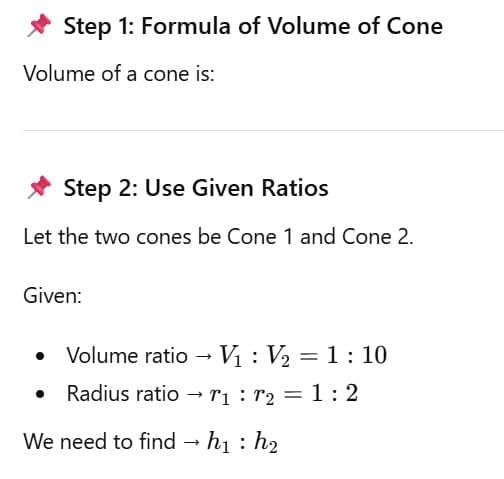
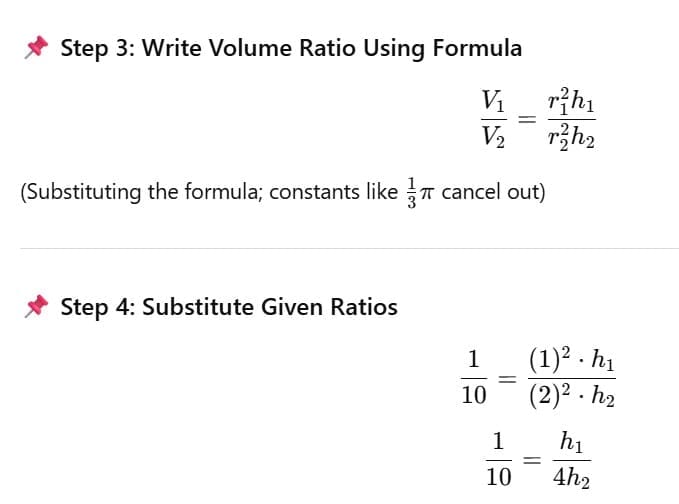
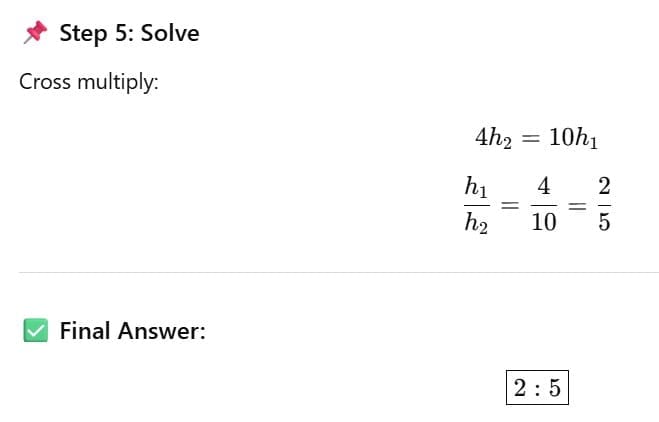
Example 2: The volumes of two cones are in the ratio 1:10. The radius of the cones are in the ratio of 1: 2. What is the ratio of the height of the cone?
(a) 3:4
(b) 3:5
(c) 2:5
(d) 1:3
Ans: (c)
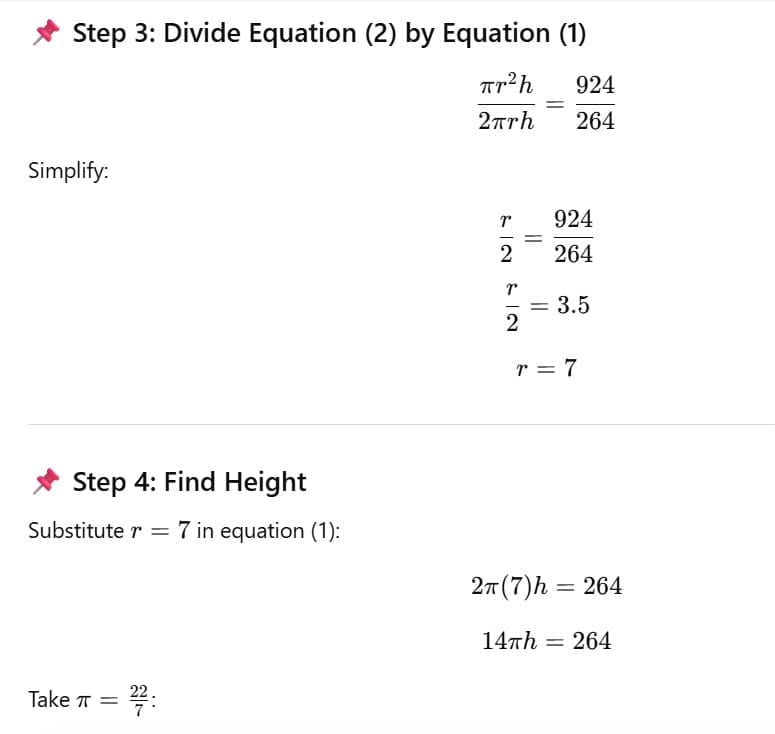
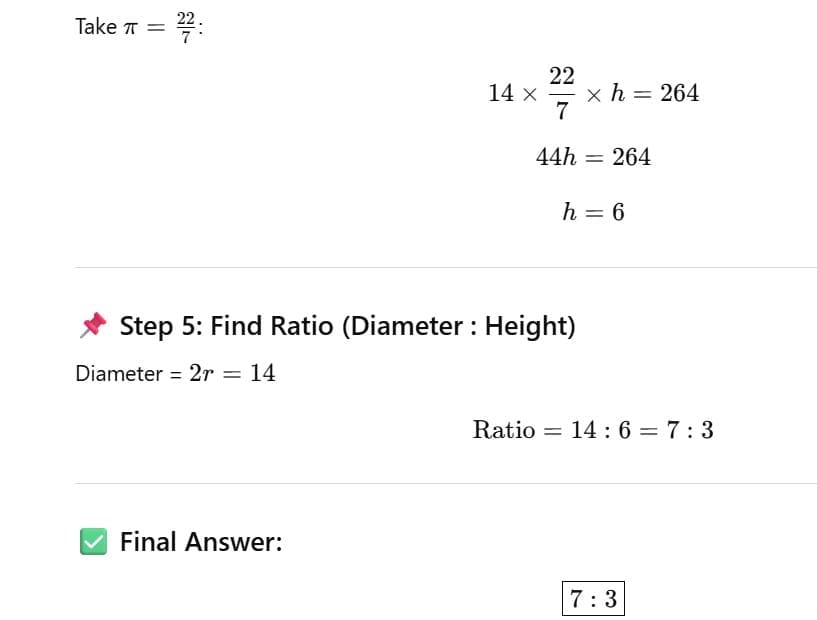
Example 3: The curved surface area of a cylindrical pillar is 264 m2 and its volume is 924m3. Find the ratio of its diameter to its height.
(a) 7:4
(b) 3:4
(c) 6:5
(d) 7:3
Ans: (d)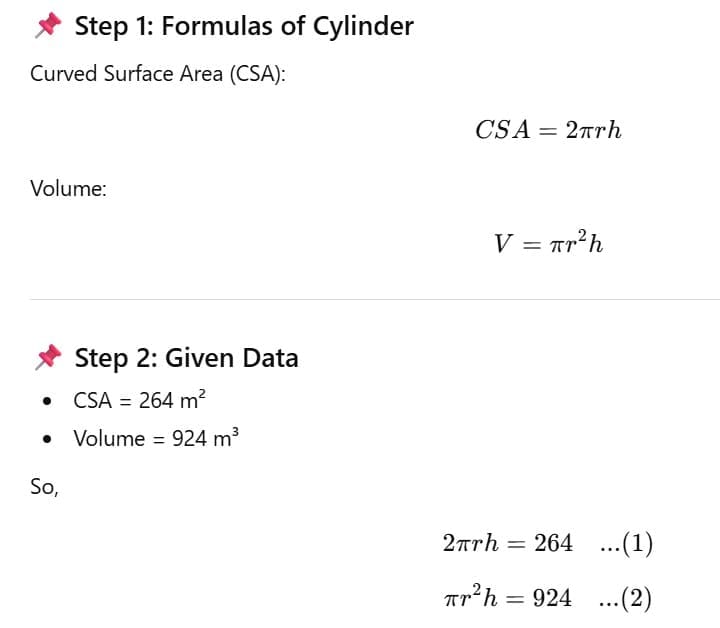
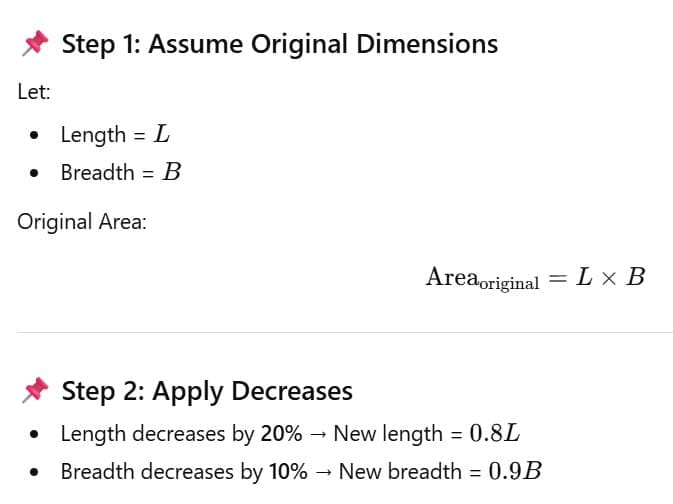
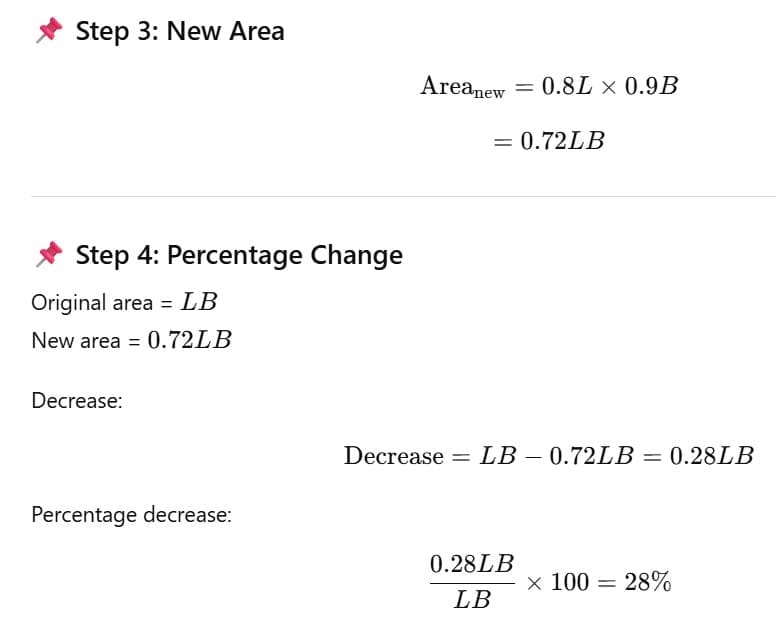
Example 4: A rectangular piece of cloth when soaked in water, was found to have lost 20% of its length and 10% of its breadth. Calculate the total percentage of decrease in the area of rectangular piece of cloth?
(a) 75% decrease
(b) 28 % increase
(c) 28 % decrease
(d) 20% decrease
Ans: (c)

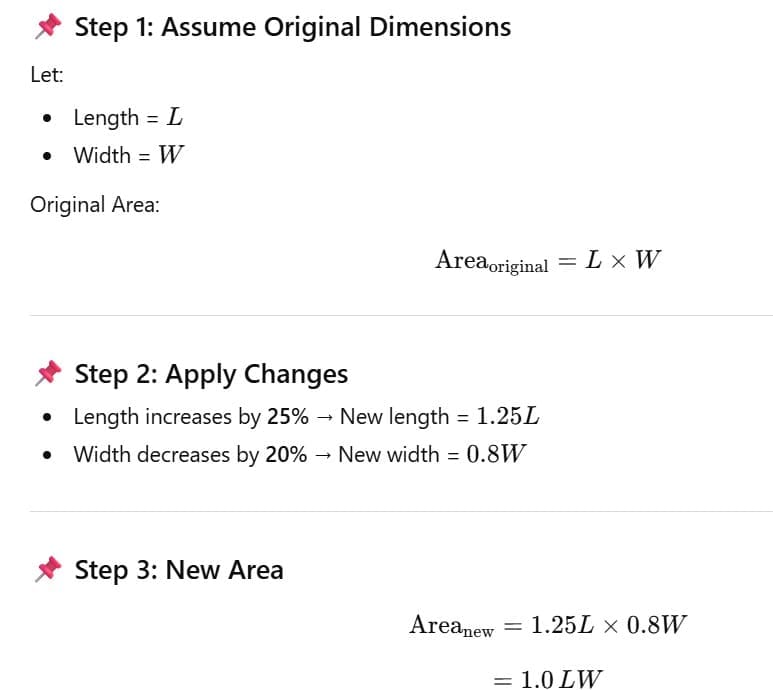
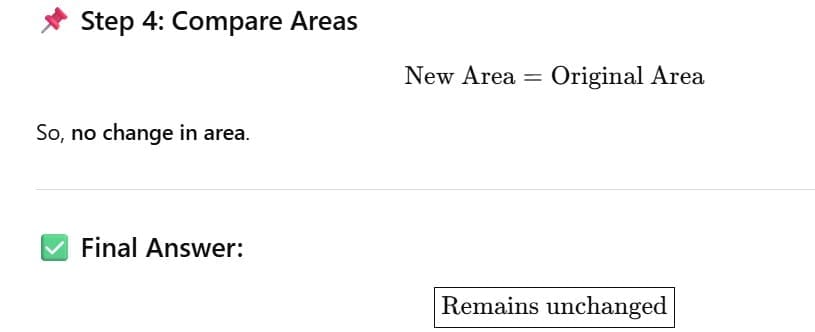
Example 5: If the length of a rectangle is increased by 25% and the width is decreased by 20%, then find the area of the rectangle?
(a) 25% increase
(b) 50 % decrease
(c) remains unchanged
(d) 10 % increase
Ans: (c)
Summary
This chapter collected essential definitions and standard formulas for perimeter, area and volume of common plane figures and solids. Worked examples illustrate common competitive-exam techniques: express quantities in terms of base formulas, use ratios and percentage multipliers carefully, and apply π = 22/7 when problems are constructed to produce whole numbers. Practice applying the formulas for cylinders, cones, spheres and cuboids, and use Heron's formula for triangles when side lengths are known but the height is not.
FAQs on Solved Examples: Volume, Surface Area & Solid Figures
| 1. What is the formula for calculating the perimeter of a rectangle? |  |
| 2. How do you determine the area of a triangle? | |
| 3. What is the formula for finding the volume of a cylinder? | |
| 4. How is the surface area of a cube calculated? | |
| 5. Can you explain the difference between volume and surface area? | |