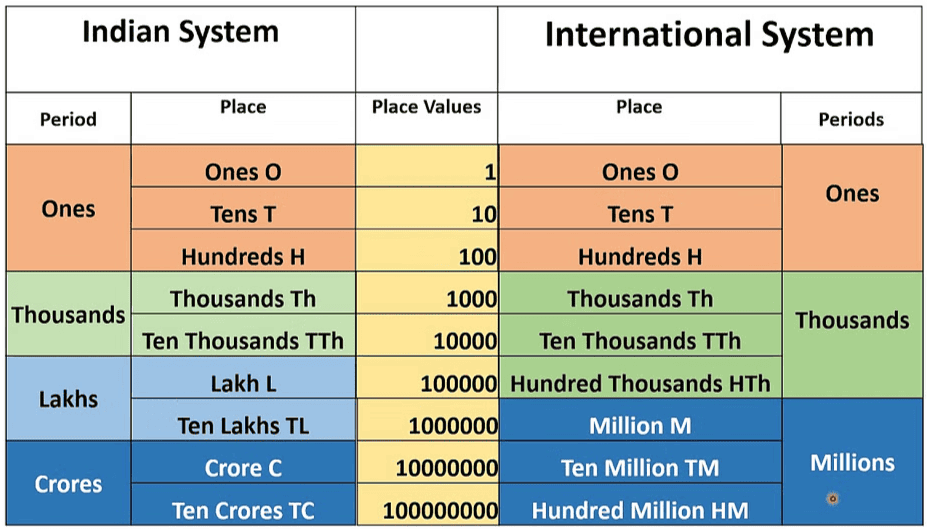
Indian system of numeration groups digits as: units, tens, hundreds | thousands, ten-thousands | lakhs, ten-lakhs | crores, ten-crore, etc. Examples: 1 lakh = 1,00,000, 1 crore = 1,00,00,000.
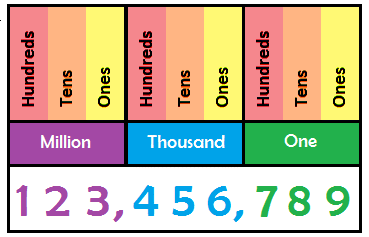
International system of numeration groups digits in threes from the right: units, tens, hundreds | thousands | millions | billions, etc. Example: 1 million = 1,000,000.
When writing numbers in the Indian system, place commas after the first three digits from the right and then after every two digits: for example, 3,70,07,690.
Worked Questions and Answers
Q.1. Ria read that the population of Delhi is about 2 crore 50 lakh. Convert this population into standard form. Answer: The population of Delhi in standard form is 2,50,00,000.
Solution:
Explanation:
1 crore = 1,00,00,000
1 lakh = 1,00,000
So, 2 crore + 50 lakh = 2,50,00,000.
Indian and International System
Q2: The moon is approximately 384,400 km away from the Earth. Write this distance in standard form. Ans: The distance from the Earth to the moon in Indian standard form is 3,84,400 km.
Solution:
Explanation:
Write the number with commas according to the Indian system: 3,84,400 (three lakh eighty-four thousand four hundred).
Q3: Which is the greatest 7-digit number, and how can you obtain the smallest 8-digit number from it? Ans: The greatest 7-digit number is 99,99,999. Adding 1 to this number gives the smallest 8-digit number, which is 1,00,00,000.
Solution:
Explanation:
The greatest 7-digit number is 99,99,999.
By adding 1 to the greatest 7-digit number, we get the smallest 8-digit number: 99,99,999 + 1 = 1,00,00,000 Thus, when we add 1 to the greatest 7-digit number, we get the smallest 8-digit number.
Q4: Find the place value of 4 in the number 4,67,13,223. Ans: The place value of 4 in 4,67,13,223 is 40,00,000.
Solution:
Explanation:
The digit 4 is in the ten-lakh (ten-lakh means ten times one lakh) place.
Therefore, its place value is:
4 × 10,00,000 = 40,00,000
Q5: Write the numeral for the following by separating the periods: (a) 603274087 (b) 37007690 Ans:
Q6: Compare 5,67,89,123 and 6,78,90,345. Which one is greater? Ans: 6,78,90,345 is greater than 5,67,89,123.
Solution:
Explanation: Compare digits from the left (highest place value) side by side. In the crore place, 6 > 5, so 6,78,90,345 is the greater number.
Q7: Write the greatest 5-digit number using the digits 4, 7, 2, 9, 5, and 1 only once. Ans: The greatest 5-digit number using the digits 4, 7, 2, 9, 5, and 1 is 97,542.
Solution:
Explanation: To make the greatest 5-digit number, choose the five largest digits and arrange them in descending order.
The five largest digits available are 9, 7, 5, 4, 2.
Therefore, the greatest 5-digit number is 97,542..
Q8: Write the smallest 6-digit number using the digits 3, 0, 6, 1, 9, and 8 without repetition. Ans: The smallest 6-digit number using the digits 3, 0, 6, 1, 9, and 8 is 1,03,689.
Solution:
Explanation:
To get the smallest 6-digit number, place the smallest non-zero digit in the hundred-thousands place and then arrange the remaining digits in ascending order.
Smallest non-zero digit is 1. The remaining digits in ascending order are 0, 3, 6, 8, 9.
So the number is 1 0 3 6 8 9
Q9: Convert 15 million into standard form. Ans: 15 million in standard form is 15,000,000. In the Indian system this is written as 1,50,00,000.
Solution:
Explanation:
One million equals 1,000,000 (which is 10,00,000 in the Indian system).
So, 15 × 1,000,000 = 15,000,000
Q10: Using the International system of numeration, write the numeral for: Seventy-two million five hundred thousand three hundred twenty-one. Ans: The numeral for Seventy-two million five hundred thousand three hundred twenty-one is 72,500,321.
Solution:
Explanation:
In the International system, group digits in threes from the right: millions, thousands, units.
The number is written as 72,500,321 (seventy-two million, five hundred thousand, three hundred twenty-one).
1. What are large numbers and why are they important in math?
Ans.Large numbers are numbers that have many digits, typically more than four. They are important in math because they help us understand and work with quantities that are very big, like populations, distances in space, or money in the economy.
2. How do you read large numbers correctly?
Ans.To read large numbers, you start from the left and group the digits into sets of three, calling each set a 'thousand', 'million', 'billion', etc. For example, the number 1,234,567 is read as "one million, two hundred thirty-four thousand, five hundred sixty-seven."
3. Can you give examples of word problems involving large numbers?
Ans.An example of a word problem could be: "A library has 1,500,000 books. If 250,000 books are checked out, how many books are left in the library?" This problem helps students practice subtraction with large numbers.
4. What strategies can help solve word problems with large numbers?
Ans.Strategies to solve word problems with large numbers include reading the problem carefully, identifying the important information, breaking the problem down into smaller parts, and using estimation to check if your answer is reasonable.
5. How can I practice word problems with large numbers at home?
Ans.You can practice by creating your own word problems using large numbers from real life, such as populations of cities, distances between countries, or costs of items. You can also find worksheets or online resources that focus on word problems involving large numbers.
study material, Word Problems: Large Numbers, MCQs, past year papers, Word Problems: Large Numbers, Free, Viva Questions, Word Problems: Large Numbers, ppt, Summary, Objective type Questions, Important questions, practice quizzes, mock tests for examination, Exam, pdf , shortcuts and tricks, Sample Paper, Extra Questions, Previous Year Questions with Solutions, video lectures, Semester Notes;