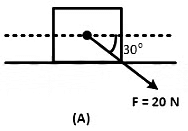
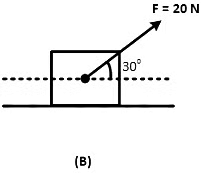
Q1: A block of mass 5 kg is (i) pushed in case (A) and (ii) pulled in case (B), by a force F = 20 N, making an angle of 30o with the horizontal, as shown in the figures. The coefficient of friction between the block and floor is μ = 0.2. The difference between the accelerations of the blocks, in case (B) and case (A) will be: (g = 10 ms-2)
 (a) 3.2 ms-2
(b) 0.8 ms-2
(c) 0 ms-2
(d) 0.4 ms-2
Ans: (b)
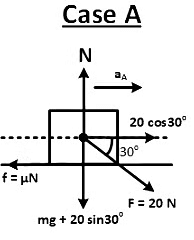 N = mg + 20 sin30o
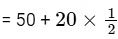 = 60 N
Limition friction, fL = μN = 0.2 × 60 = 12 N
And horizontal force(Fx) = 20 cos30o = 10√3 = 17.32 N
As Fx > fL, then the block will move with acceleration aA.

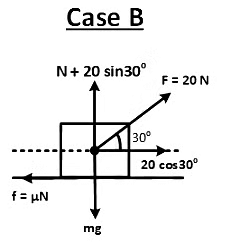 N + 20 sin30o = mg
N = mg - 20 sin30o
= 50 - 10 = 40 N
Limition friction, fL = μN = 0.2 × 40 = 8 N
And horizontal force(Fx) = 20 cos30o = 10√3 = 17.32 N
As Fx > fL, then the block will move with acceleration aB.
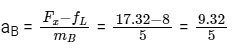
Difference between acceleration

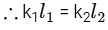
Q2: A spring whose unstretched length is l has a force constant k. The spring is cut into two pieces of unstretched lengths l1 and l2 where, l1 = nl2 and n is an integer. The ratio k1/k2 of the corresponding force constant, k1 and k2 will be:
(a) 1/n2
(b) 1/n
(c) n2
(d) n
Ans: (b)
For a spring, k × l = constant.
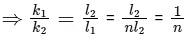
Q3: A bullet of mass 20 g has an initial speed of 1 ms-1 , just before it starts penetrating a mud wall of thickness 20 cm. If the wall offers a mean resistance of 2.5 × 10⁻² N, the speed of the bullet after emerging from the other side of the wall is close to :
(a) 0.3 ms-1
(b) 0.1 ms-1
(c) 0.7 ms-1
(d) 0.4 ms-1
Ans: (c)
Given, resistance offered by the wall

So, deacceleration of bullet,


Now, using the equation of motion,
v2 - u2 = 2 as
We have,



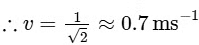
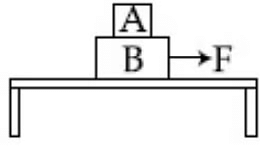
Q4: Two blocks A and B of masses mA = 1 kg and mB = 3 kg are kept on the table as shown in figure. The coefficient of friction between A and B is 0.2 and between B and the surface of the table is also 0.2. The maximum force F that can be applied on B horizontally, so that the block A does not slide over the block B is: [Take g = 10 m/s2]
 (a) 8 N
(b) 16 N
(c) 40 N
(d) 12 N
Ans: (b)
MA = 1 kg, MB = 3 k
μAB = 0.2
μB = 0.2
Fmax = (MA + MB) × 0.2 × 10 + (MA + MB) × 0.2 × 10
= 4 × 2 + 4 × 2 = 16
Q5: A ball is thrown upward with an initial velocity V0 from the surface of the earth. The motion of the ball is affected by a drag force equal to mγu2 (where m is mass of the ball, u is its instantaneous velocity and γ is a constant). Time taken by the ball to rise to its zenith is:
(a) 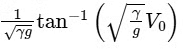
(b) 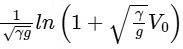
(c) 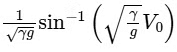
(d) 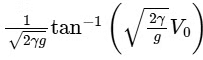
Ans: (a)
Given, drag force, F = mγv2 ......(i)
As we know, general equation of force
= ma .........(ii)
Comparing Eqs. (i) and (ii), we get
a = γv2
The net retardation of the ball when thrown vertically upward is therefore net 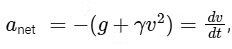 where g is the acceleration due to gravity.
Rearranging terms gives us:
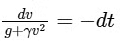 We now need to integrate both sides of this equation.
When the ball is thrown upward with velocity v0 and reaches its zenith ( "zenith" refers to the highest point that the ball reaches in its upward trajectory.), the velocity is 0. The time to reach the zenith is 0.
So the integral equation is t:
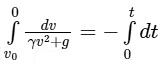
Separating the constants from the integral:
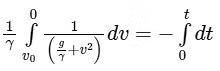
Recognizing the integral as the standard form  we write the integral in terms of the arctangent function.
This gives us :
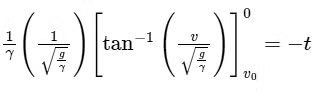
Evaluating the integral at the bounds gives us:
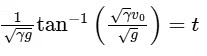
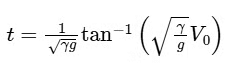
Therefore, the time taken by the ball to rise to its zenith, considering the drag force, is given by
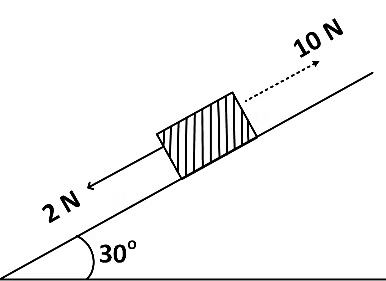
Q6: A block kept on a rough inclined plane, as shown in the figure, remains at rest upto a maximum force 2 N down the inclined plane. The maximum external force up the inclined plane that does not move the block is 10 N. The coefficient of static friction between the block and the plane is : [Take g = 10 m/s2]
 (a) √3/4
(b) 1/2
(c) √3/2
(d) 2/3
Ans: (c)
2 + mg sin30 = μmg cos30o
10 = mgsin30 + μmg cos30o
= 2μmg cos30 - 2
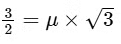
6 = μmg cos30
4 = mg sin30

Q7: Two forces P and Q, of magnitude 2F and 3F, respectively, are at an angle θ with each other. If the force Q is doubled, then their resultant also gets doubled. Then, the angle θ is -
(a) 90o
(b) 60o
(c) 30o
(d) 120o
Ans: (d)
4F2 + 9F2 + 12F2 cos θ = R2
4F2 + 36F2 + 24F2 cos θ = 4R2
4F2 + 36F2 + 24F2 cos θ
= 4(13F2 + 12F2cosθ) = 52F2 + 48F2cos θ

Q8: A mass of 10 kg is suspended vertically by a rope from the roof. When a horizontal force is applied on the rope at some point. the rope deviated at an angle of 45o at the roof point. If the suspended mass is at equilibrium, the magnitude of the force applied is (g = 10 ms-2)
(a) 200 N
(b) 140 N
(c) 70 N
(d) 100 N
Ans: (d)
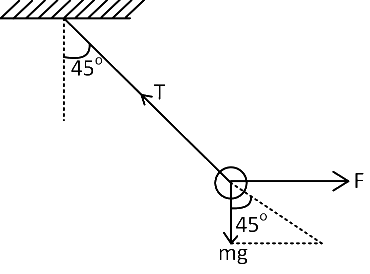 tan 45o = F/mg
∴ F = mg
= 10 × 10
= 100 N
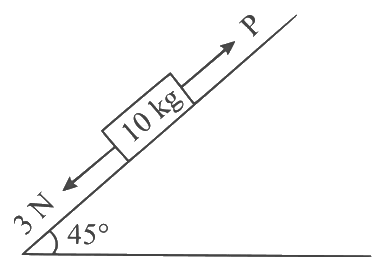
Q9: A block of mass 10 kg is kept on a rough inclined plane as shown in the figure. A force of 3 N is applied on the block. The coefficient of static friction between the plane and the block is 0.6. What should be the minimum value of force P, such that the block does not move downward? (take g = 10 ms-2)
 (a) 32 N
(b) 18 N
(c) 23 N
(d) 25 N
Ans: (a)
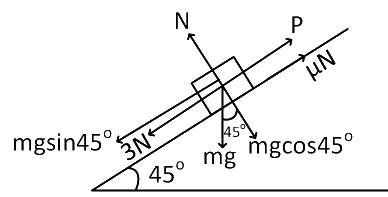 At equilibrium,
N = mg cos 45o . . . . . . (1)
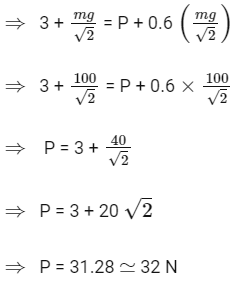
3 + mg sin 45o = P + μN