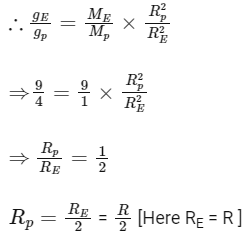
Q1: The ratio of the weights of a body on the Earth's surface to that on the surface of a planets is 9 : 4. The mass of the planet is 1/9 th of that of the Earth. If 'R' is the radius of the Earth, what is the radius of the planet ? (Take the planets to have the same mass density)
(a) R/9
(b) R/2
(c) R/3
(d) R/4
Ans: (b)
W = mg
as m = constant everywhere
∴ W ∝ g

We know,

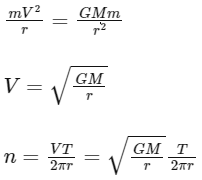
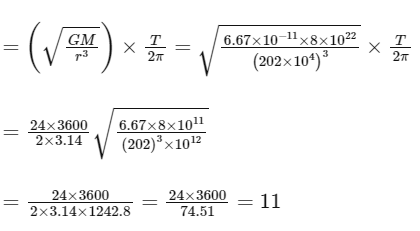
Q2: A spaceship orbits around a planet at a height of 20 km from its surface. Assuming that only gravitational field of the planet acts on the spaceship, what will be the number of complete revolutions made by the spaceship in 24 hours around the planet?
[Given ; Mass of planet = 8 × 10²² kg, Radius of planet = 2 × 10⁶ m, Gravitational constant G = 6.67 × 10⁻¹¹ Nm2 /kg2]
(a) 13
(b) 9
(c) 17
(d) 11
Ans: (d)
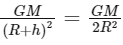
Q3: The value of acceleration due to gravity at Earth's surface is 9.8 ms-2. The altitude above its surface at which the acceleration due to gravity decreases to 4.9 ms-2, is close to : (Radius of earth = 6.4 × 10⁶ m)
(a) 1.6 × 10⁶ m
(b) 9.0 × 10⁶ m
(c) 6.4 × 10⁶ m
(d) 2.6 × 10⁶ m
Ans: (d)
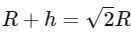

Q4: A test particle is moving in a circular orbit in the gravitational field produced by a mass density 
(a) T2/R3 is a constant
(b) TR is a constant
(c) T/R2 is a constant
(d) T/R is a constant
Ans: (d)
For circular motion of particle:
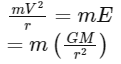

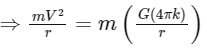
⇒ V = constant

⇒ T/R = Constant
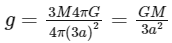
Q5: A solid sphere of mass 'M' and radius 'a' is surrounded by a uniform concentric spherical shell of thickness 2a and mass 2M. The gravitational field at distance '3a' from the centre will be:
(a) 
(b) 
(c) 
(d) 
Ans: (a)
We use Gauss's Law for gravitation
g.4 πr2 = (Mass enclosed) 4πG
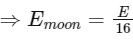
Q6: A rocket has to be launched from earth in such a way that it never returns. If E is the minimum energy delivered by the rocket launcher, what should be the minimum energy that the launcher should have if the same rocket is to be launched from the surface of the moon ? Assume that the density of the earth and the moon are equal and that the earth's volume is 64 times the volume of the moon :-
(a) E/32
(b) E/16
(c) E/4
(d) E/64
Ans: (b)
Minimum energy required (E) = - (Potential energy of object at surface of earth)
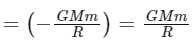
Now Mearth = 64 Mmoon
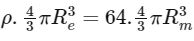
⇒ Re = 4Rm

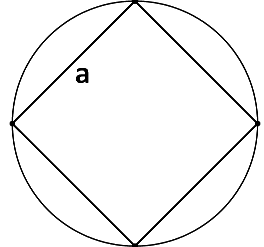
Q7: Four identical particles of mass M are located at the corners of a square of side 'a'. What should be their speed if each of them revolves under the influence of other's gravitational field in a circular orbit circumscribing the square?
 (a)
(a) 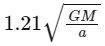
(b) 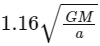
(c) 
(d) 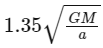
Ans: (b)
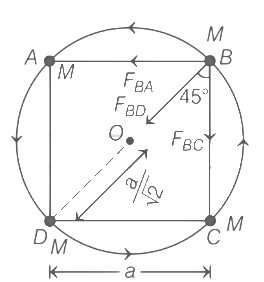 Net force on mass M at position B towards centre of circle is
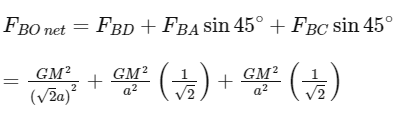
[where, diagonal length BD is √2 a]

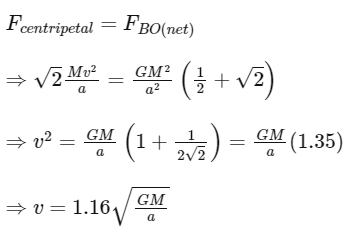
This force will act as centripetal force.
Distance of particle from centre of circle is 

So, for rotation about the centre,
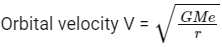
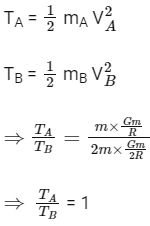
Q8: Two satellites, A and B, have masses m and 2m respectively. A is in a circular orbit of radius R, and B is in a circular orbit of radius 2R around the earth. The ratio of their kinetic energies, TA/TB, is;
(a) 2
(b) 1/2
(c) 
(d) 1
Ans: (d)
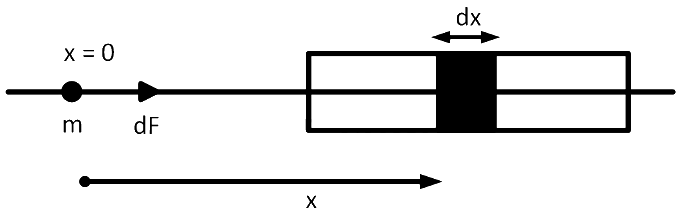
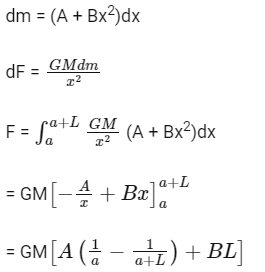
Q9: A straight rod of length L extends from x = a to x = L + a. The gravitational force it exerts on a point mass 'm' at x = 0, if the mass per unit length of the rod is A + Bx2 , is given by :
(a) 
(b) 
(c) 
(d) 
Ans: (b)
Q10: A satellite of mass M is in a circular orbit of radius R about the centre of the earth. A meteorite of the same mass, falling towards the earth, collides with the satellite completely inelastically. The speeds of the satellite and the meteorite are the same, just before the collision. The subsequent motion of the combined body will be :
(a) in the same circular orbit of radius R
(b) such that it escapes to infinity
(c) in a circular orbit of a different radius
(d) in an elliptical orbit
Ans: (d)
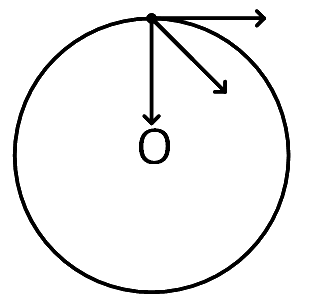


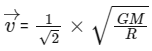
Q11: A satellite is revolving in a circular orbit at a height h form the earth surface, such that h < < R where R is the earth. Assuming that the effect of earth's atmosphere can be neglected the minimum increase in the speed required so that the satellite could escape from the gravitational field of earth is:
(a) 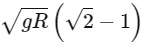
(b) 
(c) 
(d) 
Ans: (a)
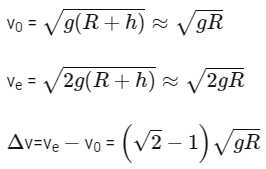
Q12: Two stars of masses 3 × 1031 kg each, and at distance 2 × 10¹¹ m rotate in a plane about their common centre of mass O. A meteorite passes through O moving perpendicular to the star's rotation plane. In order to escape from the gravitational field of this double star, the minimum speed that meteorite should have at O is - (Take Gravitational constant; G = 6.67 × 10⁻¹¹ Nm2 kg-2)
(a) 2.4 × 10⁴ m/s
(b) 1.4 × 10⁵ m/s
(c) 3.8 × 10⁴ m/s
(d) 2.8 × 10⁵ m/s
Ans: (d)
By energy convervation between 0 & ∞.

[M is mass of star m is mass of meteroite)

Q13: A satellite is moving with a constant speed v in circular orbit around the earth. An object of mass 'm' is ejected from the satellite such that it just escapes from the gravitational pull of the earth. At the time of ejection, the kinetic energy of the object is -
(a) mv2
(b) 1/2 mv2
(c) 3/2 mv2
(d) 2 mv2
Ans: (a)
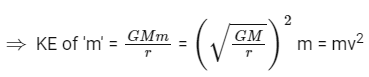
At height r from center of earth. orbital velocity

∴ By energy conservation
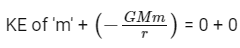
(At infinity, PE = KE = 0)
Q14: The energy required to take a satellite to a height 'h' above Earth surface (radius of Earth = 6.4 × 10³ km) is E1 and kinetic energy required for the satellite to be in a circular orbit at this height is E2. The value of h for which E1 and E2 are equal, is
(a) 1.6 × 10³ km
(b) 3.2 × 10³ km
(c) 6.4 × 10³ km
(d) 1.28 × 10⁴ km
Ans: (b)
Energy required to move a satellite from earth surface to height h is,
E1 = Uh - Usurface
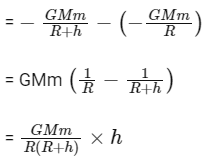
We know, for sattelite at height h.
Centrifigual force = Gravitational force
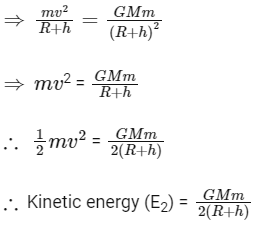
Given that,
E1 = E2
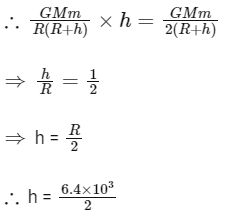
= 3.2 × 10³ km





