JEE Main Previous Year Questions (2026): Sets and Relations

Q1: Let A, B and C be sets such that ϕ ≠ A ∩ B ⊆ C. Then which of the following statements is not true ?
(a) If (A - B) ⊆ C, then A ⊆ C
(b) B ∩ C ≠ ϕ
(c) (C ∪ A) ∩ (C ∪ B) = C
(d) If (A - C) ⊆ B, then A ⊆ B
Ans: (d)
According to the question, we have the following Venn diagram.
Here,
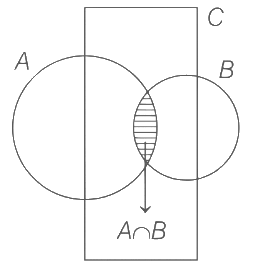 Now, from the Venn diagram, it is clear that B ∩ C ≠ ϕ , is true
Also, (C ∪ A) ∩ (C ∪ B) = C ∪ (A ∩ B) = C is true.
If (A - B) ⊆ C, for this statement the Venn diagram is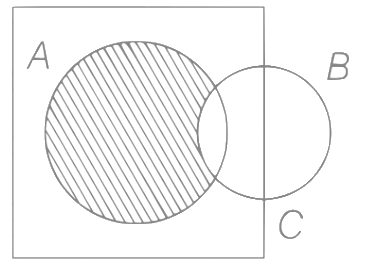 From the Venn diagram, it is clear that if A - B ⊆ C, then A ⊆ C.
Now, if (A - C) ⊆ B, for this statement the Venn diagram.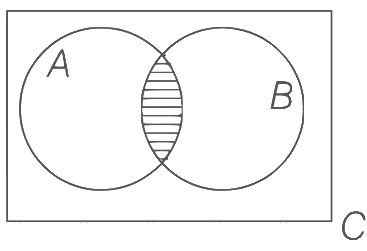 From the Venn diagram, it is clear that
Q2: Two newspapers A and B are published in a city. It is known that 25% of the city populations reads A and 20% reads B while 8% reads both A and B. Further, 30% of those who read A but not B look into advertisements and 40% of those who read B but not A also look into advertisements, while 50% of those who read both A and B look into advertisements. Then the percentage of the population who look into advertisement is :-
(a) 13.5
(b) 13
(c) 12.8
(d) 13.9
Ans: (d)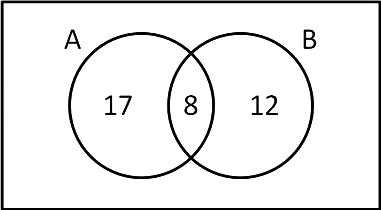 The total population to be 100 (for simplicity's sake) and the percentages can be treated as actual numbers of people in this context.
The percentage of people who read newspaper A is given as 25. However, among these, there are people who read both newspapers A and B, given as 8. To find the number of people who read only newspaper A, we subtract the number of people who read both from the total number of people who read A. That is,
n(A only) = 25 - 8 = 17
Similarly, the number of people who read only newspaper B is calculated as :
n(B only) = 20 - 8 = 12
Now, we are given the percentage of each of these groups that look into the advertisements:
30% of those who read A but not B,
40% of those who read B but not A,
50% of those who read both A and B.
To find the total percentage of the population that looks into advertisements, we add up the contributions from each of these groups. We calculate each group's contribution by multiplying the size of the group by the percentage of that group that looks at advertisements:
= 5.1 (from A only) + 4.8 (from B only) + 4 (from both A and B)
Adding these up, we get
= 13.9
This means that 13.9% of the total population looks into the advertisements.
So, the correct answer is :
Option D : 13.9.
Q3: Let Z be the set of integers.
then the number of subsets of the set A × B, is
(a) 212
(b) 218
(c) 210
(d) 215
Ans: (d)

A = { - 2, 2, 3}
B = {x ε Z : - < 2x - 1 < 9}
B = {0, 1, 2, 3, 4}
A × B has is 15 elements so number of subsets of A × B is 215.
Q4: Let S = {1, 2, 3, ... , 100}. The number of non-empty subsets A of S such that the product of elements in A is even is :
(a) 250 - 1
(b) 250 (250 - 1)
(c) 2100 - 1
(d) 250 + 1
Ans: (b)
S = {1,2,3, . . . .100}
= Total non empty subsets-subsets with product of element is odd
= 2100 - 1 - 1[(250 - 1)]
= 2100 - 250
= 250 (250 - 1)
Q5: In a class of 140 students numbered 1 to 140, all even numbered students opted Mathematics course, those whose number is divisible by 3 opted Physics course and those whose number is divisible by 5 opted Chemistry course. Then the number of students who did not opt for any of the three courses is
(a) 42
(b) 102
(c) 1
(d) 38
Ans: (d)
We're given that there are 140 students numbered from 1 to 140.
1. Define the set A to be the set of even numbered students. The cardinality of A (the number of elements in A), denoted as n (A) , can be computed as the greatest integer less than or equal to 140 /2. Hence, n (A) = [140/2] = 70 . ([140/2] = 70.([.]denotes greatest integer function)
2. Similarly, let B be the set of students whose number is divisible by 3. Hence, n (B) = [140/3] = 46 . ([.] denotes greatest integer function)
3. Let C be the set of students whose number is divisible by 5. Hence, n (C) = [140/5] = 28.
So far, we've found the number of students who opted for Mathematics (n(A)), Physics (n(B)), and Chemistry (n (C)).
We also need to consider the students who have opted for multiple subjects:
1. n (A ∩ B) represents the count of numbers that are divisible by both 2 and 3 (i.e., divisible by 6).
2. n (B ∩ C) represents the count of numbers that are divisible by both 3 and 5 (i.e., divisible by 15).So, n 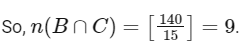
3. n (C ∩ A) represents the count of numbers that are divisible by both 2 and 5 (i.e., divisible by 10).
Finally, n(A ∩ B ∩ C) represents the count of numbers that are divisible by 2, 3, and 5 (i.e., divisible by 30).
Now we use the principle of inclusion and exclusion to compute the number of students who have opted for at least one subject. The principle states:
Substituting the values we calculated above:
Hence, the number of students who opted for at least one subject is 102. Therefore, the number of students who did not opt for any of the subjects is Total - n(A ∪ B ∪ C)
= 140 - 102 = 38




