Worksheet Solutions: Pronoun

Q1: Fill in the blanks with appropriate pronouns chosen from those given:
(i) I assure you that ________ shall help you.
(a) me
(b) min
(c) I
(d) none of these
Ans: (c)
Explanation: The subject pronoun I is correct because it is the subject of the verb phrase "shall help you."
(ii) Mohan met ________ when I was going to college.
(a) him
(b) her
(c) me
(d) mine
Ans: (c)
Explanation: The object pronoun me is correct because it is the object of the verb "met."
(iii) I saw Radha when ________ was in the room.
(a) she
(b) he
(c) her
(d) hers
Ans: (a)
Explanation: The subject pronoun she is needed because the clause describes who was in the room.
(iv) Mohan promised to help ________
(a) me
(b) mine
(c) my
(d) none of these
Ans: (a)
Explanation: The object pronoun me is correct as it receives the action "help."
(v) Everyone likes to have ________ own way.
(a) his
(b) him
(c) its
(d) their
Ans: (a)
Explanation: The distributive indefinite pronoun "everyone" is singular, so the singular possessive his is traditionally used here. (In modern, gender-neutral contexts "their" is often used.)
(vi) He has not done ________ homework.
(a) its
(b) his
(c) him
(d) none of these
Ans: (b)
Explanation: The possessive pronoun his correctly shows ownership of "homework."
(vii) The members are divided in ________ opinions.
(a) they
(b) them
(c) their
(d) there
Ans: (c)
Explanation: The possessive pronoun their is required to modify "opinions."
(viii) We like ________ house.
(a) our
(b) who
(c) us
(d) whom
Ans: (a)
Explanation: The possessive pronoun our correctly shows that the house belongs to "we."
(ix) The patient ________ was ill had died.
(a) that
(b) me
(c) whom
(d) we
Ans: (b)
Explanation: That is a relative pronoun used to introduce the clause "was ill" describing the patient, whereas the other options cannot do this.
(x) He is the boy________ I hate.
(a) who
(b) whose
(c) whom
(d) none of these
Ans: (c)
Explanation: The object pronoun whom is used because it is the object of the verb "hate."
Q2: Join together each of the following pairs of sentences by using a Relative Pronoun.
(i) The teacher taught me a lesson. I shall not forget it.
(ii) The boy has got the book. He wanted it badly.
(iii) This is a nice shirt. I bought it from the market.
(iv) He is a writer. His works are well-known.
(v) The spectators applauded Rosy. Rosy's singing was very melodious.
Ans:
(i) I shall not forget the lesson which the teacher taught me.
(ii) The boy has got the book which he wanted badly.
(iii) This is a nice shirt which I bought from the market.
(iv) He is a writer whose works are well known.
(v) The spectators applauded Rosy whose singing was very melodious.
Note: Each joined sentence uses an appropriate relative pronoun (which/whose) to connect the clauses and avoid repetition.
Q3: Classify the Pronouns in the following sentences:
(i) We enjoy ourselves very much.
(ii) The boy has shut himself in a room.
(iii) What made the boy laugh so loudly?
(iv) Everybody can come to the field.
(v) Each of the boys should be given one rupee.
Ans:
(i) We - Personal pronoun; ourselves - Reflexive pronoun.
(ii) himself - Reflexive pronoun.
(iii) what - Interrogative pronoun (used to ask a question).
(iv) everybody - Indefinite pronoun (refers to all people in general).
(v) each - Distributive pronoun (refers to individuals in a group).
Q4: Complete the following sentences using an appropriate relative pronoun.
(i) I will never forget the day _______ I first met you.
(a) when
(b) where
(c) why
Ans: (a)
Explanation: when is used to refer to a particular time or day.
(ii) He is somebody _________ I really can't stand.
(a) that
(b) whom
(c) Either could be used here
Ans: (c)
Explanation: Both that and whom are possible; whom is more formal as it is the object of "can't stand."
(iii) I have never met the people _________ live next door?
(a) who
(b) which
(c) whom
Ans: (a)
Explanation: who is used to refer to people as the subject of the relative clause "live next door."
(iv) What's the name of the guy _________ just walked in?
(a) who
(b) that
(c) Either could be used here
Ans: (a)
Explanation: who (or informally that) can be used to refer to a person who performed the action "just walked in."
(v) This is Mr. Mathews, _________ you met last year.
(a) who
(b) whom
(c) that
Ans: (b)
Explanation: whom is correct because it functions as the object of "met."
Q5: The following paragraph has not been edited. There is an error in each line. Write the error along with its correction in the space provided. Attempt any four.
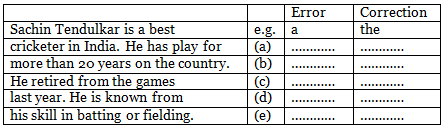
Ans:
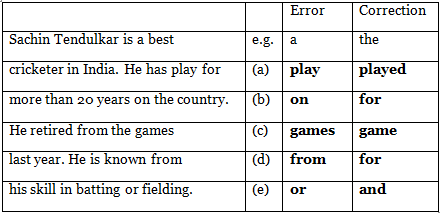
Q6: Choose the correct compound personal pronouns from the following sentences given below and match with the given answer:
(i) He himself tried to paint the whole office.
(ii) A dirty dog has scratched this car itself.
(iii) You dressed yourself very nicely.
(iv) He threw this ball himself at the window.
(v) You yourself must deliver all letters at right time.
(vi) Mr. Patel suggested and they do painting themselves.
(vii) They themselves were unable to help a poor man.
(viii) She has prepared herself for the dance competition.
(ix) Rupa, Vivan, Merry and I made the tasty lunch ourselves.
(x) We won the competition ourselves without any help.
Ans:
(i) He himself tried to paint the whole office.
(ii) A dirty dog has scratched this car itself.
(iii) You dressed yourself very nicely.
(iv) He threw this ball himself at the window.
(v) You yourself must deliver all letters at right time.
(vi) Mr. Patel suggested and they do painting themselves.
(vii) They themselves were unable to help a poor man.
(viii) She has prepared herself for the dance competition.
(ix) Rupa, Vivan, Merry and I made the tasty lunch ourselves.
(x) We won the competition ourselves without any help.
Explanation: The underlined words are compound personal pronouns (reflexive or emphatic). They are used correctly to refer back to the subject or to add emphasis. A few sentences need small article or preposition corrections in the main sentence (for example "the whole office," "on the window"); the pronouns themselves are correct as shown.
Q7: Join the sentences given below using who, whom, whose, which, as suggested.
(i) That's the cat. I photographed it.
(ii) He is the man. I sent the money to him.
(iii) I often go to Mumbai. Mumbai is the commercial capital of India.
(iv) Lencho prayed to God. His eyes see into our minds.
(v) This man cheated me. I trusted him.
(vi) The house sat on the crest of a low hill. It was the only one in the entire valley.
(vii) My mother is going to host a TV show on cooking. She cooks very well.
(viii) He's the accountant. He does my accounts.
(ix) These sportsperson are going to meet the President. Their performance has been excellent.
Ans:
(i) That's the cat I photographed.
(ii) He is the man to whom I sent the money.
(iii) I often go to Mumbai, which is the commercial capital of India.
(iv) Lencho prayed to God, whose eyes see into our minds.
(v) This man, whom I trusted, cheated me.
(vi) The house - the only one in the entire valley - sat on the crest of a low hill.
(vii) My mother, who cooks very well, is going to host a TV show on cooking.
(viii) He is the accountant who does my accounts.
(ix) These sportspeople, whose performance has been excellent, are going to meet the President.
Note: Each sentence uses the relative pronoun that correctly links the clauses: who/whom/whose/which as required by the role (subject, object or possessive).
Q8: Guess the difference in meanings of the underlined phrases.
(i)
(a) He promised to look into the matter_________
(b) He asked me to look for his lost book _________
(c) I shall look forward to your arrival _________
Ans:
(a) "Look into the matter" means to investigate or examine the problem.
(b) "Look for his lost book" means to search so as to find the book.
(c) "Look forward to your arrival" means to wait for something with pleasant expectation.
(ii)
(a) An epidemic of cholera broke out in the village _________
(b) The thieves broke into the locked house _________
(c) They broke up their friendship _________
Ans:
(a) "Broke out" means something (usually bad) began suddenly - an epidemic began in the village.
(b) "Broke into" means to enter a place by force or illegally - the thieves entered the locked house by force.
(c) "Broke up" means to end a relationship or friendship - they ended their friendship.
(iii)
(a) You must carry out your duty faithfully _________
(b) Please carry on with your work _________
(c) They carried off the trophy in the football matches _________
Ans:
(a) "Carry out" means to perform or complete a task - you must perform your duty faithfully.
(b) "Carry on" means to continue doing something - continue with your work.
(c) "Carry off" here means to win or succeed in obtaining - they won the trophy in the football matches.
Q9: Using a dictionary, find the difference between the following pairs of phrases. Make sentences of your own with each of them.
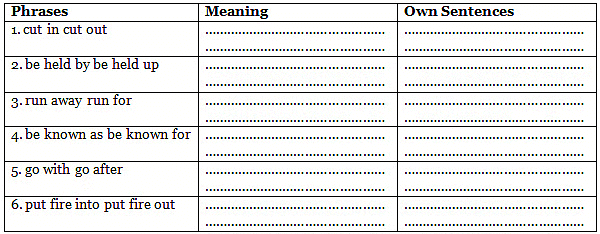
Ans:
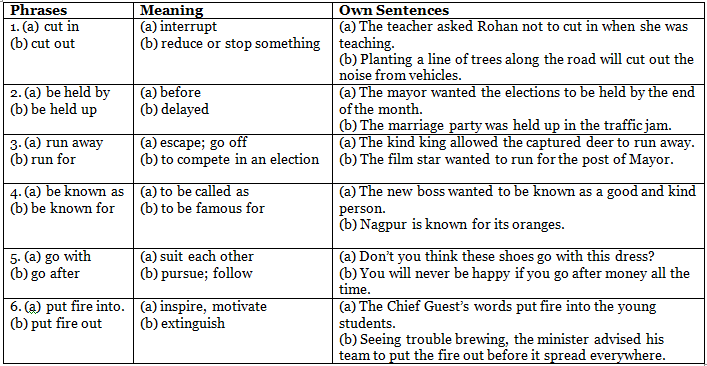
Q10: Correct the following sentences.
(i) We scored as many goals as them.
(ii) My friend is old as me.
(iii) It was him who began the quarrel.
Ans:
(i) Correct: We scored as many goals as they did.
(ii) Correct: My friend is as old as I am. (Or: My friend is as old as me - accepted in informal speech.)
(iii) Correct: It was he who began the quarrel. (In informal speech "him" is often used, but the formal subject pronoun is "he.")
FAQs on Worksheet Solutions: Pronoun
| 1. What are pronouns and their primary functions in a sentence? |  |
| 2. How do personal pronouns differ from possessive pronouns? | |
| 3. Can you provide examples of reflexive pronouns and their usage? | |
| 4. What is the role of demonstrative pronouns in sentences? | |
| 5. How can one identify and correct pronoun-antecedent agreement errors? | |




