Worksheet Solutions: Adverb | English Grammar Basic - Class 10 PDF Download
Q1: Insert the Adverbs in the brackets at the proper places in the following sentences:
(i) The elder brother supports the younger brother (always).
(ii) The officer has examined the case (already).
(iii) The boy comes in time (never).
(iv) He will pass the examination (certainly).
(v) The boy is clever to win the prize (enough).
Ans:
(i) The elder brother always supports the younger brother. (always)
(ii) The officer has already examined the case. (already)
(iii) The boy never comes in time. (never)
(iv) He will certainly pass the exam. (certainly)
(v) The boy is clever enough to win the prize. (enough)
Q2: Point out the difference of meaning in the following pairs of sentences:
(i) We found the road easy.
We found the road easily.
(ii) Only Chaoba helped me in difficulty.
Chaoba only helped me in difficulty.
(iii) He is too late for the class.
He too is late for the class.
(iv) He worked hard for the examination
He hardly worked for the examination.
(v) I came home directly.
I directly came home.
Ans: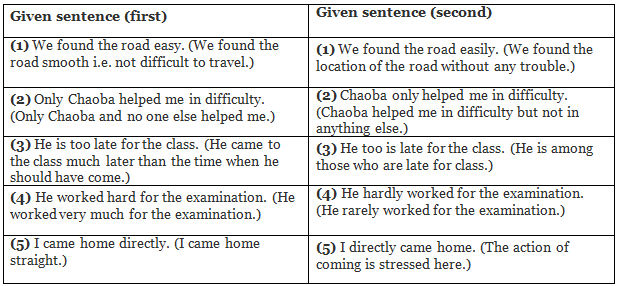
Q3: Underline Interrogative, Relative, Affirmative or Negative and Sentence Adverbs in the following sentences:
(i) Where did you go that day?
(ii) I know how much this book costs.
(iii) How often have you been to the zoo?
(iv) Certainly, he has not come to the meeting.
(v) Surprisingly, the man was found to be quite innocent.
Ans:
Q4: Correct the following sentences:
(i) Though Sheela works very hardly, she fails in the examination.
(ii) She felt much sorry for the delay.
(iii) I did not know to drive a car.
(iv) The horse runs very fastly.
(v) It is very good to be true.
Ans:
(i) Though Sheela works very hard, she fails in the examination.
(ii) She felt very sorry for the delay.
(iii) I did not know how to drive a car.
(iv) The horse runs very fast.
(v) It is too good to be true.
|
20 videos|110 docs|18 tests
|

|
4.62/5 Rating |

|
Dec 22, 2024 Last updated |

|
Explore Courses for Class 10 exam
|

|
study material
,past year papers
,Extra Questions
,Exam
,Worksheet Solutions: Adverb | English Grammar Basic - Class 10
,video lectures
,shortcuts and tricks
,mock tests for examination
,Worksheet Solutions: Adverb | English Grammar Basic - Class 10
,Free
,Sample Paper
,Objective type Questions
,MCQs
,ppt
,Semester Notes
,Previous Year Questions with Solutions
,Worksheet Solutions: Adverb | English Grammar Basic - Class 10
,practice quizzes
,Viva Questions
,Summary
,Important questions
;




Worksheet Solutions: Adverb Free PDF Download
Importance of Worksheet Solutions: Adverb
Worksheet Solutions: Adverb Notes
Worksheet Solutions: Adverb Class 10 Questions
Study Worksheet Solutions: Adverb on the App
|
© EduRev
|
Education Revolution
|


|


