Chapter Notes: Comparing Quantities


Recalling Ratios and Percentages
Ratio: A ratio is a way of comparing two or more quantities. For example, 2 : 3 is a ratio, which means for every two parts of one quantity there are three parts of the other.
Percentage: A percentage is a number or ratio expressed as a fraction of 100. It shows how many parts out of 100 a quantity represents.
Ratios allow us to compare quantities directly. For instance, if there are 5 green marbles and 2 pink marbles, the ratio of green marbles to pink marbles is 5 : 2. Percentages show how large a part is compared to the whole, and are very useful for discounts, taxes, marks, and many everyday comparisons.
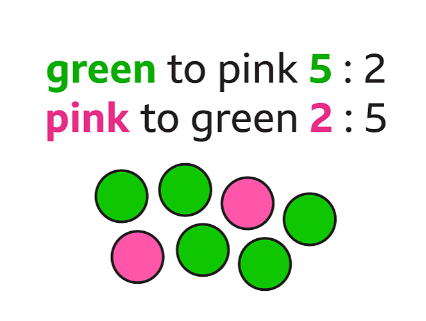 Ratios
Example - Basket of Fruits
A basket contains 20 apples and 5 oranges.
1. Ratio of number of oranges to number of apples
Express the ratio as: \(5 : 20\)
As a fraction this is:
\(\dfrac{5}{20} = \dfrac{1}{4}\)
2. Percentage of apples
Percentage of apples is calculated by dividing the number of apples by the total number of fruits and multiplying by 100.
\(\text{Percentage of apples} = \dfrac{20}{25} \times 100\)
\(= 80\%\)
Worked Example: Picnic Planning (Class VIII)
A picnic is being planned in a school for class VIII. Girls are 60% of the total number of students and are 18 in number. The picnic site is 55 km from the school and the transport company is charging at the rate of ₹ 12 per km. The total cost of refreshments will be ₹ 4280.

1. The ratio of the number of girls to the number of boys in the class?
Sol: Let the total number of students be \(n\).
Girls are 60% of the class, so \( \dfrac{60}{100}\times n = 18.\)
From this, \(n = 30.\)
Number of boys \(= 30 - 18 = 12.\)
The ratio of girls to boys is
\(\dfrac{18}{12} = \dfrac{3}{2} \; \text{or} \; 3:2.\)
2. The cost per head if two teachers are also going with the class?
Sol:
Transport charge \(= \text{distance} \times \text{rate per km}.\)
\( = 55 \times 12 \)
\( = 660 + 660 = 1320\)
Total expenses \(= \text{Transport charge} + \text{Refreshment charge}.\)
\( = 1320 + 4280 \)
\( = 5600\)
Total number of persons \(= 18 \text{ girls} + 12 \text{ boys} + 2 \text{ teachers} = 32.\)
Cost per head \(= \dfrac{5600}{32}\)
\( = ₹175\)
3. If their first stop is at a place 22 km from the school, what percent of the total distance of 55 km is this? What percent of the distance is left to be covered?
Sol: Percentage of distance covered \(= \dfrac{22}{55} \times 100\)
\( = 40\%.\)
Percentage left to be covered \(= 100\% - 40\% = 60\%.\)
Finding Discounts
A discount is the reduction given on the marked price (list price) of an article.
Discount = Marked Price - Sale Price

Example: The list price of a frock is ₹220. A discount of 20% is announced on sale. What is the amount of discount on it and its sale price?
Sol: Marked Price \(= ₹220.\)
Discount \(= 20\% \text{ of } 220 = \dfrac{20}{100}\times 220\)
\( = ₹44.\)
Sale Price \(= 220 - 44\)
\( = ₹176.\)
Estimation in Percentages
If a percentage value is given in decimal form, we usually round it to the nearest integer for easy interpretation unless instructed otherwise. For example, 50.69% rounded to the nearest whole percent is 51%.
Sales Tax / Value Added Tax / Goods and Services Tax
When you buy a good or service, the seller may add a tax to the marked price. This extra money paid to the seller is then passed to the government. Different names such as sales tax, VAT or GST are used in different places and systems, but the basic idea is the same: a percentage of the price is added as tax.
Total Bill = Actual Amount + Tax Amount



Example: The cost of a pair of roller skates at a shop was ₹450. The sales tax charged was 5%. Find the bill amount.
Sol: Tax amount \(= \dfrac{5}{100}\times 450\)
\( = ₹22.50.\)
Total bill \(= 450 + 22.50\)
\( = ₹472.50.\)
Simple Interest and Compound Interest
Simple Interest
Simple interest is interest computed on the principal (original amount) only. It does not change with time other than being proportional to the number of years.
Formula for Simple Interest:
\( \text{SI} = \dfrac{P \times R \times T}{100} \)
- P = Principal (original amount)
- R = Rate of interest per annum (in %)
- T = Time (in years)
Example: A sum of ₹10,000 is borrowed at a rate of interest 15% per annum for 2 years. Find the simple interest on this sum and the amount to be paid at the end of 2 years.
Sol:
Interest for one year \(= \dfrac{10000 \times 15}{100}\)
\( = ₹1,500.\)
Interest for two years \(= 1500 \times 2\)
\( = ₹3,000.\)
Amount to be paid at the end of 2 years \(= \text{Principal} + \text{Interest}\)
\( = 10000 + 3000 = ₹13,000.\)

Calculating Compound Interest
Compound interest is interest earned on the principal and on the interest already accumulated. It is often called "interest on interest".
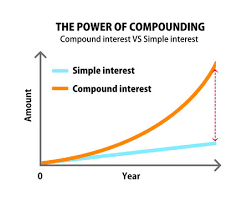
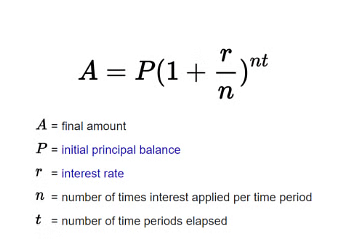
Compound interest formula (amount after t years)
\( A = P\left(1 + \dfrac{R}{100}\right)^t \)
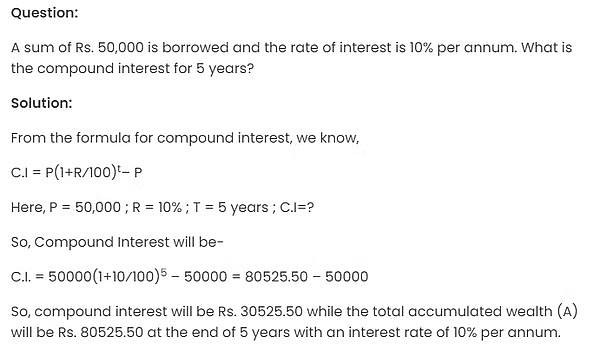
Compound Interest (CI) is the difference between the final amount and the initial principal.
\( \text{CI} = A - P \)
Deducing the Compound Interest Formula
We derive the formula by observing the accumulation year by year. Let the rate per year be \(r\%\), and write \(i = \dfrac{r}{100}\).
- Year 1: Interest on principal \(P\) is \(Pi\). Final value after year 1 is \(P + Pi = P(1+i)\).
- Year 2: Interest is now earned on \(P(1+i)\). So interest for the second year is \(P(1+i)\times i\). Final value after year 2 is \(P(1+i) + P(1+i)\times i = P(1+i)^2\).
- After t years: Final value (amount) is \(P(1+i)^t\). Substituting \(i=\dfrac{R}{100}\) gives \(A = P\left(1 + \dfrac{R}{100}\right)^t\). Therefore, \( \text{CI} = P\left(1 + \dfrac{R}{100}\right)^t - P.\)
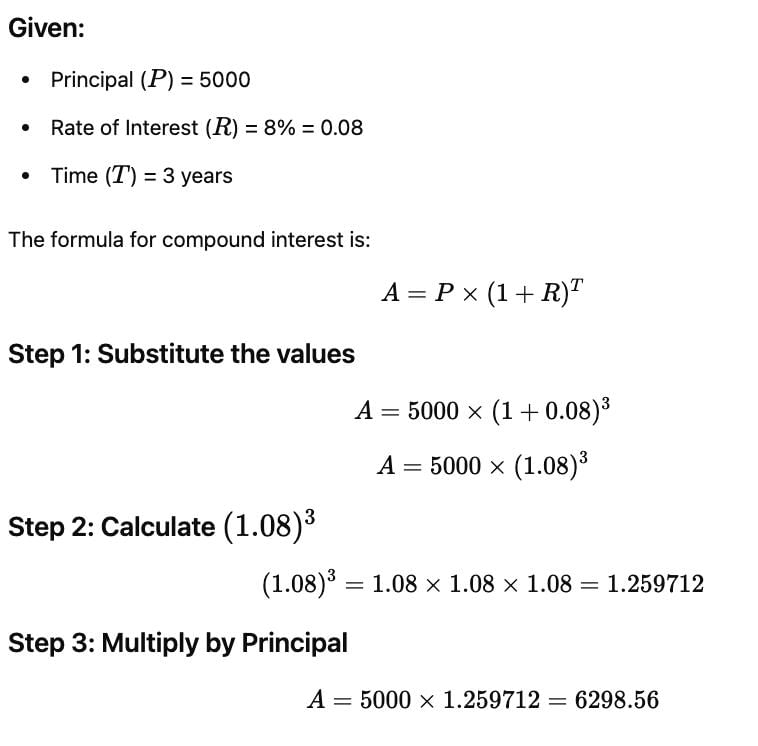
Try yourself: A sum of 5000 is invested at a compound interest rate of 8% per annum. Calculate the total amount after 3 years.
Applications of Compound Interest Formula
Compound interest appears in many growth and decay situations where change compounds over time. Important applications include:
- Population growth or decline (when growth rate compounds annually or periodically).
- Growth of bacteria or other biological populations under ideal conditions.
- Increase in the market value of an asset.
- Depreciation (reduction) in value of an asset when it reduces by a percentage each year.
Example: The value of a piece of art was $5,000 in the year 2010. It increased in value at a rate of 4% per year. Find the value of the art at the end of the year 2015.
Sol: We use the compound interest formula \(A = P\left(1 + \dfrac{r}{100}\right)^t.\)
Principal \(P = 5000.\)
Rate \(r = 4\%.\)
Time \(t = 2015 - 2010 = 5\) years.
\( A = 5000\left(1 + \dfrac{4}{100}\right)^5 \)
\( = 5000(1.04)^5 \)
\( \approx 5000 \times 1.2167 \)
\( \approx 6083.50.\)
So the approximate value at the end of 2015 is $6,083.50.
FAQs on Chapter Notes: Comparing Quantities
| 1. What are ratios and how are they used in comparing quantities? |  |
| 2. How can I calculate a discount on a product? | |
| 3. What is the difference between sales tax and value-added tax (VAT)? | |
| 4. How is compound interest calculated? | |
| 5. What are the applications of the compound interest formula? | |