Chapter Notes: Exponents and Powers


Introduction
Exponents and powers are fundamental concepts in mathematics that simplify the expression of large numbers and complex calculations. An exponent indicates how many times a number, called the base, is multiplied by itself.

- Example: In the expression 23 (read as "2 raised to the power of 3").
- Here, 2 is the base, and 3 is the exponent.
- This expression means that 2 is multiplied by itself three times:
- i.e, 2 × 2 × 2 = 8
Another Example,
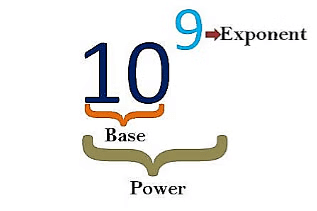
- Here 10 is the base and 9 is the exponent and this complete number is the power.
- The exponent could be positive or negative.
- This tells us that the number 10 will be multiplied 9 times,
- like, 10 × 10 × 10 × 10 × 10 × 10 × 10 × 10 × 10
Power with Negative Exponents
The exponents could be negative also and we can convert them in positive by the following method.
100-3 = 11003
This shows that for any non-zero negative integers a:
a-m = 1am where m is the positive integer and am is the multiplicative inverse of a-m.
Example: Simplify the following
(1) 6-2
(2) 4-5
(3) y-7
Ans:
1. 6-2 = 162 = 136
2. 4-5 = 145 = 11024
3. y-7 = 1y7
Law of Exponents
If we have a and b as the base and m and n as the exponents, then 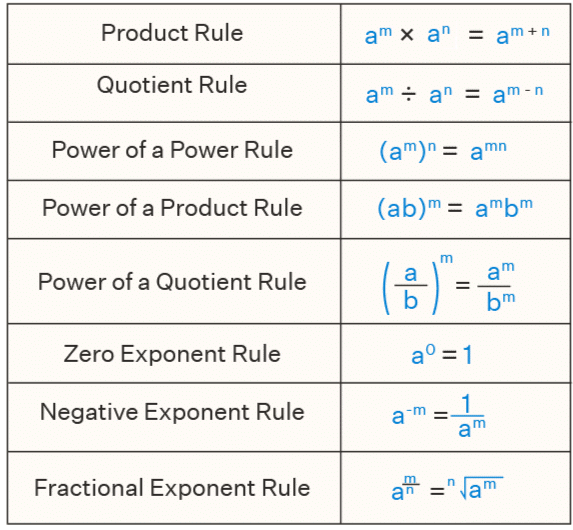
Some Examples
Problem: Simplify the expression .
Solution:
Identify the Base: In this expression, the base is .
Apply the Rule of Exponents: When multiplying two expressions with the same base, we add the exponents. The rule is:
+ n Here, and
Add the Exponents:
+ 2 = 3 6 Calculate 36:
- Calculating step by step:
So,
3 6 =729Final Answer:
Use of Exponents to Express Small Numbers in Standard Form
Sometimes, we need to write the numbers in very small or large form, and we can use the exponents to represent the numbers in small numbers.
1. Standard form to write the natural numbers like xyz000000......
Step 1: First of all count the number of digits from left leaving only the first digit.
Step 2: To write it in exponent or standard form, write down the first digit.
Step 3: If there are more digits in the number then put a decimal after the first digit and then write down the other digits until the zero comes. And if there are no digits after the first digit then skip this step.
Step 4: Now place a multiplication sign and then write down the counted digits in the first step as the exponent to the base number 10.
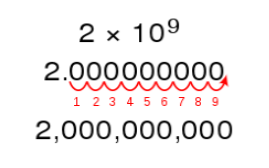
Example: Express 1730000000000 in exponent form.
Sol: In standard form, the number 1730000000000 will be written as 1.73 x 10¹².
2. Standard form to write decimal numbers like 0.00000.....xyz.
Step 1: First of all count the number of digits from the decimal point to the last digit.
Step 2: If there is only one digit after the zeros then simply write down that digit. Place a multiplication sign and write down the counted digits in step-1 with a negative sign as the exponent to base number 10.
Step 3: If there are two or more non-zero digits at the end of the number. Then, write down the digits followed by a decimal point after the first digit and the other non-zero digits.
Step 4: Now calculate the number of digits in the first step and minus the number of digits appearing after the decimal point.
Step 5: Place a multiplication sign and write down the counted digits in step-4 with a negative sign as an exponent to base number 10.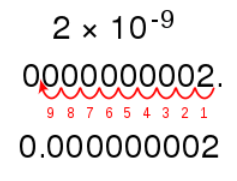
Example: Express 0.000000000000073 in exponent form.
Sol: In standard form, the number will be written as 7.3 x 10⁻¹⁴.
Comparing Very Large and Very Small Numbers
To compare the very large or very small numbers we need to make their exponents the same. When their exponents are the same then we can compare the numbers and check which number is large or small.
To compare the diameters of the Sun and the Earth, we can use their exponential forms.
- The diameter of the Sun is 1.4×10⁹meters.
- The diameter of the Earth is 1.2756×10⁷meters.
To compare these, divide the diameter of the Sun by the diameter of the Earth:
Divide the coefficients and subtract the exponents:
9 - 7 ) Calculating the coefficient:
1
So:1.1×10²≈110
Thus, the diameter of the Sun is approximately 110 times the diameter of the Earth.
Example: Compare the two numbers 4.56 × 10⁸ and 392 × 107.
Sol:
Let's compare the two numbers 4.56×10⁸ and 392×107by following the same steps.
First, express both numbers in scientific notation.
The second number can be rewritten as:
392×1079
Now, compare by dividing 4.56×10⁸ and 392×109:
Divide the coefficients and subtract the exponents:
Now, calculate the coefficient:
≈1.16
So, the result is:10(-1) =0.116
Thus, 4.56×10⁸ is smaller by about 10 times.
Points to Remember
- Numbers with negative exponents obey the following laws of exponents:
(a) am × an = am+n
(b) am ÷ an = am-n
(c) (am)n = amn
(d) am × bm = (ab)m
(e) a0 = 1
(f) am / bm = (a / b)m
- Very small numbers can be expressed in standard form using negative exponents.
FAQs on Chapter Notes: Exponents and Powers
| 1. What are negative exponents and how do they work? |  |
| 2. How do you apply the laws of exponents when multiplying numbers? | |
| 3. How can exponents be used to express very small numbers in standard form? | |
| 4. What is the difference between very large and very small numbers when using exponents? | |
| 5. What are some key points to remember about exponents and powers? | |