Number Names

Introduction
A numerical name serves as a means of representing numbers through words. In primary school, students receive instruction on expressing numbers verbally. This forms the foundational knowledge in mathematics. Memorizing the names of numbers is crucial for all students, aiding them in correct spelling. Children should initially focus on learning the names of numbers from 1 to 10, gradually progressing to numbers 11 to 20 and beyond. It is essential for them to be familiar with the names of all counting numbers. Let's delve into the process of reading and writing numbers from 1 to 50.
Number Name 1 to 50 in English
The table below provides the names corresponding to numbers 1 through 50. Students can familiarize themselves with these numbers and their respective names, engaging in practice questions related to them.
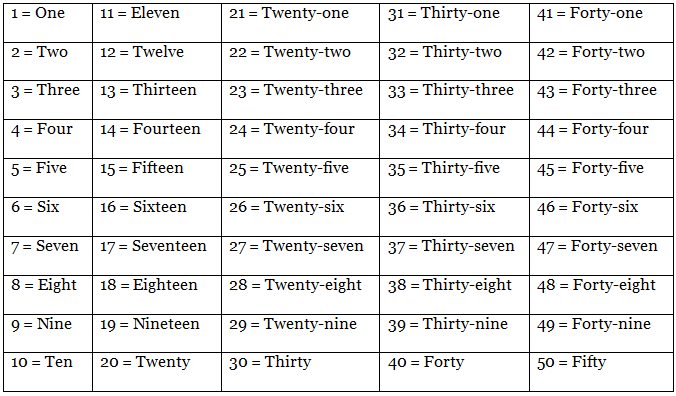
Rules to Write Numbers from One to Fifty (1 to 50) Spelling
When spelling out the digits from one to fifty (1 to 50), certain guidelines must be adhered to.
Rule 1: Understanding place values - The significance of the digits in a number is determined by their respective positions. The first four place values, contingent on the placement of the number 1, can be articulated as follows:
- 1 - one's place
- 10 - tens place
- 100 - hundreds
- 1000 - thousands place
Rule 2: Utilize the number names and spellings provided in the one to fifty chart for numbers such as 1 to 20, 30, 40, 50, 100, and 1000. For instance, the name for the number 5 is "five," for 30 it is "thirty," and so forth.
Rule 3: When expressing the number names of multiples of 100 and thousand, write the number name of the digit in the hundreds place followed by the term "hundred." For example, the name for the number 400 is "four hundred."
Rule 4: When creating the number names for other two or three-digit numbers, use the expanded form. For numbers between eleven and nineteen, treat the ones and tens places as a single unit. Spell out the addends and combine them with their respective names. For example, 54 can be expressed as 50 + 4, and its written form is "fifty-four."
Strategy To Grasp Number Names Till 50
Number names for digits one through ten: There is no specific technique; simply commit the numerals to memory.
Number names from eleven to twenty: Eleven and twelve are exceptions. From thirteen to nineteen, a consistent pattern emerges-use the format number + teen. Thirteen, fourteen, fifteen, sixteen, seventeen, eighteen, nineteen, and twenty deviate from this pattern.
Number names from twenty-one to thirty: A consistent pattern is observed, expressed as twenty + one, twenty + two, twenty + three, and so on. Thirty follows a different pattern.
Number names from thirty-one to forty: Utilize the format thirty + one, thirty + two, and so forth. Forty follows a distinct pattern.
Number names from forty-one to fifty: Follow the format forty + one, forty + two, and so on, with fifty being the exception.
Importance of Names of Numbers
It is crucial for every student to be acquainted with the names of numbers. This foundational knowledge in mathematics aids students in accurate spelling and facilitates easy note-taking during classes when teachers articulate such numerical terms.
Numbers hold a pivotal position in mathematics, serving as the fundamental elements for various mathematical and arithmetic operations. This significance extends beyond primary classes, influencing higher-level courses as well.
Examples
Example1: Solve and put down the given expression in words. 320 + 97 - (120 + 260)
Ans: Now, we have to simplify the expression: 320 + 97 - (120 + 260)
First, simplify the expression inside the bracket
320 + 97 - (120 + 260) = 320 + 97 - 380
320 + 97 - (120 + 260) = 37 = Thirty-seven.
Hence, the simplified expression of 320 + 97 - (120 + 260) is 37.
Thus, the number 37 in words is thirty-seven.
Example 2: Find the answer of (one hundred and twenty-one) - (seventy-eight).
Ans: In the form of numbers, one hundred and twenty-one is expressed as 121, and seventy-eight is expressed as 78.
The given problem is (one hundred and twenty-one) - (seventy-eight).
= (121 - 78)
= 43
On utilising the number name chart from 1 to 50, 43 can be expressed as follows.
43 = 40 + 3 = Forty + Three = Forty Three
FAQs on Number Names
| 1. How do I write number names from 1 to 10 correctly in words? |  |
| 2. What's the difference between writing a number and writing its name? | |
| 3. How do I teach a Class 1 child to remember number names easily? | |
| 4. Why is learning number names important for mathematics? | |
| 5. What are common mistakes kids make when writing number names in words? | |


