JEE Advanced Previous Year Questions (2018 - 2025): Gravitation


2024
Q1: A particle of mass m is under the influence of the gravitational field of a body of mass M (≫ m). The particle is moving in a circular orbit of radius r₀ with time period T₀ around the mass M. Then, the particle is subjected to an additional central force, corresponding to the potential energy Vc(r) = mα/r³, where α is a positive constant of suitable dimensions and r is the distance from the center of the orbit. If the particle moves in the same circular orbit of radius r₀ in the combined gravitational potential due to M and Vc(r), but with a new time period T₁, then (T₁² - T₀²) / T₁² is given by [G is the gravitational constant.] [ JEE Advanced 2024 Paper 2]
(a) 3αGM r02
(b) α2GM r02
(c) αGM r02
(d) 2αGM r02
Ans: (a)
Solution:
F1 = GMmr02
F2 = GMmr02 - 3mαr04
ω12ω02 = F2F1 = GMr02 - 3αr04GMr02
T12T02 = 1 - 3αGMr02
T12 - T02T12 = 3αGMr02
2023
Q1: Two satellites Pand Qare moving in different circular orbits around the Earth (radius R). The heights of Pand Qfrom the Earth surface are ℎPand ℎQ, respectively, where ℎP = R/3. The accelerations of Pand Qdue to Earth's gravity are gPand gQ, respectively. If gP/gQ = 36/25, what is the value of ℎQ?
[JEE Advanced 2023 Paper 1]
(a) 3R /5
(b) R / 6
(c) 6R / 5
(d) 5R/5
Ans: (a)
Solution: The formula to calculate the acceleration due to gravity at a height ( h ) from the surface of the Earth is expressed as :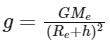
To find the ratio of gravitational acceleration at two different heights ( hP ) and ( hQ ) above the Earth's surface, use the formula for each and form a ratio :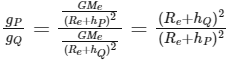
Given ℎP=Re/3, the ratio simplifies to: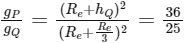
Solving for ℎQ in terms of Re yields  .
.
2022
Q1: Two spherical stars Aand B have densities ρAand ρB, respectively. Aand Bhave the same radius, and their masses MAand MBare related by MB = 2MA. Due to an interaction process, star Aloses some of its mass, so that its radius is halved, while its spherical shape is retained, and its density remains ρA. The entire mass lost by Ais deposited as a thick spherical shell on Bwith the density of the shell being ρA. If vAand vBare the escape velocities from Aand Bafter the interaction process, the ratio 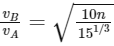 . The value of nis __________ . [JEE Advanced 2022 Paper 1]
Ans: 2.2 to 2.4
Solution: 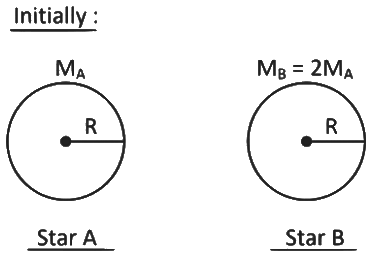
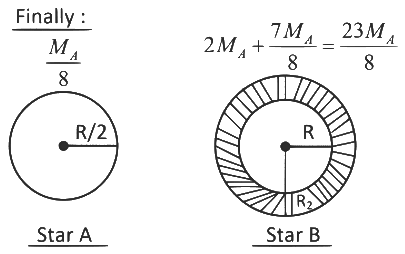
Due to an interaction process, star A losses some of it's mass and radius becomes R/2. Let new mass of star A is M'A. Here in both cases density of star A remains same ρA.
Initially 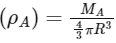
Finally 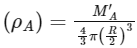
Density remains same,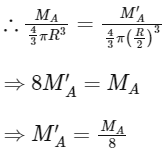
So, Lost mass by
This lost mass 7MA / 8is attached on the star B and density of the attached mass stay ρA. So new radius of star B is R2.
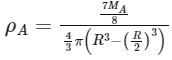
Density of the removed part from star A is,
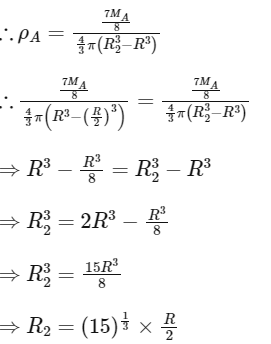
Density of the added part in star B stay's same as ρA,
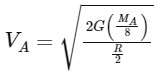
Escape velocity from star A after interaction process,
And escape velocity from star B after interaction process,
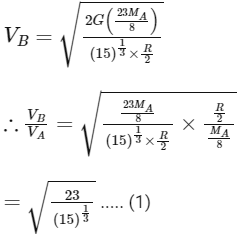
Given,
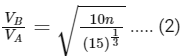
Comparing equation (1) and (2), we get,
10n = 23
⇒ n = 2.3
2021
Q1: The distance between two stars of masses 3MS and 6MS is 9R. Here R is the mean distance between the centers of the Earth and the Sun, and MS is the mass of the Sun. The two stars orbit around their common center of mass in circular orbits with period nT, where T is the period of Earth's revolution around the Sun. The value of n is __________. [JEE Advanced 2021 Paper 2]
Ans:9
Solution: For earth-sun system,
For binary system
Using Eqs. (i) and (ii), we get
T = 9T0
So, n = 9
2019
Q1: Consider a spherical gaseous cloud of mass density ρ(r) in free space where r is the radial distance from its center. The gaseous cloud is made of particles of equal mass m moving in circular orbits about the common center with the same kinetic energy K. The force acting on the particles is their mutual gravitational force. If ρ(r) is constant in time, the particle number density n(r) = ρ(r)/m is [G is universal gravitational constant]
(a)

(b)

(c)

(d)
 [JEE Advanced 2019 Paper 1]
Ans: (d)
Solution: 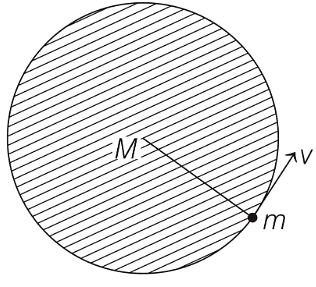
Gravitational force = Centripetal force of the earth
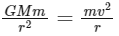 (∵ M = total mass from 0 to r)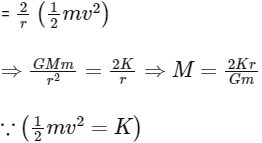
Differentiate on both sides, we get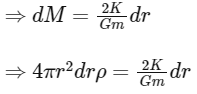
(∵ volume = mass × density)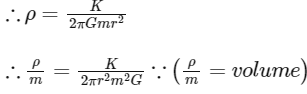
2018
Q1: A planet of mass M, has two natural satellites with masses m1and m2.The radii of their circular orbits are R1and R2respectively, Ignore the gravitational force between the satellites. Define v1,L1,K1and T1to be , respectively, the orbital speed, angular momentum, kinetic energy and time period of revolution of satellite 1; and v2,L2,K2,and T2to be the corresponding quantities of satellite 2.Given m1/m2 = 2and R1/R2 = 1/4,match the ratios in List-Ito the numbers in List- II.
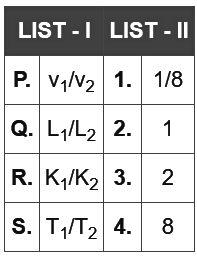
(a) P → 4, Q → 2, R → 1, S → 3
(b) P → 3, Q → 2, R → 4, S → 1
(c) P → 2, Q → 3, R → 1, S → 4
(d) P → 2, Q → 3, R → 4, S → 1 [JEE Advanced 2018 Paper 2]
Ans: (b)
Solution: Given m1/m2 = 2 and R1/R2 = 1/4
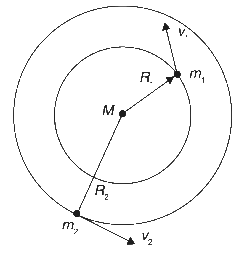 Now,
Now,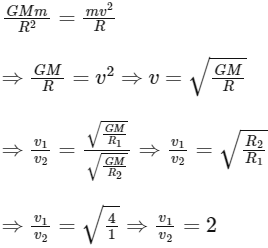
Thus, the correct mapping is P → 3.
Now, L = mvR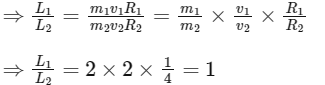
Thus, the correct mapping is Q → 2.
Now,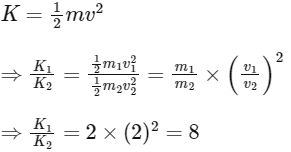
Thus, the correct mapping is R → R.
Now,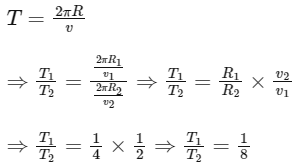
Thus, the correct mapping is S → 1.
Therefore, option (B) is correct.
FAQs on JEE Advanced Previous Year Questions (2018 - 2025): Gravitation
| 1. What are the most important gravitation formulas I need for JEE Advanced? |  |
| 2. How do I solve JEE Advanced gravitation problems involving orbital velocity and satellite motion? | |
| 3. Why do gravitational potential and gravitational field strength have different signs or directions in JEE problems? | |
| 4. What's the difference between escape velocity and orbital velocity that keeps appearing in JEE papers? | |
| 5. How do I handle gravitational potential energy problems in JEE when dealing with multiple masses or variable distances? | |




