JEE Advanced Previous Year Questions (2018 - 2025): Limits, Continuity and Differentiability


2024
Q1: Let k ∈ ℝ. If then the value of k is:
(a) 1
(b) 2
(c) 3
(d) 4 [JEE Advanced 2024 Paper 2]
Ans: (b)
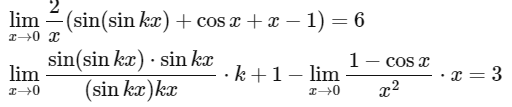
k + 1 = 3 ⇒ k = 2
Q2: Let f : ℝ → ℝ be a function defined by
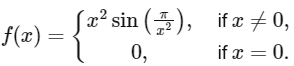
Then which of the following statements is TRUE?
(a) f(x) = 0 has infinitely many solutions in the interval [1/10¹⁰, ∞).
(b) f(x) = 0 has no solutions in the interval [1/π, ∞).
(c) The set of solutions of f(x) = 0 in the interval (0, 1/10¹⁰) is finite.
(d) f(x) = 0 has more than 25 solutions in the interval (1/π², 1/π). [JEE Advanced 2024 Paper 2]
Ans: (d)
Option-A: f(x) = x² sin(π/x²)
f(x) = 0 ⇒ sin(π/x²) = 0 ⇒ π/x² = nπ, n ∈ ℕ
x² = 1/n ⇒ x = 1/√n
1/√n ≥ 1/10¹⁰ ⇒ √n ≥ 10¹⁰ ⇒ n ≤ 10²⁰, finite number of solutions.
Option-B: x = 1/√n
1/√n > 1/π ⇒ x > √n ⇒ n < π², Number of solutions is 9.
Option-C: x = 1/√n
1/√n < 1/10¹⁰ ⇒ √n > 10¹⁰ ⇒ n > 10²⁰, infinite number of solutions.
Option-D: 1/π² < 1/√n < 1/π ⇒ √n ∈ (π, π²) ⇒ n ∈ (π², π⁴), Definitely more than 25 solutions.
Q3: Let f : ℝ → ℝ and g : ℝ → ℝ be functions defined by

Let a, b, c, d ∈ ℝ. Define the function h : ℝ → ℝ by
h(x) = a f(x) + b (g(x) + g(1/2 - x)) + c(x - g(x)) + d g(x), x ∈ ℝ.
Match each entry in List-I to the correct entry in List-II.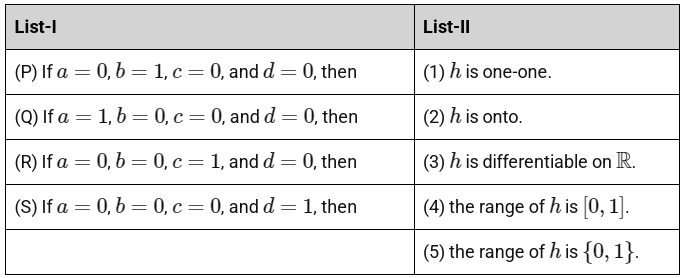
The correct option is:
(a) (P) → (4), (Q) → (3), (R) → (1), (S) → (2)
(b) (P) → (5), (Q) → (2), (R) → (4), (S) → (3)
(c) (P) → (5), (Q) → (3), (R) → (2), (S) → (4)
(d) (P) → (4), (Q) → (2), (R) → (1), (S) → (3) [JEE Advanced 2024 Paper 1 ]
Ans: (c)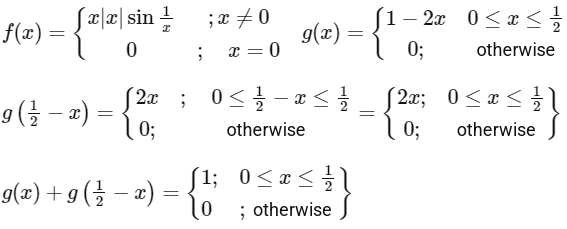
(P) Now a = 0, b = 1, c = 0, d = 0.
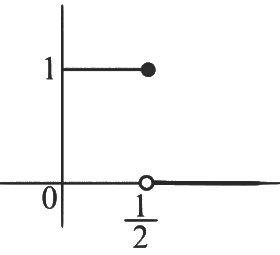 Hence Range of h(x) is {0, 1}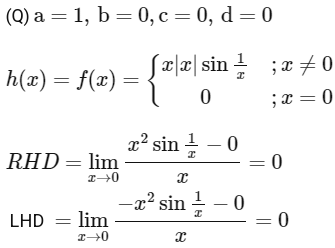
Hence h(x) 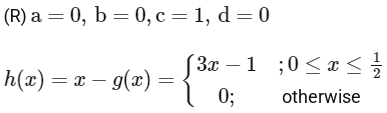
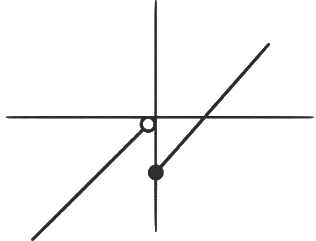
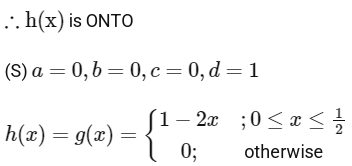
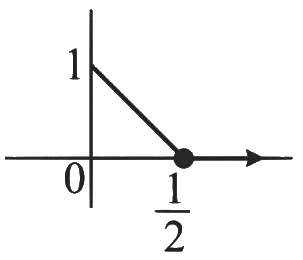 Range of h(x) is [0, 1]
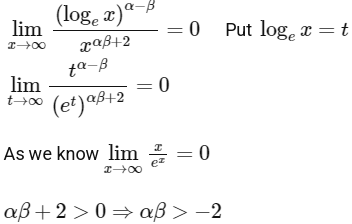
Q4: Let S be the set of all (α, β) ∈ ℝ × ℝ such that

Then which of the following is (are) correct?
(a) (-1, 3) ∈ S
(b) (-1, 1) ∈ S
(c) (1, -1) ∈ S
(d) (1, -2) ∈ S [JEE Advanced 2024 Paper 2]
Ans: (b), (c)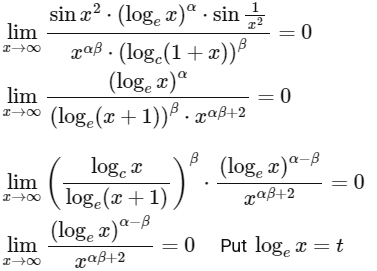
2023
Q1: Let f : (0, 1)→ R be the function defined as
 , where [x] denotes the greatest integer less than or equal to x. Then which of the following statements is(are) true?(a) The function f is discontinuous exactly at one point in (0, 1)
(b) There is exactly one point in (0, 1) at which the function f is continuous but NOT differentiable
(c) The function f is NOT differentiable at more than three points in (0, 1)
(d) The minimum value of the function f is -1/512 [JEE Advanced 2023 Paper 2]
Ans: (a) & (b)
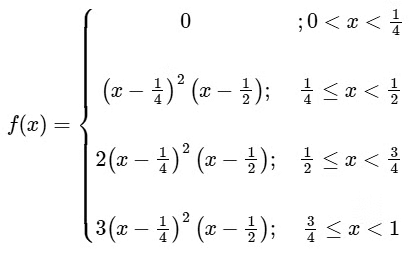
f (x) is discontinuous at x = 3/4 only
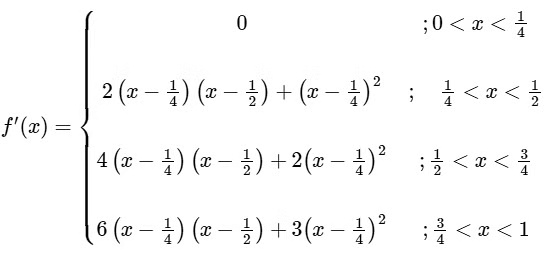
f (x) is non-differentiable at x = 1/2 and 3/4
Minimum values of f(x) occur at x = 5/12 whose value is -1/432
2022
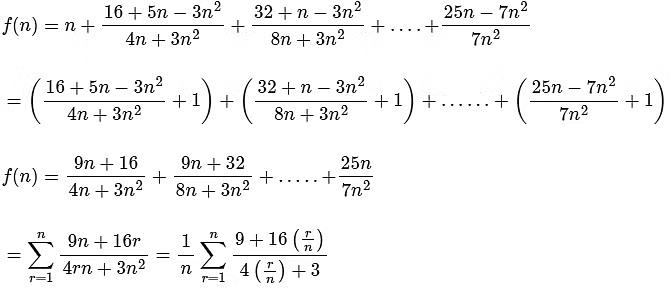
Q1: For positive integer n, define

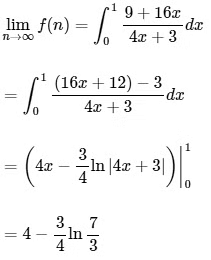
Then, the value of  is equal to :
(a) 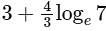
(b) 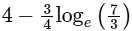
(c) 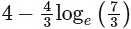
(d) 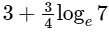 [JEE Advanced 2022 Paper 2]
Ans: (b)
Q2: If 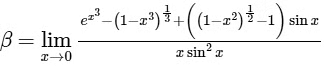 , then the value of 6β is ___________. [JEE Advanced 2022 Paper 2]
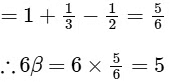
Ans: 5
Given,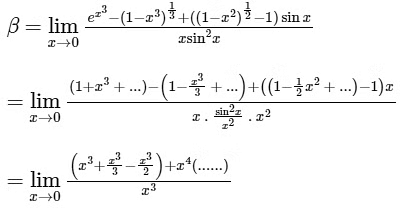
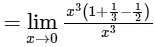 [Neglecting higher power of x]
Q3: Let α be a positive real number. Let  be the functions defined by
Then the value of 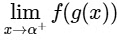 is_______. [JEE Advanced 2022 Paper 1]
Ans: 0.49 to 0.51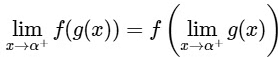 [As f(x) is continuous function so we can write this]
Now,
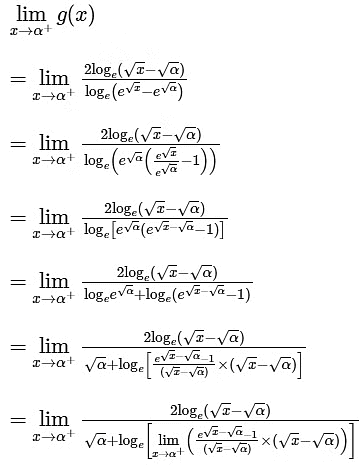
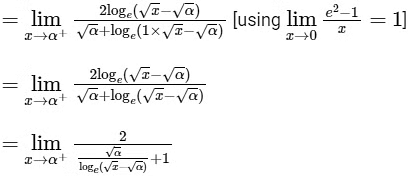
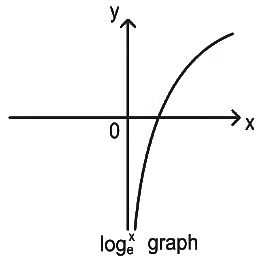
From graph you can see 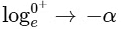
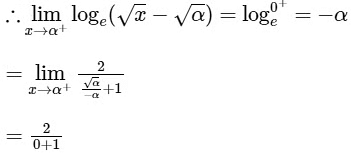
= 2

2021
Q1: Let f : R → R be defined by
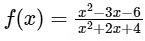 Then which of the following statements is (are) TRUE?
(a) f is decreasing in the interval (-2, -1)
(b) f is increasing in the interval (1, 2)
(c) f is onto
(d) Range of f is [-3/2, 2] [JEE Advanced 2021 Paper 1]
Ans: (a) & (b)
Given,
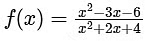 ---- (i)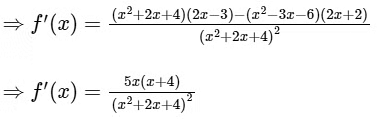

Sign scheme for f'(x)
Here, f is decreasing in the interval (-2, -1) and f is increasing in the interval (1, 2).
Now,  and
and 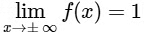
∴ Range = 
Hence, f(x) is into.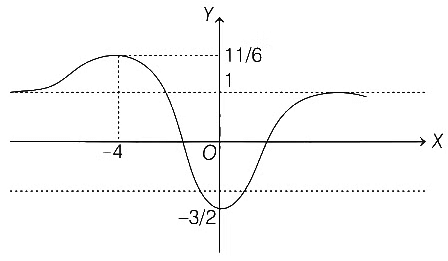 f(x) has local maxima at x = -4
and local minima at x = 0.
2020
Q1: Let f : R → R and g : R → R be functions satisfying f(x + y) = f(x) + f(y) + f(x)f(y)
and f(x) = xg(x) for all x, y ∈ R.
If 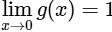 , then which of the following statements is/are TRUE?
(a) f is differentiable at every x∈R
(b) If g(0) = 1, then g is differentiable at every x ∈ R
(c) The derivative f'(1) is equal to 1
(d) The derivative f'(0) is equal to 1 [JEE Advanced 2020 Paper 2]
Ans: (a), (b) & (d)
The given function f : R → R is satisfying as
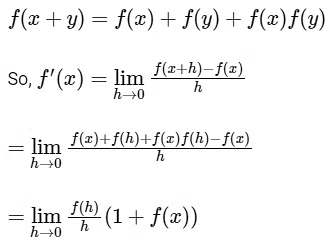
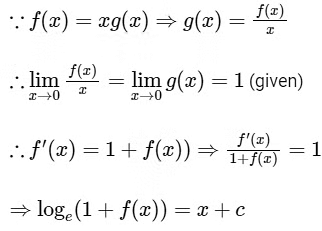
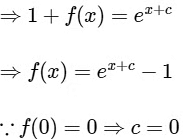
Therefore, f(x) = ex - 1 is differentiable at every x ∈ R.
and  Now,
Now, 
LHD (at x = 0) of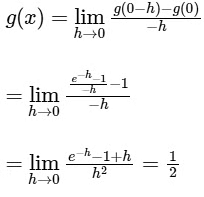
and, RHD (at x = 0) of
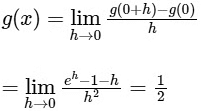
So, if g(0) = 1, then g is differentiable at every x ∈ R.
Q2: Let the function f : R → R be defined by f(x) = x3 - x2 + (x - 1)sin x and let g : R → R be an arbitrary function. Let fg : R → R be the product function defined by (fg)(x) = f(x)g(x). Then which of the following statements is/are TRUE?
(a) If g is continuous at x = 1, then fg is differentiable at x = 1
(b) If f g is differentiable at x = 1, then g is continuous at x = 1
(c) If g is differentiable at x = 1, then fg is differentiable at x = 1
(d) If f g is differentiable at x = 1, then g is differentiable at x = 1 [JEE Advanced 2020 Paper 1]
Ans: (a) & (c)
Given functions f : R → R be defined
by f(x) = x3 - x2 + (x + 1) sin x and g : R → R be an arbitrary function.
Now, let g is continuous at x = 1, then
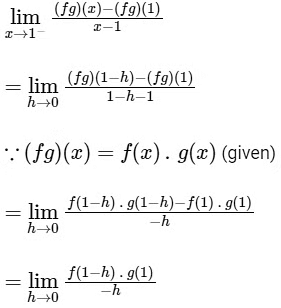
{∵ f(1) = 0 and g is continuous at x = 1, so g(1 - h) = g(1)}
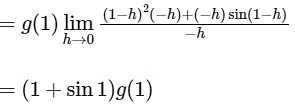
Similarly, 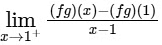
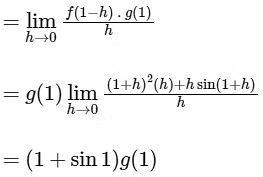
∵ RHD and LHD of function fg at x = 1 is finitely exists and equal, so fg is differentiable at x = 1
Now, let (fg)(x) is differentiable at x = 1, so
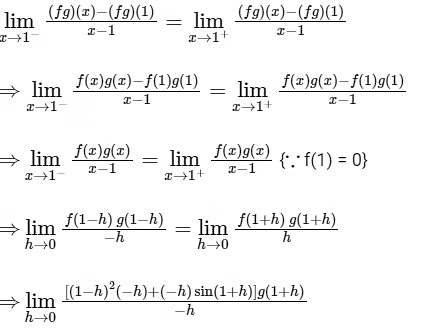
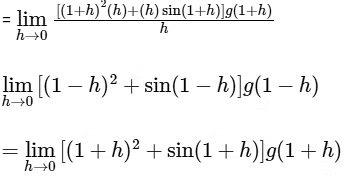
It does not mean that g(x) is continuous or differentiable at x = 1.
But if g is differentiable at x = 1, then it must be continuous at x = 1 and so fg is differentiable at x = 1.
Q3: The value of the limit  is ________. [JEE Advanced 2020 Paper 2]Ans: 8
The Limit
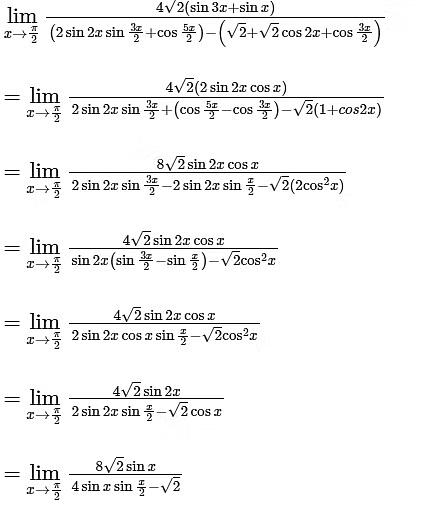
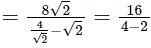
= 8
Q4: let e denote the base of the natural logarithm. The value of the real number a for which the right hand limit 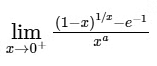 is equal to a non-zero real number, is ____ . [JEE Advanced 2020 Paper 1]
Ans: 1
The right hand limit
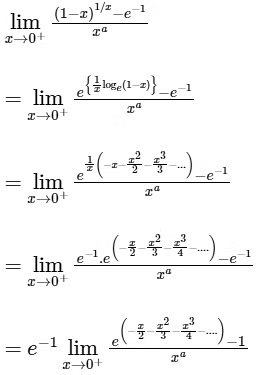
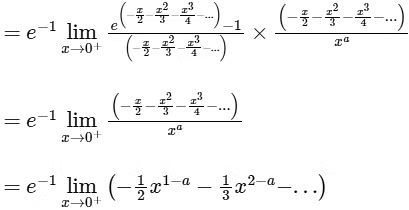
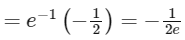
The above limit will be non-zero, if a = 1. And at a = 1, the value of the limit is
2019
Q1: For a ∈ R, |a| > 1, let
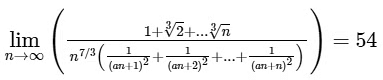
(a) -6
(b) -7
(c) 8
(d) -9 [JEE Advanced 2019 Paper 2]
Ans: (c) & (d)
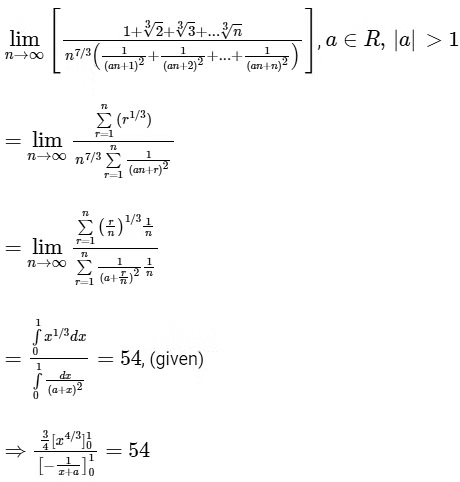
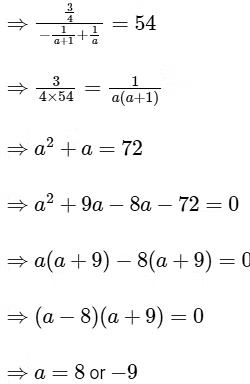
Hence, options (c) and (d) are correct.
Q2: Let f : R → R be given by
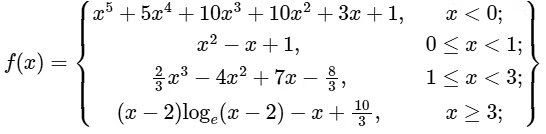
(a) f is increasing on (-∞, 0)
(b) f' is not differentiable at x = 1
(c) f is onto
(d) f' has a local maximum at x = 1 [JEE Advanced 2019 Paper 1]
Ans: (b), (c) & (d)
Given function f : R → R is
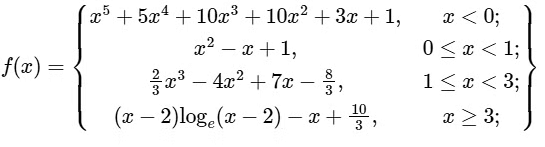
So,
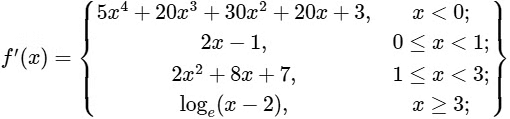
At x = 1, f"(1-) = 2 > 0 and f"(1+) = 4-8 = -4 < 0
∴ f'(x) is not differentiable at x = 1 and f'(x) has a local maximum at x = 1.
For x ∈ (-∞, 0)
f'(x) = 5x4 + 20x3 + 30x2 + 20x + 3
and since
f'(-1) = 5-20 + 20 + 30 - 20 + 3 = -2 < 0
So, f(x) is not increasing on x ∈(-∞, 0).
Now, as the range of function f(x) is R, so f is onto function.
Hence, options (b), (c) and (d) are correct.
2018
Q1: For every twice differentiable function f : R → [-2, 2] with (f(0))2 + (f′(0))2 = 85, which of the following statement(s) is(are) TRUE?
(a) There exist r, s ∈ R, where r < s, such that f is one-one on the open interval (r, s)
(b) There exists x0 ∈ (-4, 0) such that |f'(x0)| ≤ 1
(c)
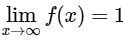 (d) There exists α ∈ (-4, 4) such that f(α) + f"(α) = 0 and f'(α) ≠ 0 [JEE Advanced 2018 Paper 1]Ans: (a), (b) & (d)
We have,
(f(0))2 + (f′(0))2 = 85
and f : R → [-2, 2]
(a) Since, f is twice differentiable function, so f is continuous function.
∴ This is true for every continuous function.
Hence, we can always find x ∈ (r, s), where f(x) is one-one.
∴ This statement is true.
(b) By L.M.V.T.
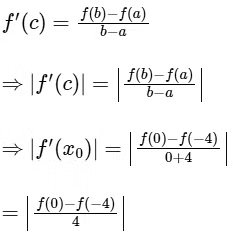
Range of f is [-2, 2]
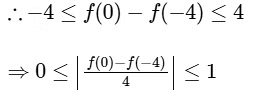
Hence, |f'(x0)| = 1.
Hence, statement is true.
(c) As no function is given, then we assume
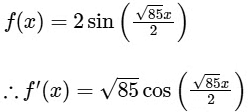
Now, 

and  does not exists.Hence, statement is false.
(d) From option b, 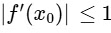
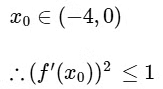
hence, 
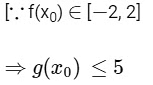
Now, let p ∈ (-4, 0) for which g(p) = 5
Similarly, let q be smallest positive number q ∈ (0, 4)
such that g(q) = 5
Hence, by Rolle's theorem is (p, q)
g'(c) = 0 for α ∈ (-4, 4) and since g(x) is greater than 5 as we move from x = p to x = q
and f(x))2 ≤ 4
⇒ (f'(x))2 ≥ 1 in (p, q)
Thus, g'(c) = 0
⇒ f'f + f'f" = 0
So, f(α) + f"(α) = 0 and f'(α) ≠ 0
Hence, statement is true.
Q2: Let f : R → R and g : R → R be two non-constant differentiable functions. If f'(x) = (e(f(x) - g(x))) g'(x) for all x ∈ R and f(1) = g(2) = 1, then which of the following statement(s) is (are) TRUE?
(a) f(2) < 1 - loge2
(b) f(2) > 1 - loge2
(c) g(1) > 1 - loge2
(d) g(1) < 1 - loge2 [JEE Advanced 2018 Paper 1]
Ans: (b) & (c)
We have,
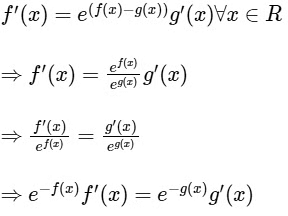
On integrating both side, we get

At x = 1
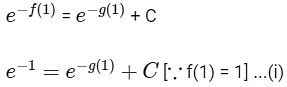
At x = 2
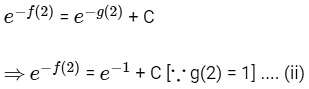
From Eqs. (i) and (ii)
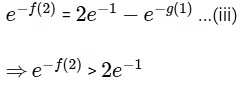
We know that, e-x is decreasing
∴ -f(2) < loge 2-1
f(2) > 1 - loge 2
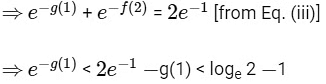 ⇒ g(1) > -loge 2
Q3: Let  and
and 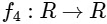 be functions defined by
(i) 
(ii) 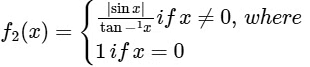 the inverse trigonometric function tan-1x assumes values in (-π/2, π/2)
(iii)  , where for t ∈ R, [t] denotes the greatest integer less than or equal to t,
(iv) 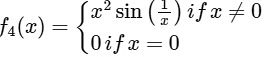
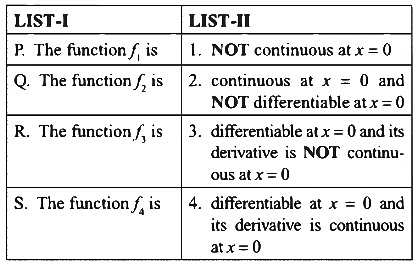
(b) P → 4 ; Q → 1 ; R → 2 ; S → 3
(c) P → 4 ; Q → 2 ; R → 1 ; S → 3
(d) P → 2 ; Q → 1 ; R → 4 ; S → 3 [JEE Advanced 2018 Paper 2 ]
Ans: (d)
(i) Given,
f1 : R → R and f1(x) =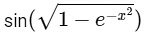
∴ f1(x) is continuous at x = 0
Now,

At x = 0
f1'(x) does not exists.
∴ f1(x) is not differential at x = 0
Hence, option (2) for P.
(ii) Given, 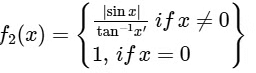
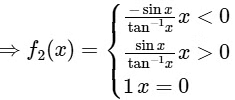
Clearly, f2(x) is not continuous at x = 0.
∴ Option (1) for Q.
(iii) Given, f3(x) = [sin(loge(x + 2))], where [ ] is G.I.F.
and f3 : (-1, eπ/2 - 2) → R
It is given,
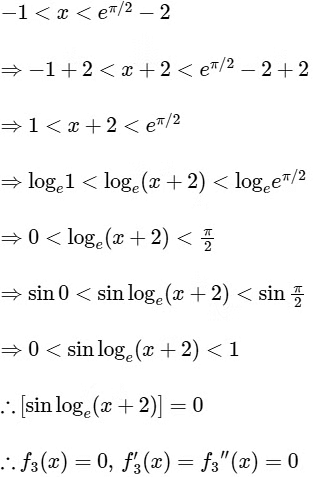
It is differentiable and continuous at x = 0.
∴ Option (4) for R
(iv) Given, 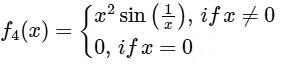
Now, 
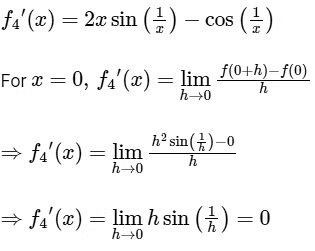
thus

Again, 
 does not exists.
Since,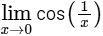 does not exists.
Hence, f'(x) is not continuous at x = 0.
∴ Option (3) for S.
Q4: The value of  is ________. [JEE Advanced 2018 Paper 1]
Ans: 8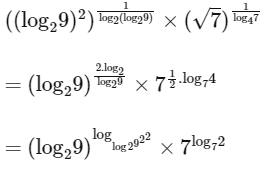
= 22 x 2
= 8
FAQs on JEE Advanced Previous Year Questions (2018 - 2025): Limits, Continuity and Differentiability
| 1. What are the key topics covered in Limits, Continuity, and Differentiability for JEE Advanced? |  |
| 2. How can I effectively prepare for Limits, Continuity, and Differentiability in the JEE Advanced exam? | |
| 3. What are some common types of problems asked in the JEE Advanced from Limits and Continuity? | |
| 4. How important is the topic of Differentiability in the JEE Advanced exam? | |
| 5. Are there any specific strategies for tackling limits and continuity questions in JEE Advanced? | |




