JEE Advanced Previous Year Questions (2018 - 2025): Differential Equations

2024
Q1: Let f(x) be a continuously differentiable function on the interval (0, ∞) such that f(1) = 2 and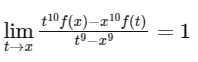 for each x > 0. Then, for all x > 0, f(x) is equal to:
(a) 3111x - 911 x¹⁰
(b) 911x + 1311 x¹⁰
(c) -911x + 3111 x¹⁰
(d) 1311x + 911 x¹⁰ [JEE Advanced 2024 Paper 1]
Ans: (b)
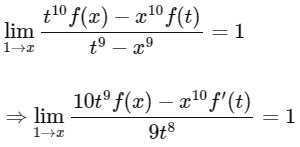
⇒ 10x f(x) - x² f'(x) = 9
⇒ x² f'(x) = 10x f(x) - 9
⇒ f'(x) = 10 f(x)x - 9x²
⇒ dydx - 10x y = - 9x²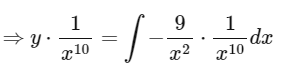
⇒ yx¹⁰ = 911x¹¹ + c
∴ f(1) = 2 ⇒ 21 = 911 + c ⇒ c = 1311
∴ f(x) = 911x + 1311 x¹⁰
⇒ Option (B) is correct.
2023
Q1: For x ∈ R, let g(x) be a solution of the differential equation such that y(2) = 7. Then the maximum value of the function y(x) is : [JEE Advanced 2023 Paper 2]
Ans: 16
Q2: Let  be a differentiable function such that f(1) = 1/3 and
  . Let e denote the base of the natural logarithm. Then the value of f(e) is :
(a) 
(b) 
(c) 
(d)  [JEE Advanced 2023 Paper 2]
Ans: (c)
1. We are given a relationship between the integral of the function f(t) and the function f(x) :

2. Differentiate both sides of the above equation with respect to x :
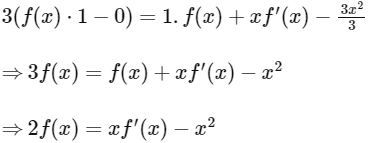
3. We can rewrite this as a first order linear differential equation:

4. The general form of a first order linear differential equation is:
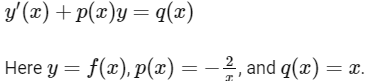
5. The integrating factor is obtained by exponentiating the integral of p(x) with respect to x:

6. ∴ Solution of D.E :
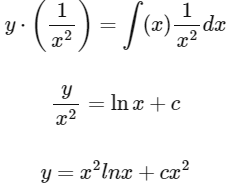
∴ The general solution is :

Here, y(x) is the same as f(x), i.e. the function we're trying to find.
7. Given that f(1) = 1 / 3, let's use this condition to find the constant c :
Therefore, the function f(x) we are looking for is:

We want to find f(e), so substituting x = e into the function, we get :

So, the correct answer is Option C.
2022
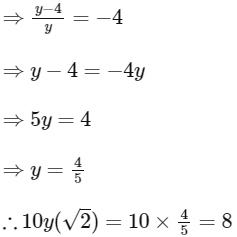
Q1: If y(x) is the solution of the differential equation  and the slope of the curve y = y(x) is never zero, then the value of 10y(√2) is: [JEE Advanced 2022 Paper 2]
Ans: 8
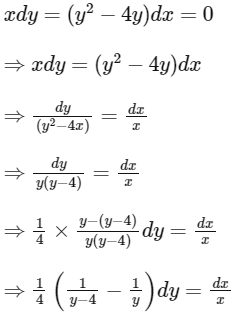
Integrating both side, we get
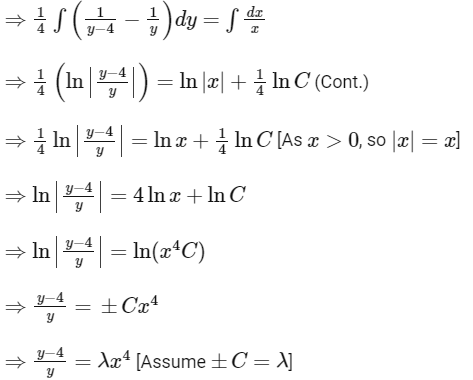
Given, y (1) = 2
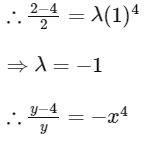
Now, 
Q2: For x ∈ R, let the function y(x) be the solution of the differential equation

Then, which of the following statements is/are TRUE ?
(a) y(x) is an increasing function
(b) y(x) is a decreasing function
(c) There exists a real number β such that the line y = β intersects the curve y = y(x) at infinitely many points
(d) y(x) is a periodic function [JEE Advanced 2022 Paper 2]
Ans: (c)
Given, 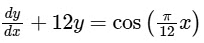
This is a linear differential equation.
Where P = 12 and 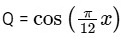

Solution of differencial equation is
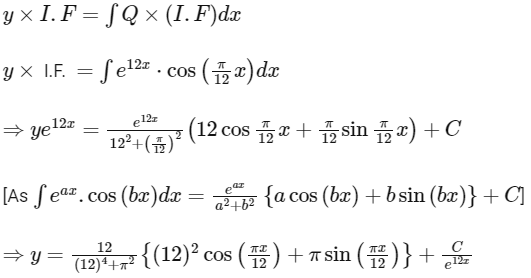
Given, y(0) = 0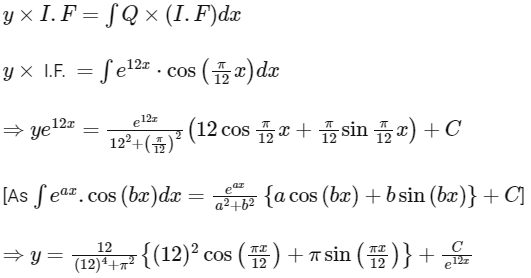
y(x) is not a periodic function as e-12x is a non-periodic function.
∴ Option (D) is a wrong statement.
Now, 
Values of  varies between
So, f(x) is neither increasing nor decreasing.
∴ Option (A) and (B) are wrong statements.
For some β ∈ R, y = β intersects y = f(x) at infinitely many points.
So option C is correct.
2019
Q1: Let Γ denote a curve y = y(x) which is in the first quadrant and let the point (1, 0) lie on it. Let the tangent to I` at a point P intersect the y-axis at YP. If PYP has length 1 for each point P on I`, then which of the following options is/are correct?
(a) 
(b) 
(c) 
(d) 
Ans: (a) & (c)
Let a point P(h, k) on the curve y = y(x), so equation of tangent to the curve at point P is

Now, the tangent (i) intersect the Y-axis at Yp, so coordinates Yp is 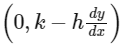
Where, 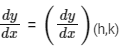
So, PYp = 1 (given)
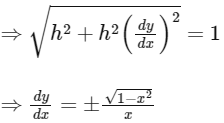
[on replacing h by x]
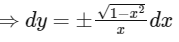
On putting x = sinθ, dx = cosθdθ, we get
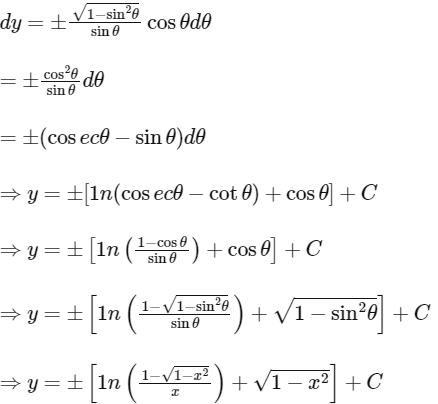
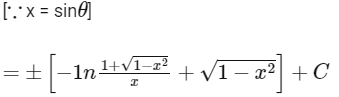
[on rationalization]
∵ The curve is in the first quadrant so y must be positive, so

As curve passes through (1, 0), so so required curve is

and required differential equation is
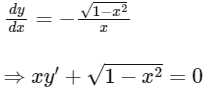
Hence, options (a) and (c) are correct.
2018
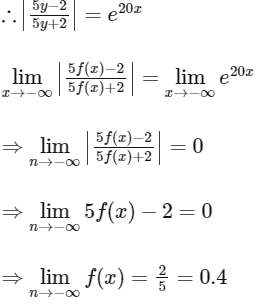
Q1: Let f : R → R be a differentiable function with f(0) = 0. If y = f(x) satisfies the differential equation  , then the value of
  is [JEE Advanced 2018 Paper 2]
Ans: 0.4
We have,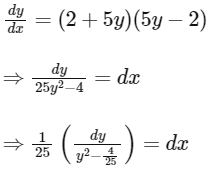
On integrating both sides, we get
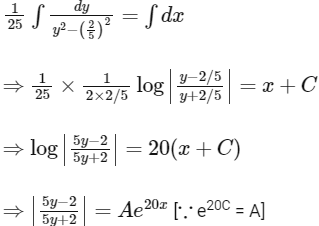
when x = 0 ⇒ y = 0, then A = 1