JEE Advanced Previous Year Questions (2018 - 2025): Current Electricity


2024
No Question in JEE Advanced Exam from Chapter Current Electricity in Year 2023 !
2023
No Question in JEE Advanced Exam from Chapter Current Electricity in Year 2023 !
2022
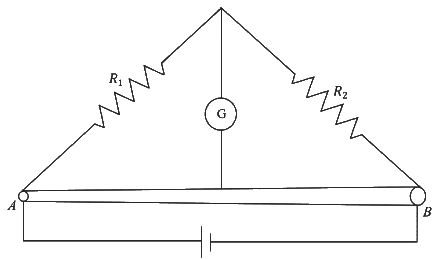
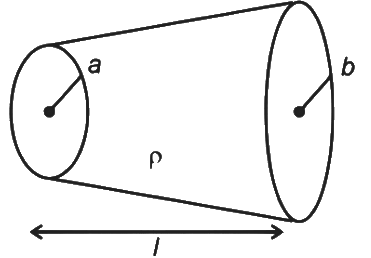
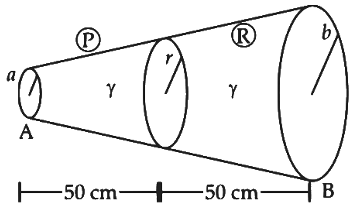
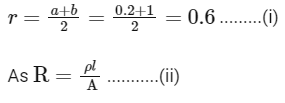
Q1: Two resistances R1 = XΩ and R2 = 1Ω are connected to a wire AB of uniform resistivity, as shown in the figure. The radius of the wire varies linearly along its axis from 0.2 mm at A to 1 mm at B. A galvanometer (G) connected to the center of the wire, 50 cm from each end along its axis, shows zero deflection when A and B are connected to a battery. The value of X is ____________. [JEE Advanced 2022 Paper 2]

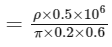
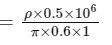
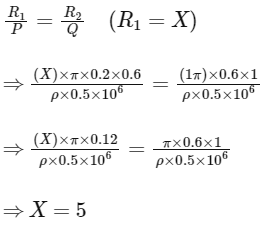
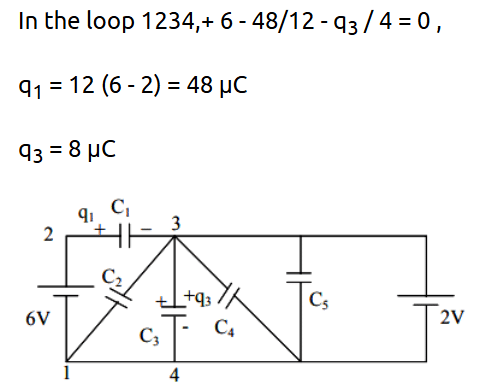
Q2: In the following circuit  . The charge stored in C3 is ____________ μC. [JEE Advanced 2022 Paper 1]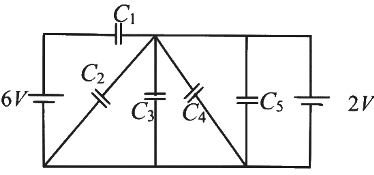
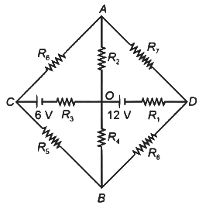
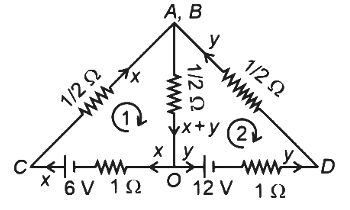
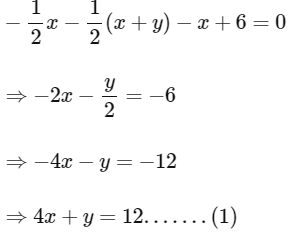
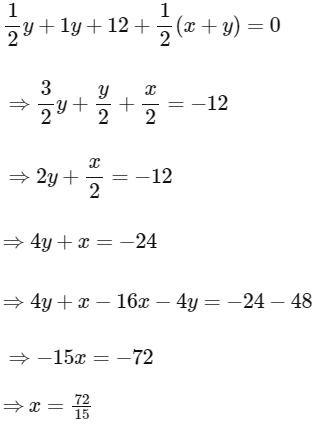
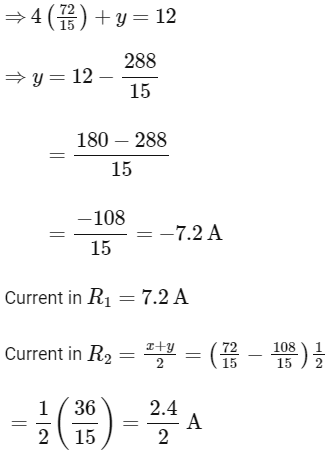
Q3: The figure shows a circuit having eight resistances of 1Ω each, labelled R1 to R8, and two ideal batteries with voltages ε1=12 V and ε2=6 V.
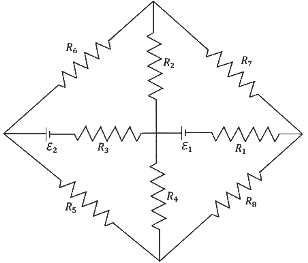
Which of the following statement(s) is(are) correct?
(a) The magnitude of current flowing through R1 is 7.2 A.
(b) The magnitude of current flowing through R2 is 1.2 A.
(c) The magnitude of current flowing through R3 is 4.8 A.
(d) The magnitude of current flowing through R5 is 2.4 A. [JEE Advanced 2022 Paper 1]
2021
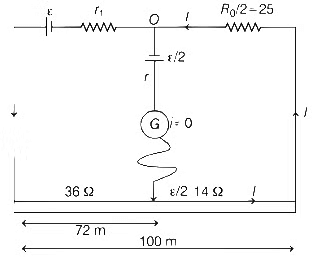
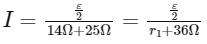
Q1: In order to measure the internal resistance r1 of a cell of emf E, a meter bridge of wire resistance R0 = 50Ω, a resistance R0/2, another cell of emf E/2 (internal resistance r) and a galvanometer G are used in a circuit, as shown in the figure. If the null point is found at l = 72 cm, then the value of r1 = __________ Ω. [JEE Advanced 2021 Paper 2]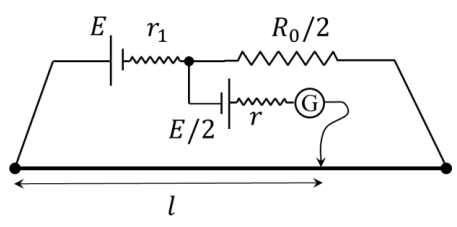

2020
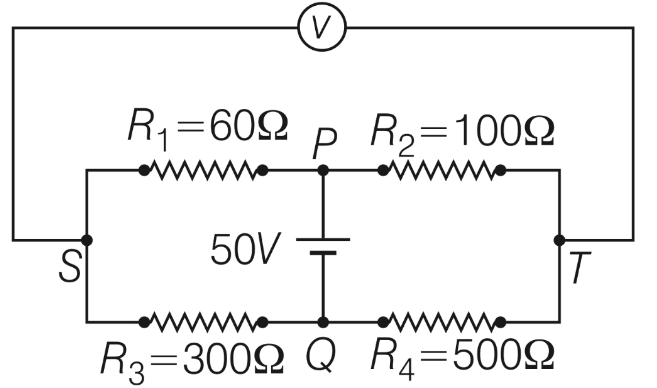
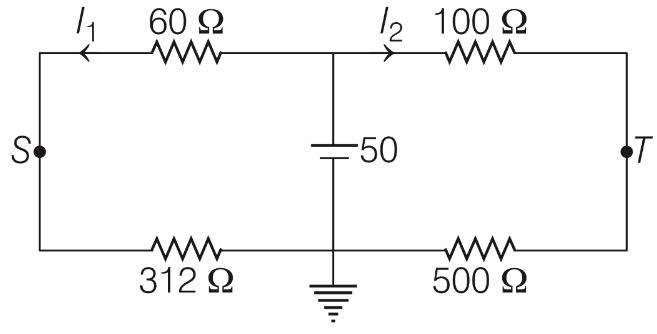
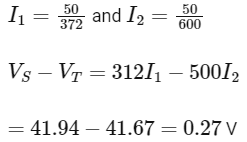
Q1: In the balanced condition, the values of the resistances of the four arms of a Wheatstone bridge are shown in the figure below. The resistance R3 has temperature coefficient 0.0004∘C-1. If the temperature of R3 is increased by 100∘C, the voltage developed between S and T will be ________ volt. [JEE Advanced 2020 Paper 2]

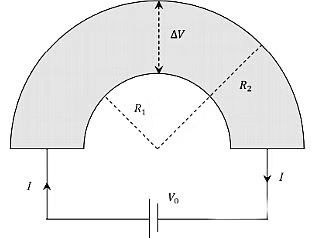
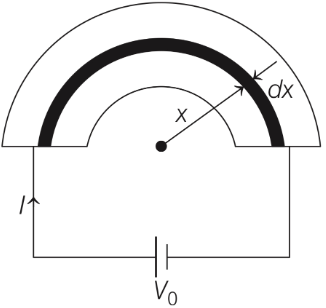
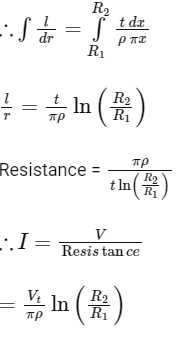
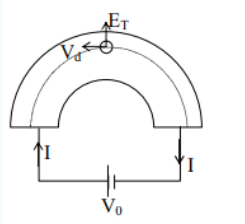
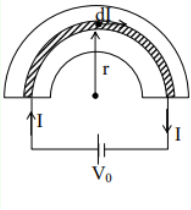
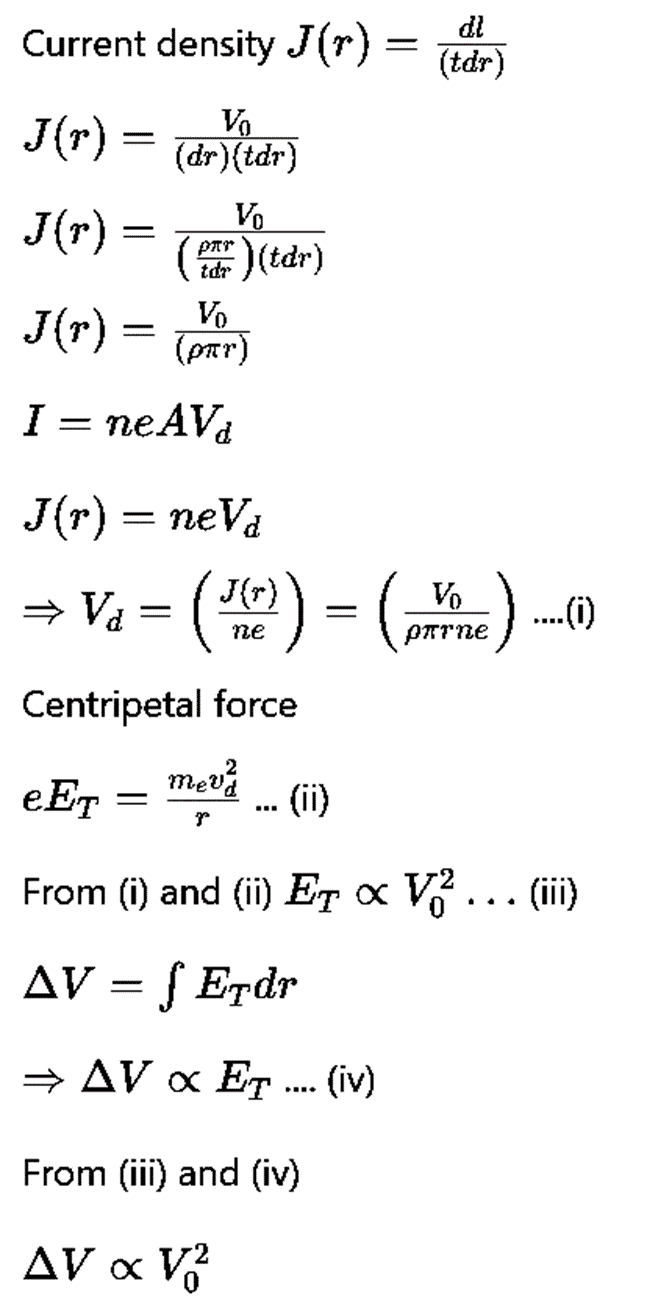
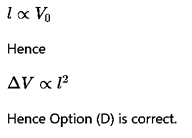
Q2: Shown in the figure is a semicircular metallic strip that has thickness t and resistivity ρ. Its inner radius is R1 and outer radius is R2. If a voltage V0 is applied between its two ends, a current I flows in it. In addition, it is observed that a transverse voltage ΔV develops between its inner and outer surfaces due to purely kinetic effects of moving electrons (ignore any role of the magnetic field due to the current). Then (figure is schematic and not drawn to scale) [JEE Advanced 2020 Paper 1]
(a) 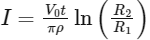
(b) the outer surface is at a higher voltage than the inner surface
(c) the outer surface is at a lower voltage than the inner surface
(d) 
2019
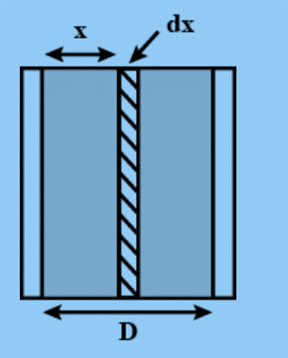
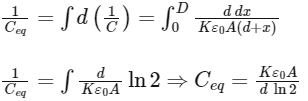
Q1: A parallel plate capacitor of capacitance C has spacing d between two plates having area A. The region between the plates is filled with N dielectric layers, parallel to its plates, each with thickness,  . The dielectric constant of the mth layer is
  . For a very large N(>103), the capacitance C is
  .
.
The value of α will be______
[∈0 is the permittivity of free space.] [JEE Advanced 2019 Paper 1]
 Parallel plate capacitor,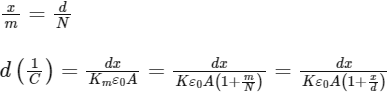
Q2: In the circuit shown, initially there is no charge on the capacitors and keys S1 and S2 are open. The values of the capacitors are C1 = 10μF, C2 = 30μF and C3 = C4 = 80μF.
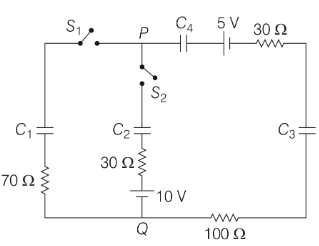
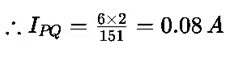
(a) The key S1 is kept closed for long time such that capacitors are fully charged. Now, key S2 is closed, at this time, the instantaneous current across 30Ω resistor (between points P and Q) will be 0.2 A (round off to 1st decimal place).
(b) If key S1 is kept closed for long time such that capacitors are fully charged, the voltage across the capacitor C1 will be 4V.
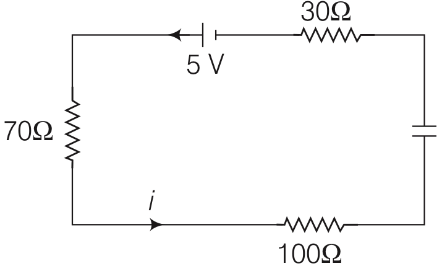
(c) At time t = 0, the key S1 is closed, the instantaneous current in the closed circuit will be 25 mA.
(d) If key S1 is kept closed for long time such that the capacitors are fully charged, the voltage difference between points P and Q will be 10 V. [JEE Advanced 2019 Paper 1]


FAQs on JEE Advanced Previous Year Questions (2018 - 2025): Current Electricity
| 1. What is the principle behind Kirchhoff's laws in current electricity? |  |
| 2. How do you calculate equivalent resistance in series and parallel circuits? | |
| 3. What is Ohm's Law and how is it applied in circuit calculations? | |
| 4. What are the factors affecting the resistance of a conductor? | |
| 5. How can the concept of electric power be defined and calculated in a circuit? | |




