JEE Exam  >  JEE Notes  >  Physics Main & Advanced  >  JEE Advanced Previous Year Questions (2018 - 2025): Electromagnetic Waves

JEE Advanced Previous Year Questions (2018 - 2025): Electromagnetic Waves

2024

No Question in JEE Advanced Exam from Chapter Electromagnetic Waves in Year 2024 !

2023

Q1: The electric field associated with an electromagnetic wave propagating in a dielectric medium is given by 2023. Which of the following option(s) is(are) correct?

[Given: The speed of light in vacuum,  c = 3 × 10⁸ m s-1 ]
(a) 2023

(b) 2023
(c) The wave is polarized in the xy-plane with polarization angle 30 with respect to the x-axis.
(d) The refractive index of the medium is 2.             [JEE Advanced 2023 Paper 2]
Ans:
(a) & (d)
1. Calculation of the Speed of Light in a Medium:
- The speed of light in a medium, denoted as V, is given by the formula V = W/k.
- Substituting values, we get 2023

2. Determination of the Refractive Index:
- The refractive index, μ, is the ratio of the speed of light in vacuum, C, to the speed of light in the medium, V.
- Substituting values, 2023
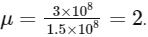
- Hence, the refractive index μ is 2.
Therefore, the option (D) is the answer.
Given, 2023

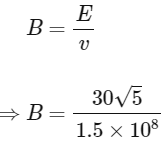
Now magnitude of

2023

2023

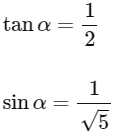
2023

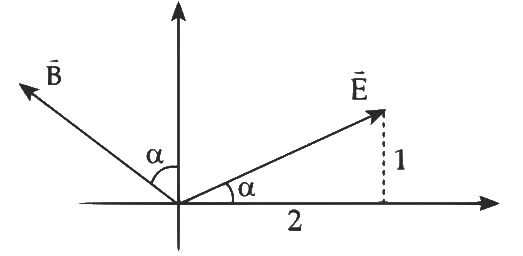
The direction of 2023 is along the direction of 2023

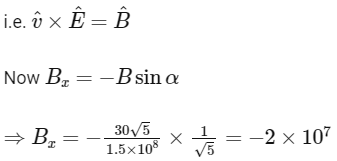
2023

Therefore, option (A) is the answer.

The document JEE Advanced Previous Year Questions (2018 - 2025): Electromagnetic Waves is a part of the JEE Course Physics for JEE Main & Advanced.
All you need of JEE at this link: JEE

FAQs on JEE Advanced Previous Year Questions (2018 - 2025): Electromagnetic Waves

1. What are electromagnetic waves and their properties?
Ans. Electromagnetic waves are waves of electric and magnetic fields that propagate through space. They are characterized by their wavelength, frequency, and speed. Key properties include: they travel at the speed of light in a vacuum (approximately \(3 \times 10^8\) m/s), they can travel through a vacuum as well as through various media, and their speed depends on the medium. Electromagnetic waves encompass a wide range of wavelengths, from radio waves to gamma rays.
2. How do electromagnetic waves propagate through different media?
Ans. Electromagnetic waves propagate through media by oscillating electric and magnetic fields perpendicular to each other and the direction of wave travel. The speed of electromagnetic waves is affected by the medium; for example, they travel slower in materials like glass or water compared to a vacuum. The refractive index of a medium determines how much the wave's speed decreases and how it bends when entering a new medium.
3. What is the significance of Maxwell's equations in understanding electromagnetic waves?
Ans. Maxwell's equations describe how electric and magnetic fields interact and propagate. They are fundamental to understanding electromagnetic waves. These equations show that a changing electric field produces a magnetic field and vice versa, leading to the propagation of electromagnetic waves. They also reveal the relationship between electric and magnetic fields in wave propagation, helping to explain phenomena such as the speed of light and the behavior of waves in different media.
4. How do electromagnetic waves relate to the electromagnetic spectrum?
Ans. The electromagnetic spectrum is the range of all types of electromagnetic radiation, classified by wavelength or frequency. It includes radio waves, microwaves, infrared, visible light, ultraviolet, X-rays, and gamma rays. Each type of electromagnetic wave has unique properties and applications, ranging from communication (radio waves) to medical imaging (X-rays). Understanding the spectrum helps in identifying the uses and effects of different electromagnetic waves.
5. What are practical applications of electromagnetic waves in technology?
Ans. Electromagnetic waves have numerous applications in technology, including: radio waves for communication (radio and television broadcasts), microwaves for cooking and satellite communications, infrared for remote controls and thermal imaging, visible light for illumination and photography, ultraviolet for sterilization and fluorescent lamps, and X-rays for medical imaging and security scanning. Each application exploits specific properties of electromagnetic waves for practical use.
Explore Courses for JEE exam
Get EduRev Notes directly in your Google search
Related Searches
pdf , Viva Questions, Extra Questions, Summary, JEE Advanced Previous Year Questions (2018 - 2025): Electromagnetic Waves, shortcuts and tricks, MCQs, Semester Notes, study material, Sample Paper, JEE Advanced Previous Year Questions (2018 - 2025): Electromagnetic Waves, Previous Year Questions with Solutions, Objective type Questions, video lectures, Exam, practice quizzes, Free, past year papers, JEE Advanced Previous Year Questions (2018 - 2025): Electromagnetic Waves, ppt, mock tests for examination, Important questions;