JEE Advanced Previous Year Questions (2018 - 2025): Waves


2024
Q1: A source (S) of sound has frequency 240 Hz. When the observer (O) and the source move towards each other at a speed v with respect to the ground (as shown in Case 1 in the figure), the observer measures the frequency of the sound to be 288 Hz.
However, when the observer and the source move away from each other at the same speed v with respect to the ground (as shown in Case 2 in the figure), the observer measures the frequency of sound to be n Hz. The value of n is ______. [JEE Advanced 2024 Paper 1]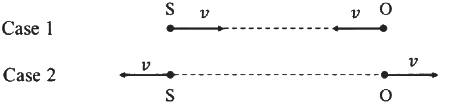 Ans: 200
Frequency received by observer
f0 = (C ± V0C ± Vs) fs, C is the speed of sound
Case-1:
f1 = (C + VC - V) fs
288 = (C + VC - V) × 240
Case-2:
f2 = (C - VC + V) fs
n = (C - VC + V) × 240
Multiplying the two equations, we get:
(288) × (n) = (240) × (240)
N = 200
Q2: Two uniform strings of mass per unit length μ and 4μ, and length L and 2L, respectively, are joined at point O, and tied at two fixed ends P and Q, as shown in the figure. The strings are under a uniform tension T. If we define the frequency v₀ = (1 / 2L) √(T / μ),
which of the following statement(s) is(are) correct? [JEE Advanced 2024 Paper 1]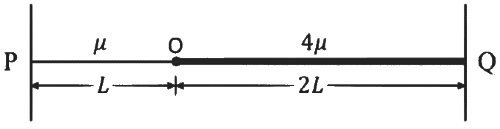 (a) With a node at O, the minimum frequency of vibration of the composite string is v₀.(b) With an antinode at O, the minimum frequency of vibration of the composite string is 2v₀.
(c) When the composite string vibrates at the minimum frequency with a node at O, it has 6 nodes, including the end nodes.
(d) No vibrational mode with an antinode at O is possible for the composite string.
Ans: (a), (c), (d)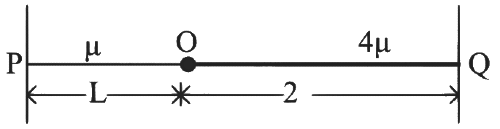
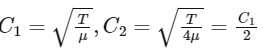
For node at O :
L = nλ12 , 2L = mλ22 (n, m are integers)
λ1 = 2Ln , λ2 = 4Lm
C1λ1 = C2λ2
⇒ C12Ln = C22Lm
⇒ 4n = m
For minimum frequency, n = 1, m = 4
The string will look like Total no. of nodes
For antinode at O :
L = (2n + 1) λ14 ; 2L = (2n + 1) λ24 (n, m are integers)
λ1 = 4L(2n + 1) ; λ2 = 8L(2m + 1)
C1λ1 = C2λ2
C1C2 = λ1λ2
2 = 4L(2n + 1)8L(2m + 1)
4 = (2m + 1)(2n + 1) ⇒ even = oddodd ⇒ This node is not possible
2023
Q1: A string of length 1 m and mass 2×10⁻⁵ kg is under tension T. When the string vibrates, two successive harmonics are found to occur at frequencies 750 Hz and 1000 Hz. The value of tension T is ________ Newton. [JEE Advanced 2023 Paper 2]
Ans: 5
T : Tension in the string.
∵ Successive frequencies are being given
∴ It is the case of both ends fixed.
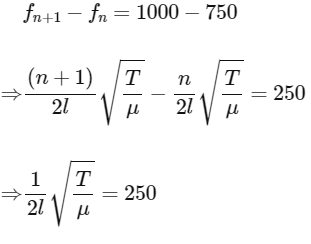
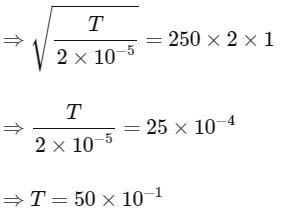
T = 5 N
Q2: S1 and S2 are two identical sound sources of frequency 656 Hz. The source S1 is located at O and S2 moves anti-clockwise with a uniform speed 42 m s-1 on a circular path around O, as shown in the figure. There are three points P,Q and R on this path such that P and R are diametrically opposite while Q is equidistant from them. A sound detector is placed at point P. The source S1 can move along direction OP.
[Given: The speed of sound in air is 324 m s-1 ]
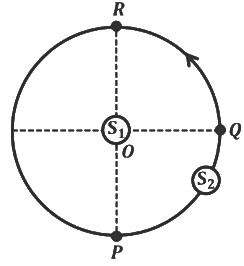
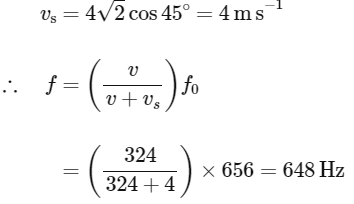
When only S2 is emitting sound and it is at Q, the frequency of sound measured by the detector in Hz is _________. [JEE Advanced 2023 Paper 2]
Ans: 648
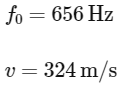
f0 = 656 Hz
Velocity of second = 324 m s-1
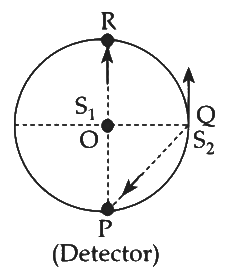
Velocity of the source away from detector,
Q3: S1 and S2 are two identical sound sources of frequency 656 Hz. The source S1 is located at O and S2 moves anti-clockwise with a uniform speed 42 m s-1 on a circular path around O, as shown in the figure. There are three points P,Q and R on this path such that P and R are diametrically opposite while Q is equidistant from them. A sound detector is placed at point P. The source S1 can move along direction OP.
[Given: The speed of sound in air is 324 m s-1 ]
Consider both sources emitting sound. When S2 is at R and S1 approaches the detector with a speed 4m s-1, the beat frequency measured by the detector is _________ Hz. [JEE Advanced 2023 Paper 2]
Ans: 8.20
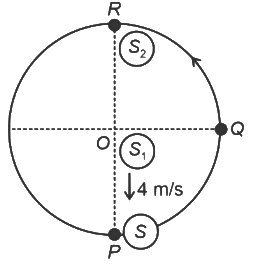
Frequency heard due to movement of (S1)
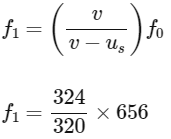
And frequency heard due to movement of (S2)
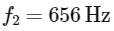
∴ Beat frequency

2021
Q1: A source, approaching with speed u towards the open end of a stationary pipe of length L, is emitting a sound of frequency fs. The farther end of the pipe is closed. The speed of sound in air is v and f0 is the fundamental frequency of the pipe. For which of the following combination(s) of u and fs, will the sound reaching the pipe lead to a resonance?
(a) u = 0.8v and fs = f0
(b) u = 0.8v and fs = 2f0
(c) u = 0.8v and fs = 0.5f0
(d) u = 0.5v and fs = 1.5f0 [JEE Advanced 2021 Paper 2]
Ans: (a) & (d)
Natural frequency of closed pipe,
f = (2n + 1)f0
f0 is fundamental frequency
n = 0, 1, 2 .......
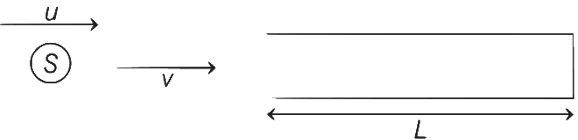
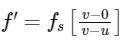
Frequency of source received by pipe,
For resonance,
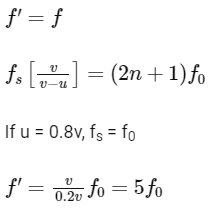
For n = 2 pipe can be in resonance
Hence, option (a) is correct.
If u = 0.8v, fs = 2f0
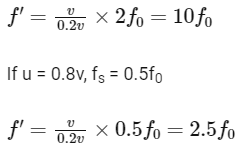
Not possible.
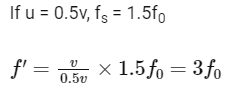
For n = 1 f = 3f0
Pipe can be in resonance.
Hence, option (d) is correct.
2020
Q1: A stationary tuning fork is in resonance with an air column in a pipe. If the tuning fork is moved with a speed of 2 ms-1 in front of the open end of the pipe and parallel to it, the length of the pipe should be changed for the resonance to occur with the moving tuning fork. If the speed of sound in air is 320 ms-1, the smallest value of the percentage change required in the length of the pipe is ____________. [JEE Advanced 2020 Paper 1]
Ans: 0.62 to 0.63

(where, l1 ⇒ initial length of pipe)
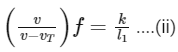
(where, vT = speed of tuning fork, l2 = new length of pipe)
Dividing Eq. (i) by Eq. (ii), we get
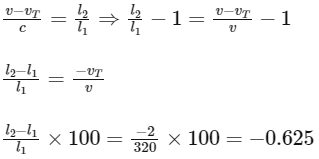
Therefore, smallest value of percentage change required in the length of pipe is 0.625.
2019
Q1: A musical instrument is made using four different metal strings, 1, 2, 3 and 4 with mass per unit length μ, 2μ, 3μ and 4μ respectively. The instrument is played by vibrating the strings by varying the free length in between the range L0 and 2L0. It is found that in string-1μ at free length L0 and tension T0 the fundamental mode frequency is f0.
List-I gives the above four strings while list-II lists the magnitude of some quantity.
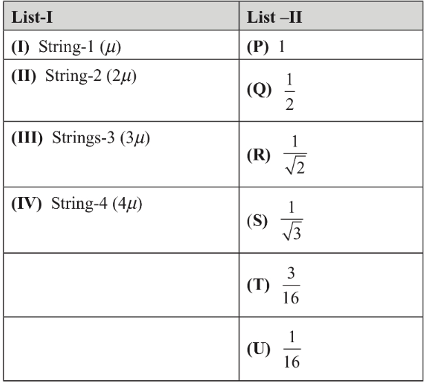
(a) I → P, II → Q, III → T, IV → S
(b) I → P, II → R, III → S, IV → Q
(c) I → Q, II → S, III → R, IV → P
(d) I → Q, II → P, III → R, IV → T [JEE Advanced 2019 Paper 2]
Ans: (b)
Fundamental frequency is maximum when length is minimum i.e. L0,
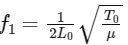
Case 1:

Case 2: 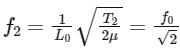
Case 3: 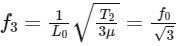
Case 4: 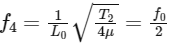
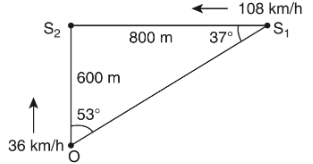
Q2: A train S1, moving with a uniform velocity of 108 km/h, approaches another train S2 standing on a platform. An observer O moves with a uniform velocity of 36 km/h towards S2, as shown in figure.
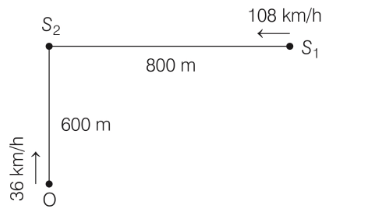
Both the trains are blowing whistles of same frequency 120 Hz. When O is 600 m away from S2 and distance between S1 and S2 is 800 m, the number of beats heard by O is __________ .
[Speed of the sound = 330 m/s _______ .] [JEE Advanced 2019 Paper 1]
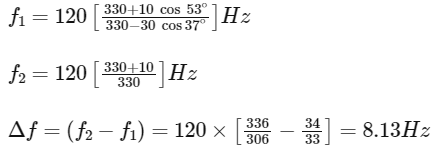
Ans: 8.13
Vsound = 330 m/s
2018
Q1: In an experiment to measure the speed of sound by a resonating air column, a tuning fork of frequency 500 Hz is used. The length of the air column is varied by changing the level of water in the resonance tube. Two successive resonances are heard at air columns of length 50.7 cm and 83.9 cm. Which of the following statements is (are) true?
(a) The speed of second determined from this experiment is 332ms-1
(b) The end correction in this experiment is 0.9cm
(c) The wavelength of the sound wave is 66.4cm
(d) The resonance at 50.7 cm corresponds to the fundamental harmonic [JEE Advanced 2018 Paper 2]
Ans: (a) & (c)
Frequency of tuning fork = 500 Hz
Length of n1 harmonic = 50.7 cm
Length of n2 harmonic = 83.9 cm
We know that
n2 harmonic - n1 harmonic = λ/2
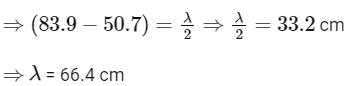
Therefore, wavelength of sound wave is 66.4 cm, so option (C) is correct.
Now, speed of sound is given as
v = f λ = 500 × 66.4 × 10-2
⇒ v = 332 m s-1
Thus, speed of sound determined from this experiment is 332 n s-1, so option (A) is correct. 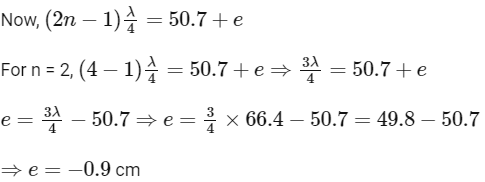
Thus, the end correction in this experiment is 0.9 cm. Therefore, option (B) is correct.
Q2: Two men are walking along a horizontal straight line in the same direction. The man in front walks at a speed 1.0ms-1 and the man behind walks at a speed 2.0ms-1 . A third man in standing at a height 12 m above the same horizontal line such that all three men are in a vertical plane. The two walking men are blowing identical whistles which emit a sound of frequency 1430 Hz. The speed of sound in air is 330ms-1 . At the instant, when the moving men are 10 m apart, the stationary man is equidistant from them. The frequency of beats in Hz, heard by the stationary man at this instant, is ______. [JEE Advanced 2018 Paper 1]
Ans: 5
From given data, we can draw the figure below.
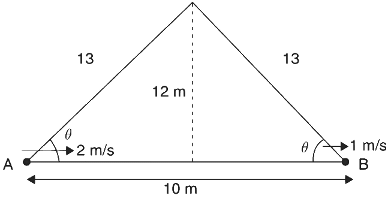
Now, frequency of man behind is
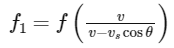
where, x is speed of sound in air, vs is speed of man and f is frequency of whistle. Therefore,
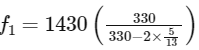
Frequency of man in front is

Now, frequency of beat is given as

= 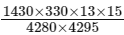
= 5.0058 Hz ≈ 5.00 Hz
FAQs on JEE Advanced Previous Year Questions (2018 - 2025): Waves
| 1. What are the key topics covered in the Waves section of JEE Advanced? |  |
| 2. How can I effectively prepare for the Waves topic in JEE Advanced? | |
| 3. What are some common types of questions asked in the Waves section of JEE Advanced? | |
| 4. How important is the Waves topic for scoring well in JEE Advanced? | |
| 5. Are there any recommended books for studying Waves for JEE Advanced? | |




