Humanities/Arts Exam > Humanities/Arts Notes > History Class 11 > Map Based Questions: Writing and City Life
Map Based Questions: Writing and City Life

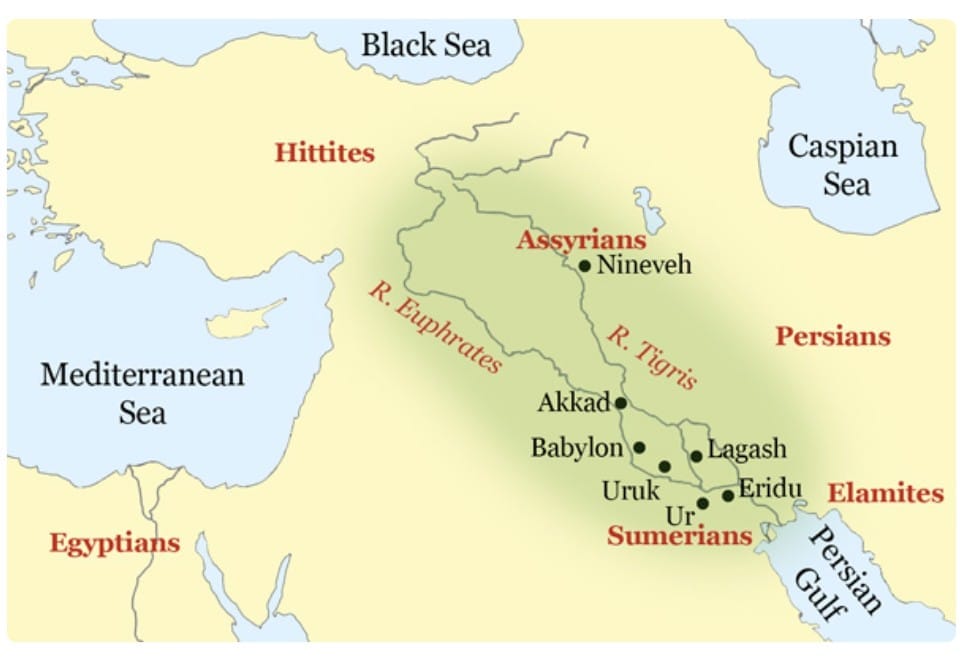
Q1: On the map of West Asia mark and locate the famous cities of Mesopotamia.
Ans:
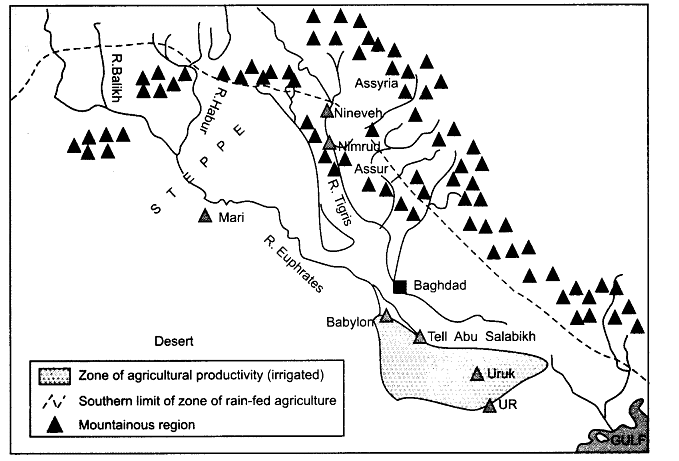
Q2: On the map given below mark and locate the following
(i) Zone of agricultural productivity
(ii) Southern limit of zone of rain-fed agriculture
(iii) Mountainous region
Ans:
The document Map Based Questions: Writing and City Life is a part of the Humanities/Arts Course History Class 11.
All you need of Humanities/Arts at this link: Humanities/Arts
FAQs on Map Based Questions: Writing and City Life
| 1. How do I identify and interpret Indus Valley Civilisation cities on history maps for Class 11 exams? |  |
Ans. Map-based questions require recognising settlements like Harappa and Mohenjo-daro by their grid patterns and planned structures. Students should locate these sites on the Indian subcontinent, noting their geographical positioning near river systems. Understanding city layouts-streets, drainage systems, and residential areas-helps answer spatial reasoning questions. Refer to mind maps and flashcards on EduRev showing Indus Valley settlement patterns to strengthen map-reading skills and identification techniques.
| 2. What are the main differences between Mesopotamian and Egyptian cities shown in ancient civilisation maps? | |
Ans. Mesopotamian cities like Ur featured ziggurats as central structures with defensive walls, while Egyptian settlements organised around temples and the Nile concentrated on agricultural access. Map-based comparisons highlight how geography shaped urban planning: Mesopotamian cities used irrigation networks, whereas Egyptian cities developed linear patterns along river corridors. Students practising comparison questions gain clarity on how environment influenced urban development and settlement hierarchies.
| 3. How do I answer questions about the significance of writing systems in early cities for CBSE history? | |
Ans. Writing systems emerged in cities as administrative tools for record-keeping, taxation, and trade. Map-based questions connect settlement locations with script development-cuneiform in Mesopotamia and hieroglyphics in Egypt corresponded to specific urban centres. Understanding which cities produced which writing systems helps students contextualise how urbanisation and literacy interconnected. This connection between city life and written communication is frequently tested in map-interpretation questions.
| 4. What exactly should I look for when answering map-based questions about city layouts and town planning? | |
Ans. Examine street patterns, building distributions, public spaces, and defensive structures visible on historical maps. Key features include grid systems (indicating planned development), drainage infrastructure, granaries, and religious monuments positioned centrally. Students should identify residential versus administrative zones and note how natural resources influenced settlement expansion. These observational skills directly translate to scoring marks on map-based question papers in Class 11 history examinations.
| 5. Why do map-based questions focus so much on ancient cities and their geographical locations? | |
Ans. Geography fundamentally shaped city survival-proximity to rivers, fertile land, and trade routes determined whether settlements thrived or declined. Map-based questions test students' understanding that urban development wasn't random; it reflected strategic resource management and environmental constraints. By analysing city locations on historical maps, students grasp how civilisations adapted to landscapes, which strengthens conceptual understanding beyond mere memorisation of facts.
About this Document

4.82/5 Rating

Apr 20, 2026 Last updated
Related Exams
Document Description: Map Based Questions: Writing and City Life for Humanities/Arts 2026 is part of History Class 11 preparation. The notes and questions for Map Based Questions: Writing and City Life have been prepared according to the Humanities/Arts exam syllabus. Information about Map Based Questions: Writing and City Life covers topics like and Map Based Questions: Writing and City Life Example, for Humanities/Arts 2026 Exam. Find important definitions, questions, notes, meanings, examples, exercises and tests below for Map Based Questions: Writing and City Life.
Introduction of Map Based Questions: Writing and City Life in English is available as part of our History Class 11 for Humanities/Arts & Map Based Questions: Writing and City Life in Hindi for History Class 11 course. Download more important topics related with notes, lectures and mock test series for Humanities/Arts Exam by signing up for free. Humanities/Arts: Map Based Questions: Writing and City Life
Description
Map Based Questions: Writing & City Life of History Class 11 questions designed to help you identify locations, underst& diagrams, & present answers clearly in exams. Start for free. Download free PDF for last-minute revision.
Information about Map Based Questions: Writing and City Life
In this doc you can find the meaning of Map Based Questions: Writing and City Life defined & explained in the simplest way possible. Besides explaining types of Map Based Questions: Writing and City Life theory, EduRev gives you an ample number of questions to practice Map Based Questions: Writing and City Life tests, examples and also practice Humanities/Arts tests



Related Searches
Map Based Questions: Writing and City Life, Semester Notes, Map Based Questions: Writing and City Life, Important questions, Free, pdf , mock tests for examination, Extra Questions, Exam, Viva Questions, video lectures, Objective type Questions, ppt, Sample Paper, Map Based Questions: Writing and City Life, past year papers, shortcuts and tricks, Summary, study material, MCQs, practice quizzes, Previous Year Questions with Solutions;