Word Problem: Money

Q1: Sarla had 12905 in her purse. Her father gave her 15320 more. She also puts this amount in the same purse. How much money does she have in her purse now?
Ans: Money Sarla had = ₹12,905
Money given to her = ₹15,320
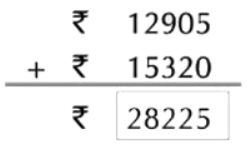
So now Sarla has ₹28,225.
Q2: A cup and a bowl together cost ₹ 398.50. The cup costs ₹ 135.25. How much does the bowl cost?
Ans: Cost of cup and bowl together = ₹398.50
Cost of cup = ₹135.25
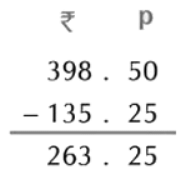
Cost of bowl = ₹398.50 - ₹135.25 = ₹263.25
Q3: A box of crayons costs ₹ 25.25. What is the cost of 32 such boxes?
Ans: Cost of one box of crayons = ₹25.25
Cost of 32 boxes of crayons = ₹25.25 × 32
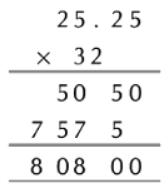
Thus, the cost of 32 boxes of crayons is ₹808.00.
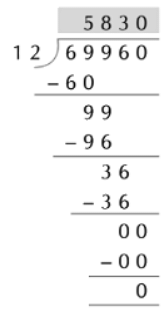
Q4: The cost of 12 gifts is ₹ 69960. What is the cost of one gift?
Ans: Cost of 12 gifts = ₹69,960
Cost of 1 gift = ₹69,960 ÷ 12 = ₹5,830
Q5: Mohan bought a bicycle for ₹1534.67 and a helmet for ₹425.50. What is the estimated total cost?
Ans: We estimate the total by rounding each price to the nearest rupee.
₹1,534.67 ≈ ₹1,535
₹425.50 ≈ ₹426
Estimated total = ₹1,535 + ₹426 = ₹1,961.
Q6: If you have 5 coins of ₹2 each and 4 coins of ₹5 each, what is the total amount of money you have?
Ans: 5 coins of ₹2 each = ₹2 × 5 = ₹10.
4 coins of ₹5 each = ₹5 × 4 = ₹20.
Therefore, the total amount of money = ₹10 + ₹20 = ₹30.
Q7: Reena has 4 fifty-rupee notes and 3 ten-rupee coins. How much money does she have in total?
Ans: 4 fifty-rupee notes = ₹50 × 4 = ₹200.
3 ten-rupee coins = ₹10 × 3 = ₹30.
Total = ₹200 + ₹30 = ₹230.
Q8: After spending ₹249.75 on groceries, Sanjay has ₹675.50 left. How much money did he originally have?
Ans: Original amount = Amount spent + Amount left = ₹249.75 + ₹675.50 = ₹925.25.
Q9: Anu wants to buy a dress priced at ₹465.75 and shoes priced at ₹256.90. What is the estimated total cost?
Ans: Round each price to the nearest rupee: ₹465.75 ≈ ₹466, ₹256.90 ≈ ₹257.
Estimated total = ₹466 + ₹257 = ₹723.
Q10: If you divide ₹36250 by 25, what is the quotient?
Ans: Perform the division: ₹36,250 ÷ 25 = ₹1,450.
Check: ₹25 × ₹1,450 = ₹36,250, so the quotient is ₹1,450.
FAQs on Word Problem: Money
| 1. What is the importance of understanding money management for Class 4 students? |  |
| 2. How can students learn to differentiate between various denominations of currency? | |
| 3. What are some practical exercises to teach students about addition and subtraction of money? | |
| 4. How does learning about money help in developing problem-solving skills? | |
| 5. What role does saving money play in teaching students about future planning? | |