NCERT Solutions: Seeing without Seeing

Let us Speak
Q1: Onshangla calls her 'mother' 'Ava'. What is the word for mother in your mother tongue?
Ans: Maa
Q2: Close your eyes. Imagine that, when your eyes are closed, how would you identify the following:
water
flower (any local flower)
sugar
direction of a clapping sound.
Ans:
water - by touching
flower (any local flower) - by its smell.
sugar- by tasting
direction of a clapping sound. - by hearing
Let us write
Answer the following questions.
Q1: Fill in the blanks using suitable words from the boxes given below.
( game milk quiet biscuits orange boy)
(a) Onshangla was very ____ one day.
Ans: Onshangla was very quiet one day.
(b) A new ____ came to Onshangla's school.
Ans: A new boy came to Onshangla's school.
(c) Ava placed ____ and ____ on the table.
Ans: Ava placed biscuits and milk on the table.
(d) Ava played a new ____ with Onshangla.
Ans: Ava played a new game with Onshangla.
(e) Onshangla cried, "Oh ! it is not water, it is _ juice".
Ans: Onshangla cried, "Oh ! it is not water, it is orange juice".
Q2: What activities do you like to do with your family members? Write about them. One has been given as an example.
e.g. I like to walk with my grandfather.
(a) I like to ____ with my ____.
Ans: I like to play with my sister.
(b) I like to ____ with my ____.
Ans: I like to dance with my mother.
Q3: Write five things you can do by yourself. One example is provided for you.
(a) I can take a bathe by myself.
Ans: I can take a bathe by myself.
(b) I can _____________________
Ans: I can brush my teeth by myself.
(c) I can _____________________
Ans: I can clean my room by myself.
(d) I can _____________________
Ans: I can keep my books by myself.
(e) I can _____________________
Ans: I can comb my hair by myself.
Let us do
Our eyes do so much for us. We should take care of our eyes. Read the words in the bubbles below.
Put a ✔ for whatever is good for our eyes.
Put a X for whatever is not good for our eyes.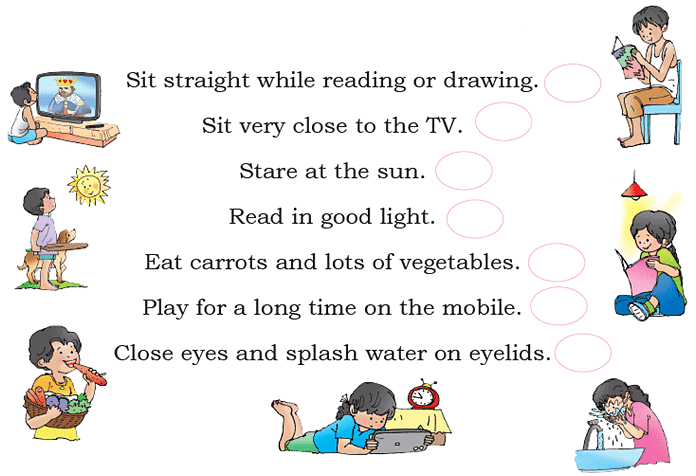 Ans:
Ans: 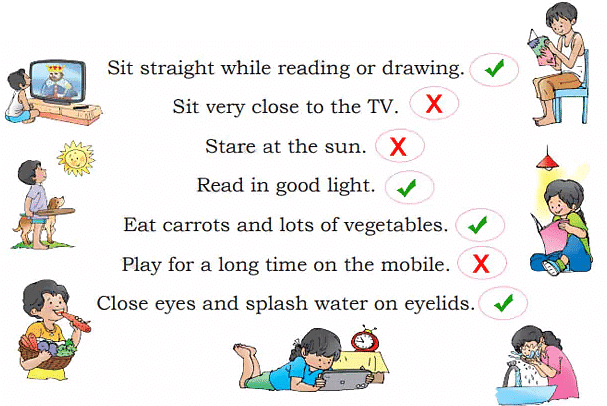
Eye Exercise
Follow the instructions of your teacher and repeat the eye movements. Do not move your face and body. Only move your eyes.
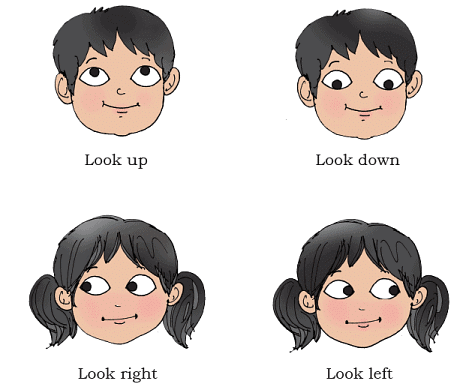 Ans: Do it yourself.
FAQs on NCERT Solutions: Seeing without Seeing
| 1. What are some common eye exercises to improve vision? |  |
| 2. How often should one do eye exercises to see improvements in vision? | |
| 3. Can eye exercises help reduce eye strain from prolonged screen time? | |
| 4. Are there any specific eye exercises that can help with nearsightedness or farsightedness? | |
| 5. Are there any precautions one should take while doing eye exercises to prevent any harm to the eyes? | |