Commerce Exam  >  Commerce Notes  >  Mathematics (Maths) Class 11  >  NCERT Solutions: Exercise Miscellaneous - Statistics

NCERT Solutions: Exercise Miscellaneous - Statistics

Q1: The mean and variance of eight observations are 9 and 9.25, respectively. If six of the observations are 6, 7, 10, 12, 12 and 13, find the remaining two observations.
Ans:
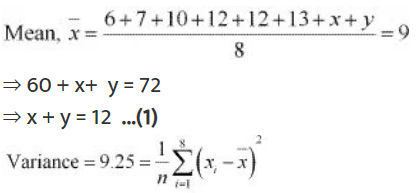
Let the remaining two observations be x and y.
Therefore, the observations are 6, 7, 10, 12, 12, 13, x, y.
NCERT Solutions: Exercise Miscellaneous - Statistics
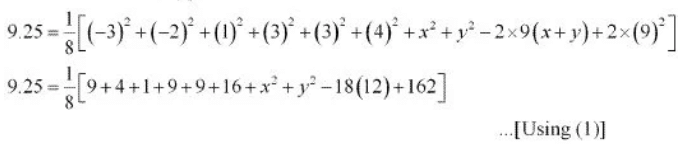
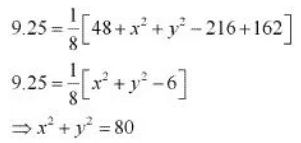
From (1), we obtain
x2 + y+ 2xy = 144 ...(3)
From (2) and (3), we obtain
2xy = 64 ... (4)
Subtracting (4) from (2), we obtain
x2 + y2 - 2xy = 80 - 64 = 16
⇒ x - y = ± 4 ...(5)
Therefore, from (1) and (5), we obtain
x = 8 and y = 4, when x - y = 4
x = 4 and y = 8, when x - y = -4
Thus, the remaining observations are 4 and 8.

Q2: The mean and variance of 7 observations are 8 and 16, respectively. If five of the observations are 2, 4, 10, 12 and 14. Find the remaining two observations.
Ans: 
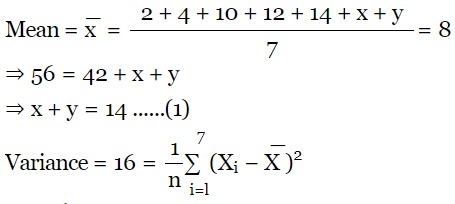
Let the remaining two observation be x and y
The observation are 2 , 4 , 10 , 12 , 14 , x , y
NCERT Solutions: Exercise Miscellaneous - Statistics
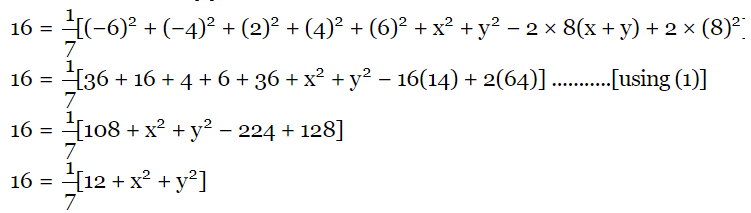
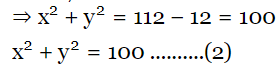
From (1), we obtain
x2 + y2 + 2xy = 196 ....(3)
From (2) and (3), we obtain
2xy = 196 - 100
⇒ 2xy = 96 ...........(4)
subtracting (4) from (2), we obtain
x2 + y2 - 2xy = 100 - 96
⇒ (x - y)2 = 4
⇒ x - y = ± 2 ............(5)
Therefore, from (1) and (5) we obtain
x = 8 and y = 6 when x - y = 2
x = 6 and y = 8 when x - y = - 2
Thus the remaining observation are 6 and 8

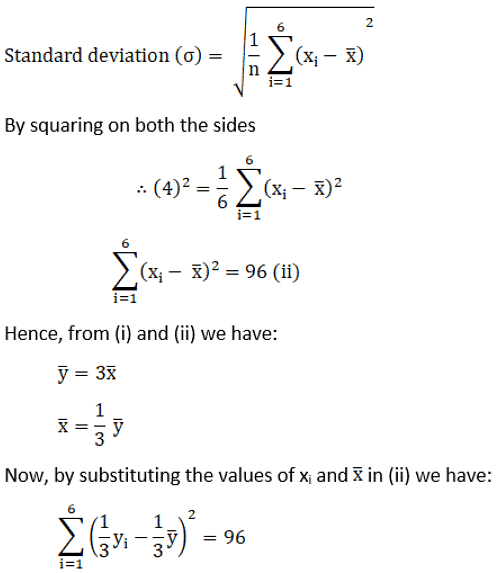
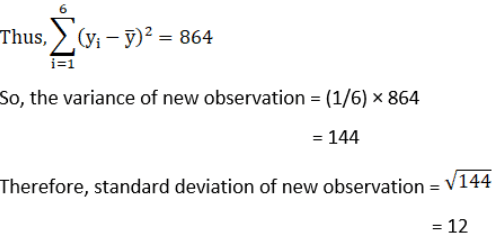
Q3: The mean and standard deviation of six observations are 8 and 4, respectively. If each observation is multiplied by 3, find the new mean and new standard deviation of the resulting observations.
Ans:
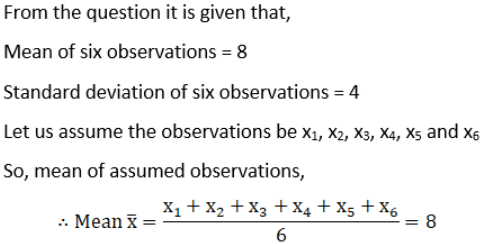
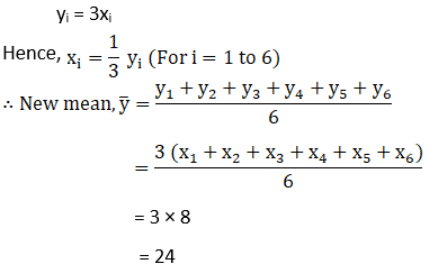
NCERT Solutions: Exercise Miscellaneous - Statistics
We know that,
NCERT Solutions: Exercise Miscellaneous - Statistics

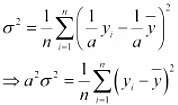
Q4: Given that NCERT Solutions: Exercise Miscellaneous - Statistics is the mean and σ2 is the variance of n observations x1, x2 ... xn. Prove that the mean and variance of the observations ax1, ax2, ax3 ...axn are ax and a2 σ2, respectively (a ≠ 0).
Ans: 
The given n observations are x1, x2 ... xn.
Mean =NCERT Solutions: Exercise Miscellaneous - Statistics
Variance = σ2
NCERT Solutions: Exercise Miscellaneous - Statistics
If each observation is multiplied by a and the new observations are yi, then
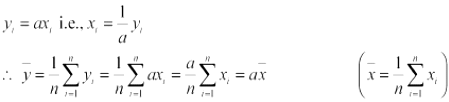
NCERT Solutions: Exercise Miscellaneous - Statistics
Therefore, mean of the observations, ax1, ax2 ... axn, isNCERT Solutions: Exercise Miscellaneous - Statistics
Substituting the values of xiand NCERT Solutions: Exercise Miscellaneous - Statisticsin (1), we obtain

NCERT Solutions: Exercise Miscellaneous - Statistics
Thus, the variance of the observations, ax1, ax... axn, is a2 σ2.

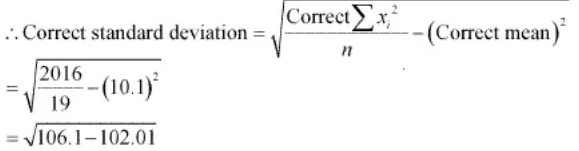
Q5: The mean and standard deviation of 20 observations are found to be 10 and 2, respectively. On rechecking, it was found that an observation 8 was incorrect. Calculate the correct mean and standard deviation in each of the following cases:
(i) If wrong item is omitted.
(ii) If it is replaced by 12.
Ans:
(i) Number of observations (n) = 20
Incorrect mean = 10
Incorrect standard deviation = 2
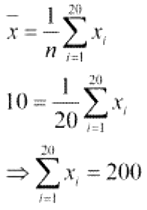
NCERT Solutions: Exercise Miscellaneous - Statistics
That is, incorrect sum of observations = 200
Correct sum of observations  = 200 - 8 = 192
Correct mean = (Correct sum )/19 = 192/19 = 10.1
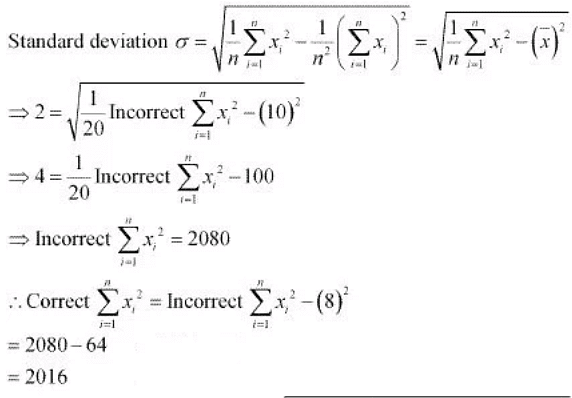
NCERT Solutions: Exercise Miscellaneous - Statistics
= √4.09
= 2.02
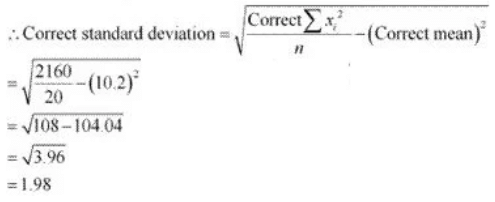
(ii) When 8 is replaced by 12,
Incorrect sum of observations = 200
Correct sum of observations = 200 - 8 + 12 = 204
∴ Correct mean = (Correct sum)/20 = 204/20 = 10.2
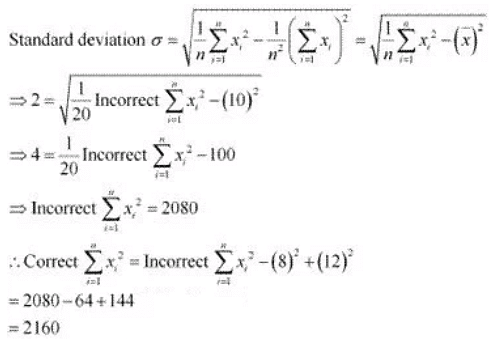
NCERT Solutions: Exercise Miscellaneous - Statistics

Q6: The mean and standard deviation of a group of 100 observations were found to be 20 and 3, respectively. Later on it was found that three observations were incorrect, which were recorded as 21, 21 and 18. Find the mean and standard deviation if the incorrect observations are omitted.
Ans: 
Number of observations (n) = 100
Incorrect mean NCERT Solutions: Exercise Miscellaneous - Statistics = 20Incorrect standard deviation (σ) = 3
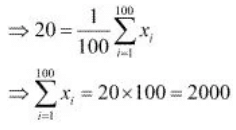
NCERT Solutions: Exercise Miscellaneous - Statistics
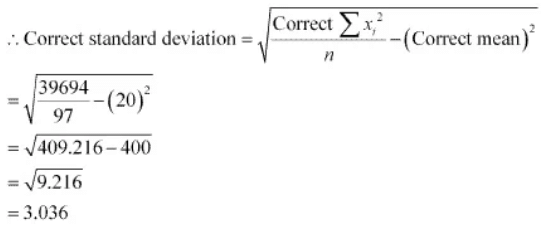
Incorrect sum of observations  = 2000
Correct sum of observations  = 2000 - 21 - 21 - 18 = 2000 - 60 = 1940
∴ Correct mean = (correct sum)/(100 - 3) = 1940/97 = 20
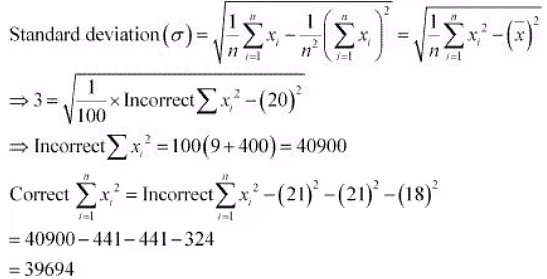
NCERT Solutions: Exercise Miscellaneous - Statistics

The document NCERT Solutions: Exercise Miscellaneous - Statistics is a part of the Commerce Course Mathematics (Maths) Class 11.
All you need of Commerce at this link: Commerce

FAQs on NCERT Solutions: Exercise Miscellaneous - Statistics

1. What is the importance of statistics in our daily lives?
Ans. Statistics play a crucial role in various aspects of our daily lives, including analyzing data, making informed decisions, predicting trends, conducting research, and understanding patterns and relationships in different fields.
2. How can statistics help in business decision-making?
Ans. Statistics can assist businesses in making informed decisions by analyzing market trends, customer preferences, sales data, financial performance, and other crucial factors that impact the success and growth of the organization.
3. What are the different types of statistical data?
Ans. The different types of statistical data include nominal data (categories without any specific order), ordinal data (categories with a specific order), interval data (numeric data with equal intervals), and ratio data (numeric data with a true zero point).
4. How is statistical analysis used in research studies?
Ans. Statistical analysis is essential in research studies to analyze data, test hypotheses, identify patterns, draw conclusions, and make predictions based on the findings. It helps researchers make sense of complex data and draw reliable conclusions.
5. How can statistics be used to interpret survey results?
Ans. Statistics can be used to interpret survey results by calculating frequencies, percentages, averages, correlations, and other statistical measures to analyze the responses, identify trends, draw comparisons, and draw meaningful insights from the survey data.
Explore Courses for Commerce exam
Get EduRev Notes directly in your Google search
Related Searches
Summary, NCERT Solutions: Exercise Miscellaneous - Statistics, pdf , NCERT Solutions: Exercise Miscellaneous - Statistics, MCQs, Extra Questions, shortcuts and tricks, Free, study material, video lectures, Sample Paper, ppt, past year papers, Semester Notes, NCERT Solutions: Exercise Miscellaneous - Statistics, Objective type Questions, Exam, Viva Questions, Important questions, practice quizzes, Previous Year Questions with Solutions, mock tests for examination;