The Limitation Act, 1963 - 1



The Limitation Act, 1963 - Introduction & Overview
- Limitation denotes a legally prescribed timeframe within which a person must initiate a suit, appeal or application to seek judicial redress.
- The Law of Limitation fixes that timeframe so claims are prosecuted promptly and evidence remains available.
- Section 2(j) of the Limitation Act, 1963 defines the terms "period of limitation" and "prescribed period" used throughout the Act.
Main Objects of the Law of Limitation
- Prevent injustice arising from enforcement of long-dormant claims.
- Protect defendants from loss of evidence and faded memories resulting in unfair trials.
- Encourage those with valid causes of action to litigate promptly.
Doctrine of Limitation and Prescription
- The doctrine rests on two key policy considerations: rights not exercised for long should not be revived indefinitely, and property rights must not remain uncertain.
- Prescription denotes acquisition or extinction of rights by lapse of time according to law; limitation bars remedy though the right may survive in conscience.
Purpose of Limiting Legal Actions
- Prevent perpetual litigation and ensure finality-interest reipublicae ut sit finis litium (it is in the public interest that there should be an end to litigation).
- Establish a reasonable timeframe for seeking remedies and promote timely dispute resolution.
Statute: The Limitation Act, 1963 - Overview
- The Limitation Act, 1963 consolidates rules on time limits for suits, appeals and applications and balances public interest with access to justice.
- The Act does not extinguish substantive rights generally; it bars the legal remedy in courts after prescribed periods, subject to exceptions in the Act.
Legal Remedies and Public Policy
- Legal remedies exist to redress injury; limitation statutes encourage timely prosecution of claims and discourage stale or oppressive litigation.
- The object is remedial: protect both plaintiffs and defendants and to preserve evidence and social stability.
Law of Limitation - Two Aspects of Statutes of Limitation
- Extinguishment in some legal systems; the Limitation Act, 1963 generally bars the remedy rather than destroying the underlying right.
- A time-barred claim may remain a moral or equitable obligation though not enforceable in a court of law except where the statute provides relief.
Significance of the Limitation Act
- Rooted in public policy; it prescribes periods within which suits, appeals and applications must be filed for public welfare.
- Provides certainty by fixing the lifespan of legal remedies and preventing indefinite vulnerability to litigation.
- The maxim interest reipublicae ut sit finis litium underlies statutory limitation law.
Nature of Limitation Laws
- Limitation provisions are primarily procedural and regulate access to courts; they do not create substantive causes of action.
- The remedy may be barred while the substantive right continues to exist beyond the prescribed period.
- Defensive pleas based on limitation are available to defendants even when they could not have brought the same claim as plaintiffs.
Application of the Limitation Act
- The Act applies to suits by plaintiffs; defendants may set up time-barred claims in defence (subject to rules on set-off and counter-claim).
- Set-off and counter-claims are treated as separate suits for the purpose of limitation and deemed instituted on the dates specified by law.
Legal Framework in India
- The Limitation Act, 1963 is the governing statutory code on limitation in India.
- The Act comprises statutory sections and a Schedule of Articles prescribing periods for different classes of suits.
Under Law of Limitation - Conceptual Framework
Salient Features of the Limitation Act
- The Act has 32 Sections (Section 32 was repealed) and 137 Articles divided into parts covering accounts, contracts, declarations, decrees, immovable property, movable property, torts, trusts, miscellaneous matters and suits with no prescribed period.
- Limitation periods vary widely according to the nature of the right sued upon: from 1 year to 30 years or more in specific contexts.
Reduction and Variability of Limitation Periods
- Some historical limitation periods were shortened (for example, certain periods reduced from 60 to 30 years for suits such as redemption or recovery of possession of mortgaged immovable property).
- Common limitation periods include three years for many contract and account suits, and 12 years in suits relating to immovable property, trusts and endowments, depending on the Article applicable.
- Suits for which the Schedule prescribes no period fall under special provisions (Article 113).
Appeals and Special Provisions
- The Act contains specific provisions on appeals and applications; historically, minimum times for appeals in capital matters were extended for adequate opportunity to move higher courts.
- Sections 4 and 5 provide rules for computation and extension of time for appeals and applications, subject to the conditions in the Act.
Expanded Definitions
- The Act expands definitions such as "application", "plaintiff" and "defendant" to include persons represented by executors, administrators and other legal representatives.
- Recipients of applications and persons represented in court proceedings are covered so the Act operates uniformly across procedural situations.
Illustrations and Examples
- Filing a suit against a foreign envoy requires Central Government consent under Sections 86-87 CPC; the time taken to obtain that consent is excluded from the limitation calculation under the Limitation Act.
- When an individual sues a foreign ruler, the delay in obtaining governmental consent is excluded from the computation of limitation.
- The Act applies without discrimination across religious or personal laws (Hindu/Muslim etc.), as confirmed by judicial pronouncements.
Scheme of the Limitation Act, 1963
- Contains 32 Sections (one repealed) and 137 Articles arranged into parts for different classes of suits and for appeals/applications.
Scheme of Articles (Schedule)
- Articles 1-113 chiefly deal with suits (classification, prescribed periods and commencement).
- Articles 114-117 deal with appeals and applications.
- Articles 118-137 contain miscellaneous provisions including computation rules and exclusions.
Classes of Suits (Schedule Structure)
- Suits relating to accounts (Articles 1-5).
- Suits relating to contracts (Articles 6-55).
- Suits relating to declarations (Articles 56-58).
- Suits relating to decrees and instruments (Articles 59-60).
- Suits relating to immovable property (Articles 61-67).
- Suits relating to movable property (Articles 63-71).
- Suits relating to tort (Articles 72-91).
- Suits relating to trusts and trust property (Articles 92-96).
- Suits relating to miscellaneous matters (Articles 97-112).
- Suits for which there is no prescribed period (Article 113).
Examples of Common Suit Types
- Account suits: dispute over financial records between parties.
- Contract suits: breach of a business agreement and recovery of loss.
Hence, the Limitation Act, 1963 organises litigation by prescribing clear limitation periods, balancing finality and fairness. It ordinarily bars the remedy while leaving the underlying right intact in conscience, subject to statutory exceptions and equitable relief provided under the Act.
Limitation of Suits, Appeals and Applications - Sections 3 to 11
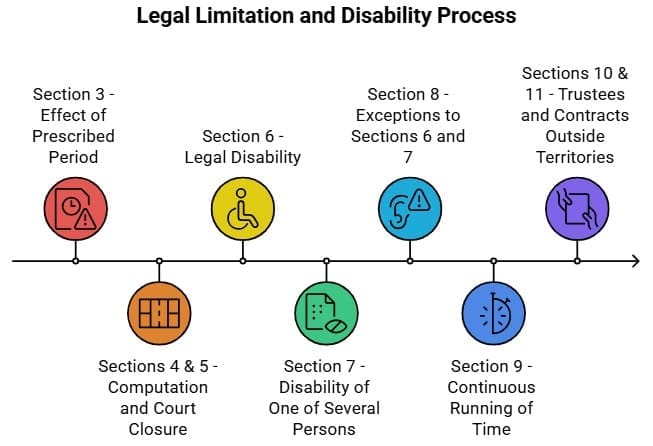
Section 3 - Effect of Prescribed Period
- Any suit, appeal or application instituted after the prescribed period shall be dismissed even if the defence of limitation is not taken by the opposite party.
- Definition of when a suit is considered instituted:
- In ordinary course, a suit is instituted when the plaint is presented to the proper officer.
- For a pauper, it is instituted when leave to sue as a pauper is applied for.
- For claims against a company in liquidation, it is instituted when the claim is first presented to the official liquidator.
- A claim by way of set-off or counter-claim is deemed a separate suit and is treated accordingly for limitation.
- The court must dismiss time-barred proceedings and cannot proceed with an application that is beyond the limitation period; a decree given on merits may be susceptible to rectification under procedural law.
- The limitation period commences when the cause of action arises - i.e., when facts exist that give a right to sue.
Prescribed Period and Practical Consequences
- Prescribed period means the time fixed by the Schedule for suits, appeals or applications.
- The Limitation Act bars the remedy; it does not ordinarily extinguish the right itself (see Bombay Dyeing & Mfg. Co. Ltd. v. State of Bombay - time-barred debts may subsist as moral obligations but be unenforceable).
- Parties cannot by agreement extend the statutory period; however, a defendant may consent to a time-barred claim.
Computation and Court Closure - Sections 4 & 5
- Section 4 provides that when the prescribed period expires on a day the court is closed, the suit, appeal or application may be instituted on the next open day.
- Section 5 allows courts to admit appeals or applications after the prescribed period if sufficient cause is shown; it is discretionary and primarily applies to appeals and applications (not suits), subject to statutory exceptions (for example, Order 21 CPC is excluded).
- Section 5 may condone excusable delays such as filing in a wrong court or other reasonable causes and applies to criminal appeals where sufficient cause is shown.
Practical Points on Condonation of Delay
- Applications to condone delay should normally be filed with the appeal memorandum where possible; courts grant condonation only in exceptional or sufficient cause cases.
- False or fabricated reasons for delay attract strict disapproval (see Pundik Jalam Patil v. Executive Engineer Jalgaon Medium Project - false statements led to refusal).
- Courts adopt a broad but reasoned approach in public interest (see State of West Bengal v. W.B. Judicial Service Association where government appeals were treated liberally due to public interest considerations).
Setting Aside Ex-parte Decrees and Interim Relief
- Making an application to set aside an ex-parte decree often requires condonation of delay where the application is filed beyond the prescribed period; courts examine diligence and reason for delay.
- Civil courts retain power to pass interim orders, including injunctions, pending adjudication on limitation or merits where legally justified.
Section 6 - Legal Disability
- Persons under legal disability (minors, lunatics and idiots) may institute suits or make applications within the period after the disability ceases.
- If a disability subsists until death, the legal representative may institute suit within the time specified after the death.
- Minor includes an unborn child for the purpose of this section.
- Section 6 does not apply to appeals by minors; it applies to suits and applications for execution of decrees and similar proceedings as specified in the Act.
- Sections 6, 7 and 8 operate together and must be read conjunctively.
Section 7 - Disability of One of Several Persons
- Where several persons are jointly interested in a suit or application and one is under disability, time does not run against those who are under disability if consent or discharge cannot be given without them.
- If a discharge can be given by one without consent of the disabled, time runs against those from whom discharge can be obtained.
- Explanation I covers discharges in various liabilities including immovable property; Explanation II extends to managers of Hindu undivided families.
Discharge of Liability in Joint Families
- Under Mitakshara law, the manager of a joint family (Karta) may in certain circumstances give discharge on behalf of the family without consent of all coparceners when he manages joint family property.
- In litigation, when limitation is computed against joint plaintiffs, the period may start when one capable of giving discharge is available.
Representative Case: Narayan v. Babasaheb (2016)
- Facts involved ancestral property and whether a sale could be set aside by those attaining majority.
- Court held Article 60 applied rather than Article 109 and fixed a three-year period from attaining majority to challenge the sale.
Section 8 - Exceptions to Sections 6 and 7
- Section 8 imposes special limitation for certain rights (for example, rights of pre-emption) restricting the extended period after cessation of disability to three years.
- This section acts as a proviso to Sections 6 and 7, applying specific shorter limits in particular cases.
Section 9 - Continuous Running of Time
- Once the limitation period begins to run, subsequent disabilities (except those covered by the Act) do not generally stop it.
- Exception arises where administration or other statutory events suspend the running of limitation as per specified Articles.
Sections 10 & 11 - Trustees and Contracts Outside Territories
- Section 10 deals with suits against trustees: many suits against trustees or their representatives concerning trust property have special rules and in some cases are not barred by any length of time under the Act.
- Section 11 deals with suits founded on contracts made outside the territories to which the Act extends; it prescribes the application of this Act's rules and exceptions where foreign limitation rules cannot be invoked to defeat a suit in India except in specific circumstances.
Exclusion of Time in Legal Proceedings - General Rules
- When computing limitation the first day is excluded.
- Time taken to obtain copies of judgments, decrees or awards is excluded where the applicant was prevented from proceeding without such copies.
- Time spent in obtaining governmental consent, notices under Section 80 CPC, or time during which there was a stay of proceedings may be excluded as provided in the Act.
- Time spent by a party diligently pursuing proceedings in a court lacking jurisdiction (in good faith) may be excluded under Section 14 when conditions are satisfied.
- Delays caused by a party's own negligence in obtaining copies are not excluded.
- Specific exclusions also apply to receivers, liquidators and insolvency proceedings as provided in the Act (e.g., time between initiation and appointment plus three months in some situations).
Judicial Time Exclusions and Related Rules
- The interval between delivery of judgment and signing of decree is not excluded except for the time reasonably required to apply for and obtain copies.
- Section 13 - Leave to sue or appeal as a pauper: time spent in good faith pursuing such application (even if initially rejected) is excluded from limitation.
- Section 14 - Bona fide proceedings without jurisdiction: time spent in a prior civil proceeding diligently pursued in a court lacking jurisdiction is excluded from limitation for the subsequent proceeding, subject to conditions (both matters civil, same party, diligence, failure due to jurisdictional defect or similar reason).
- Section 14 is mandatory where conditions exist; it differs from Section 5 in that Section 5 is discretionary and depends upon sufficient cause being shown.
- The misjoinder of parties or causes of action can amount to a defect of jurisdiction for the purpose of Section 14 if the defect genuinely prevents adjudication on merits.
Conditions and Limits for Application of Section 14
- Both prior and later proceedings must be civil and pursued by the same party.
- Prior proceedings must have been pursued diligently and failed due to lack of jurisdiction or a similar defect.
- Section 14 does not apply to criminal proceedings.
- The subsequent proceeding is treated as if time spent in the earlier defective proceeding is excluded from computation of limitation.
Case Law and Interpretation
- J. Kumardasan Nair v. IRIC Sohan and Consolidated Engg. Enterprises v. Irrigation Department examined the prerequisites for invoking Section 14 and stressed diligence, good faith and similarity of causes.
- Commissioner, M.P. Housing Board v. M/S Mohan Lal & Co. clarified that different stages of proceedings (for example, arbitration and an execution objection) may not be the "same matter in issue" for Section 14.
Exclusion of Time in Specific Cases
- Period of suspension of proceedings by court order is excluded from limitation calculation for the suspended suit or execution application.
- Time for giving notice required by law (e.g., Section 80 CPC) is excluded from the limitation period for the subsequent suit.
- Time when a defendant was absent from India is excluded for the period of absence.
- Time necessary to challenge or set aside a sale in execution may be excluded when the purchaser later seeks possession after a sale if proceedings were diligently pursued to set aside the sale.
- Receivers and liquidators have special exclusion periods (application to appointment plus three months) in suits connected with insolvency or winding up.
Practical Observations and Statutory Examples
- To rely on certain exclusions (e.g., Section 15(4)), conditions must be satisfied: the proceeding to set aside a sale must be diligently pursued and the later suit must be of the nature contemplated by the Article.
- Corporate residence rules (Article interpretations) have been considered in cases such as Turner Morrison & Co. Ltd. v. Hungerford Investment Trust Ltd. concerning where companies are regarded as resident for limitation purposes.
Under Special Situations Affecting Limitation
Section 16 - Effect of Death on Right to Sue
- If a person dies before the right to sue accrues, the limitation period begins when a legal representative capable of suing exists.
- If the defendant dies before the right accrues, limitation commences when a representative becomes available against whom an action can be taken.
- Exceptions: Rights of pre-emption, possession of immovable property and hereditary offices are treated differently by the Act.
- For Section 16 to apply, death must precede accrual of the right to sue; if the cause of action accrues during lifetime, normal rules on accrual apply.
Section 17 - Effect of Fraud or Mistake
- Where a suit or application is based on the defendant's fraud, concealment of title, or relief from mistake, limitation runs from the date when the plaintiff discovered the fraud or mistake or could, with reasonable diligence, have discovered it.
- This section does not aid those who purchase property for value from innocent third parties in certain circumstances; certain transactions obtained for value by bona fide purchasers are protected.
- Courts require clear proof of fraud; mere suspicion does not suffice for invoking the extension of limitation under Section 17.
- Section 17 has been applied in contexts such as challenging arbitration awards where fraud was alleged; judicial scrutiny ensures the fraud is material and linked to suppression of essential facts.
Acknowledgement in Writing - Recommencement of Limitation
- An express written and signed acknowledgement of liability by the party against whom a claim is made restarts the limitation period from the date of that acknowledgement in writing.
- Such acknowledgements must be clear and signed by the party or a person competent to bind the party.
Recent Judicial Trends and Interpretations
- Courts have emphasised the need for genuine and specific pleading of facts when relying on Sections 5, 14 or 17 for condonation or exclusion of time.
- Judicial approach balances equitable considerations (relief where justice demands) and statutory predictability (finality and certainty in litigation).
Key Legal Principles - Practical Checklist for Litigators
- Identify the applicable Article in the Schedule for the nature of the suit.
- Determine the date of accrual of the cause of action and compute excluding the first day.
- Check for statutory exclusions: court closure, obtaining copies, Section 80 notices, absence from India, receivers/liquidators, and stay orders.
- If relying on Section 5, prepare affidavit evidence establishing sufficient cause for delay; for Section 14, ensure prerequisites of diligence and jurisdictional defect are clearly met.
- When alleging fraud (Section 17), plead and prove the fraud; limitation runs from discovery of fraud.
- Consider if an acknowledgement in writing exists which would restart limitation.
Concluding Remarks
- The Limitation Act, 1963 is an essential procedural code ensuring litigation proceeds within legislatively fixed periods while allowing limited statutory and equitable exceptions.
- Understanding the interaction of sections (3-17), the Schedule Articles, and relevant case law is crucial for litigators and judges to decide whether a claim is maintainable or time-barred.
FAQs on The Limitation Act, 1963 - 1
| 1. What is the Law of Limitation in India and how does it apply to suits, appeals, and applications? |  |
| 2. What is the significance of the Judicial Academy Jharkhand in relation to the Limitation Act, 1963? | |
| 3. How does Section 7 of the Limitation Act, 1963 address the issue of disability of one of several persons in relation to filing legal actions? | |
| 4. What are the judicial time exclusions under the Limitation Act, 1963 and how do they impact the calculation of time limits for legal actions? | |
| 5. How does legal precedent play a role in interpreting and applying the provisions of the Limitation Act, 1963? | |