IGCSE Class 10 > Class 10 Notes > Biology for GCSE/ > Chemicals & Life
Chemicals & Life

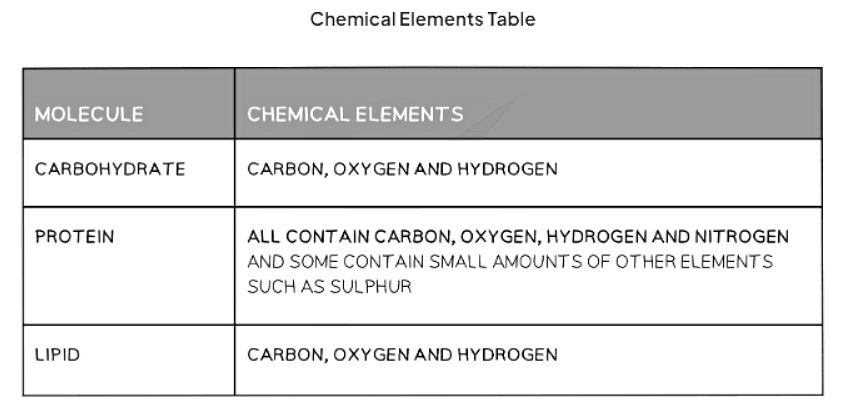
Chemical Elements
- The majority of molecules found in living organisms can be classified into three main categories: carbohydrates, proteins, and lipids.
- All of these molecular groups contain carbon and are therefore categorized as organic molecules.
Large Molecules are Made from Smaller Molecules
Carbohydrates
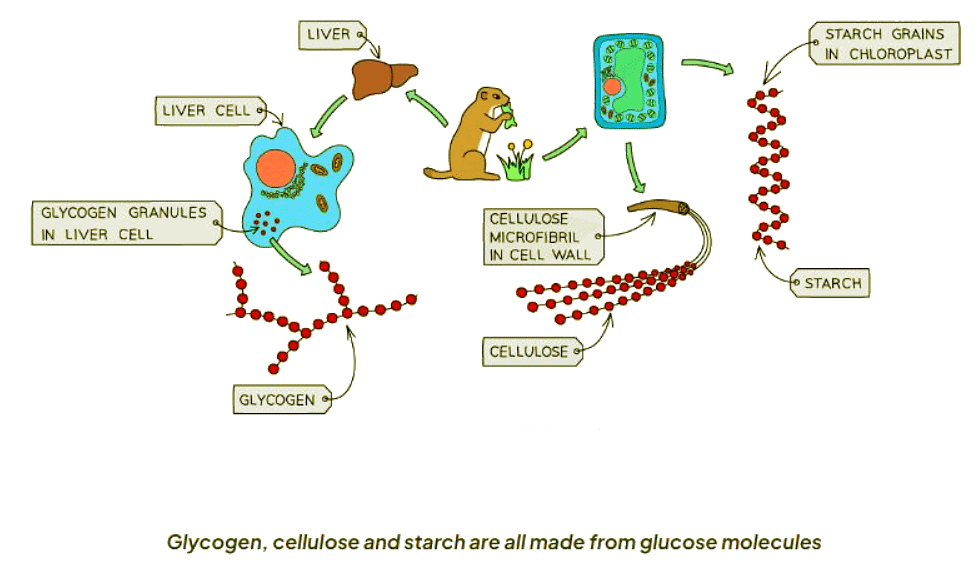
- Carbohydrates are composed of long chains of simple sugars.
- Glucose, a monosaccharide, is an example of a simple sugar.
- The combination of two glucose molecules forms maltose, a disaccharide.
- When numerous glucose molecules link together, they can form complex carbohydrates such as starch, glycogen, or cellulose, which are polysaccharides.
Fats
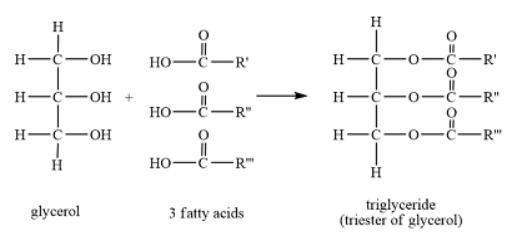
- Most fats (lipids) in the body are made up of triglycerides
- Their basic unit is 1 glycerol molecule chemically bonded to 3 fatty acid chains
- The fatty acids vary in size and structure
- Lipids are divided into fats (solids at room temperature) and oils (liquids at room temperature)
Proteins
- Triglycerides consist of long chains of amino acids.
- There are approximately 20 different types of amino acids.
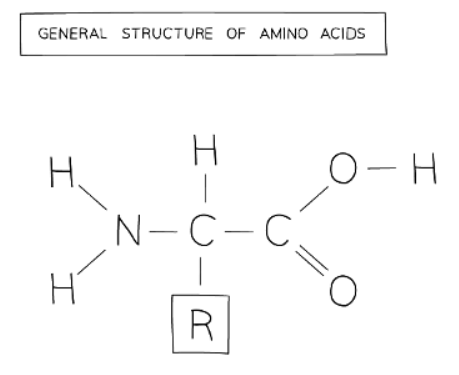
- All amino acids share a common basic structure, but each has a unique 'R' group.
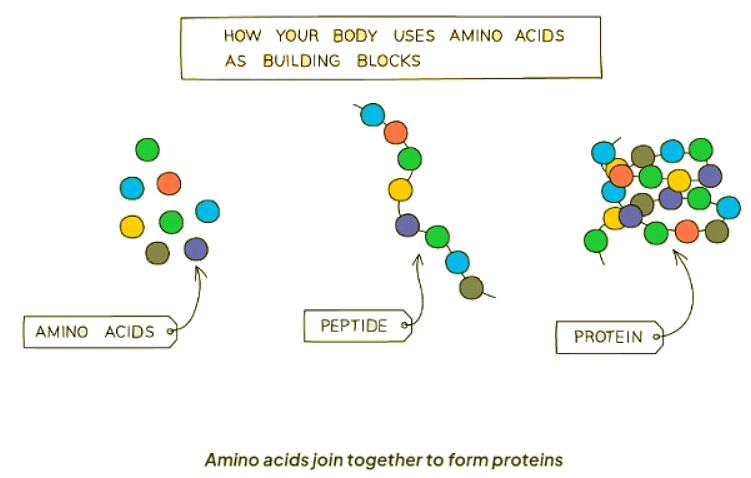
- Formation of proteins occurs when amino acids bond together.
- Amino acids can be sequenced in various orders, resulting in diverse proteins.
- Even a slight variance in amino acid sequence leads to the creation of a distinct protein.
MULTIPLE CHOICE QUESTIONTry yourself: Which category of molecules contains long chains of simple sugars?
The document Chemicals & Life is a part of the Class 10 Course Biology for GCSE/IGCSE.
All you need of Class 10 at this link: Class 10
FAQs on Chemicals & Life
| 1. What are the chemical elements that make up large molecules in living organisms? |  |
Ans. Large molecules in living organisms are made up of chemical elements such as carbon, hydrogen, oxygen, nitrogen, sulfur, and phosphorus.
| 2. How are large molecules formed from smaller molecules in biological systems? | |
Ans. Large molecules are formed from smaller molecules through chemical reactions such as condensation reactions, where water is released, and polymerization, where smaller molecules called monomers join together to form polymers.
| 3. What is the structure of a triglyceride molecule and what is its function in living organisms? | |
Ans. A triglyceride molecule consists of a glycerol molecule bonded to three fatty acid molecules. Triglycerides serve as energy storage molecules and provide insulation and protection for organs in living organisms.
| 4. Can you explain the general structure of an amino acid and how amino acids join together to form proteins? | |
Ans. Amino acids consist of a central carbon atom bonded to an amine group, a carboxyl group, a hydrogen atom, and a variable R group. Amino acids join together through peptide bonds to form proteins, with the amine group of one amino acid bonding to the carboxyl group of another.
| 5. How do the chemicals mentioned in the article contribute to the functioning of living organisms? | |
Ans. The chemicals mentioned, such as triglycerides, amino acids, and proteins, play essential roles in the structure, energy storage, and functioning of living organisms. Triglycerides provide long-term energy storage, while amino acids and proteins are crucial for various biological processes, including enzyme catalysis, structural support, and transport of molecules.
About this Document

4.71/5 Rating

Apr 29, 2026 Last updated
Related Exams
Document Description: Chemicals & Life for Class 10 2026 is part of Biology for GCSE/IGCSE preparation. The notes and questions for Chemicals & Life have been prepared according to the Class 10 exam syllabus. Information about Chemicals & Life covers topics like and Chemicals & Life Example, for Class 10 2026 Exam. Find important definitions, questions, notes, meanings, examples, exercises and tests below for Chemicals & Life.
Introduction of Chemicals & Life in English is available as part of our Biology for GCSE/IGCSE for Class 10 & Chemicals & Life in Hindi for Biology for GCSE/IGCSE course. Download more important topics related with notes, lectures and mock test series for Class 10 Exam by signing up for free. Class 10: Chemicals & Life
Description
Chemicals & Life of Biology covers all the important topics, helping you prepare for the Class 10 exam on EduRev. Start for free!
Information about Chemicals & Life
In this doc you can find the meaning of Chemicals & Life defined & explained in the simplest way possible. Besides explaining types of Chemicals & Life theory, EduRev gives you an ample number of questions to practice Chemicals & Life tests, examples and also practice Class 10 tests



Related Searches
Summary, Previous Year Questions with Solutions, past year papers, practice quizzes, study material, MCQs, Exam, Chemicals & Life, Viva Questions, mock tests for examination, Free, Sample Paper, ppt, Extra Questions, Semester Notes, Chemicals & Life, Objective type Questions, pdf , shortcuts and tricks, video lectures, Important questions, Chemicals & Life;