Learn at a Glance: Coordinate Conjunctions


What are coordinate conjunctions?
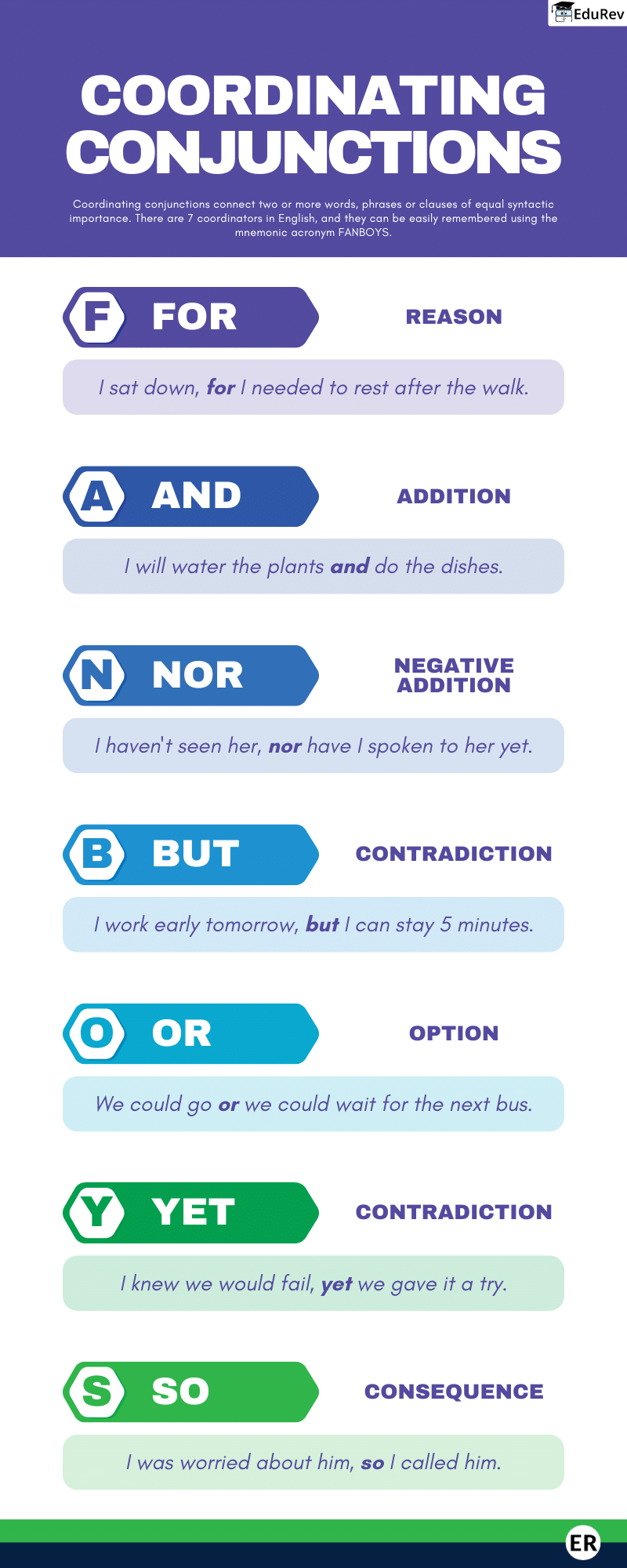
A coordinate conjunction is a word that joins two words, two phrases, or two independent clauses of equal importance in a sentence. These conjunctions do not make one part depend on the other; they simply connect them so the sentence reads naturally.
Common coordinate conjunctions
- and - adds information
- but - shows contrast or something different
- or - gives a choice or alternative
- so - shows result or consequence
- for - gives a reason (similar to 'because')
- nor - used for a negative choice, often with 'neither'
- yet - shows contrast, similar to 'but' (a little stronger)
How coordinate conjunctions join different parts
Joining two words
Coordinate conjunctions can join two nouns, verbs, adjectives or adverbs.
- Rina and Sameer are friends.
- He will run or walk to school.
- The bag is heavy but useful.
Joining two phrases
Phrases are groups of words that work together. Coordinate conjunctions join phrases of equal importance.
- She sat on the chair and under the tree.
- We can meet in the morning or in the evening.
Joining two clauses (compound sentences)
When two complete sentences (independent clauses) are joined by a coordinate conjunction, they form a compound sentence. Both clauses could stand alone as sentences, but joining them makes the writing smoother.
- He finished his homework, and he played in the park.
- It was raining, so we stayed indoors.
Punctuation rule with coordinate conjunctions
When two independent clauses are joined by a coordinate conjunction, place a comma before the conjunction. This is the simplest rule students should follow.
- Correct: The bell rang, and the children ran out.
- Correct: It was late, but he continued reading.
- Short sentences joined by a conjunction may not always need a comma, but using a comma is safe and clear for learners when both parts are full clauses.
Pairs and related words
Some conjunctions appear with special pairs called correlative conjunctions. These pairs work together and also join equal parts. These are closely related to coordinating conjunctions and useful to know:
- either... or - gives two choices
- neither ... nor - gives two negative choices
- both ... and - adds two things together for emphasis
Examples with explanation
- Rohit plays football and swims in the pool. - and joins two verbs (activities).
- I wanted to go, but it started to rain. - but shows contrast between the desire and the weather.
- Take an umbrella, or you will get wet. - or gives an alternative result.
- She was hungry, so she ate an apple. - so shows the result of being hungry.
- He did not call, nor did he send a message. - nor joins two negative clauses (note inversion in the second clause).
- She studied hard, for she wanted to pass the test. - for gives the reason.
- The road was narrow, yet cars passed easily. - yet shows contrast that is somewhat surprising.
How to change two short sentences into one using a coordinate conjunction
Start with two short sentences, then choose a suitable conjunction and join them. Remember to put a comma before the conjunction when both parts are full sentences.
- Short sentences: The sun rose. The birds began to sing. → The sun rose, and the birds began to sing.
- Short sentences: He was tired. He kept working. → He was tired, yet he kept working.
FAQs on Learn at a Glance: Coordinate Conjunctions
| 1. What are coordinate conjunctions? |  |
| 2. What are some common examples of coordinate conjunctions? | |
| 3. How do coordinate conjunctions differ from subordinating conjunctions? | |
| 4. Can coordinate conjunctions be used to join more than two elements in a sentence? | |
| 5. How can coordinate conjunctions help improve the flow and clarity of a sentence? | |