IGCSE Class 10 > Class 10 Notes > Biology for GCSE/ > Enzyme Action & Specificity
Enzyme Action & Specificity

Enzyme Action & Specificity: Extended
- Enzymes exhibit specificity to particular substrates due to the complementarity between the active site of the enzyme, where the substrate binds, and the substrate itself.
- The unique three-dimensional structure of enzymes, being proteins, underpins their specificity.
- This concept is encapsulated in the lock and key hypothesis.
- Upon the substrate binding to the active site, it forms an enzyme-substrate complex.
- Following the reaction, the products disengage from the active site, facilitated by their altered shape, rendering the enzyme available to bind another substrate.
How Enzymes Work
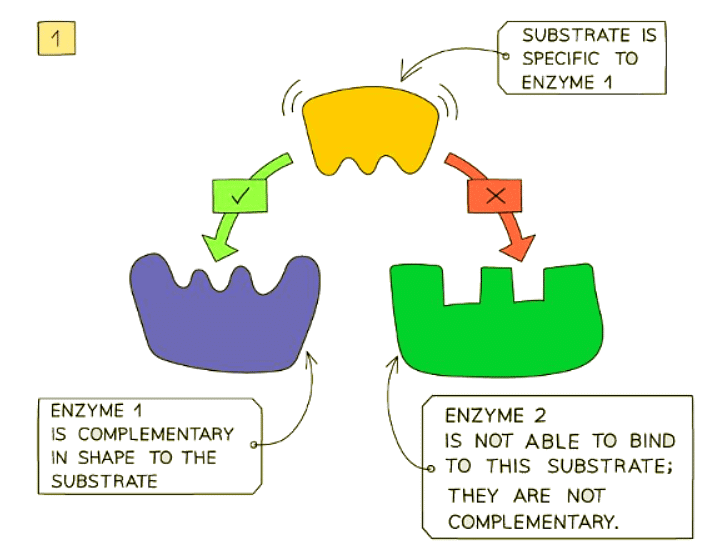
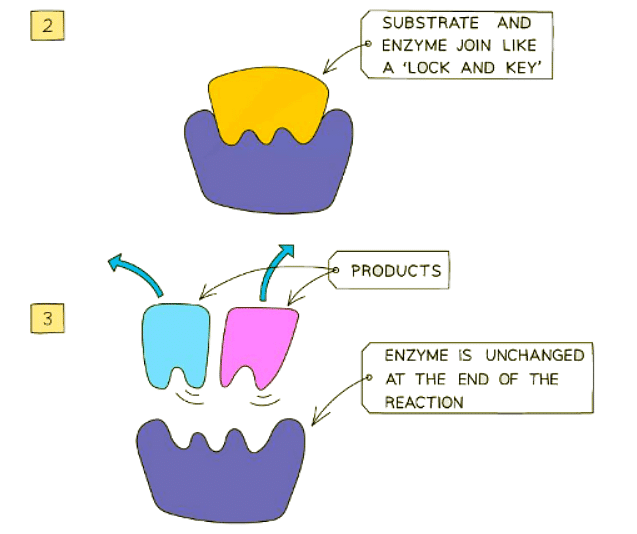
Enzymes Work Process:
- Enzymes and substrates exhibit random movement within a solution.
- When an enzyme and its corresponding substrate collide randomly, and the substrate fits into the enzyme's active site, an enzyme-substrate complex is generated, initiating the reaction.
- Subsequently, products emerge from the substrates within the active site, and upon release, the enzyme remains unaltered, available to catalyze subsequent reactions.
MULTIPLE CHOICE QUESTIONTry yourself: What is the main reason for the specificity of enzymes to particular substrates?
The document Enzyme Action & Specificity is a part of the Class 10 Course Biology for GCSE/IGCSE.
All you need of Class 10 at this link: Class 10
FAQs on Enzyme Action & Specificity
| 1. How do enzymes work in the body? |  |
Ans. Enzymes work by speeding up chemical reactions in the body. They bind to specific molecules, called substrates, and lower the activation energy needed for the reaction to occur, making the process more efficient.
| 2. What is enzyme specificity? | |
Ans. Enzyme specificity refers to the ability of an enzyme to only catalyze a specific reaction with a specific substrate. Each enzyme has a unique active site that fits only one specific substrate, ensuring precise and efficient reactions.
| 3. How does enzyme action impact biological processes? | |
Ans. Enzyme action is crucial for various biological processes such as metabolism, digestion, and cellular signaling. Without enzymes, these processes would be too slow to sustain life, highlighting the importance of enzyme specificity in maintaining cellular functions.
| 4. Can enzymes work on any type of substrate? | |
Ans. Enzymes are highly specific and can only work on substrates that fit into their unique active sites. While some enzymes may have flexibility in recognizing similar substrates, they generally cannot catalyze reactions with completely different molecules.
| 5. How can enzyme specificity be affected by factors such as pH and temperature? | |
Ans. Enzyme specificity can be influenced by pH and temperature changes. Extreme pH levels or temperatures can alter the enzyme's structure, affecting its active site and overall function. This can lead to a decrease in enzyme activity and specificity.
About this Document

4.85/5 Rating

Apr 29, 2026 Last updated
Related Exams
Document Description: Enzyme Action & Specificity for Class 10 2026 is part of Biology for GCSE/IGCSE preparation. The notes and questions for Enzyme Action & Specificity have been prepared according to the Class 10 exam syllabus. Information about Enzyme Action & Specificity covers topics like and Enzyme Action & Specificity Example, for Class 10 2026 Exam. Find important definitions, questions, notes, meanings, examples, exercises and tests below for Enzyme Action & Specificity.
Introduction of Enzyme Action & Specificity in English is available as part of our Biology for GCSE/IGCSE for Class 10 & Enzyme Action & Specificity in Hindi for Biology for GCSE/IGCSE course. Download more important topics related with notes, lectures and mock test series for Class 10 Exam by signing up for free. Class 10: Enzyme Action & Specificity
Description
Enzyme Action & Specificity of Biology covers all the important topics, helping you prepare for the Class 10 exam on EduRev. Start for free!
Information about Enzyme Action & Specificity
In this doc you can find the meaning of Enzyme Action & Specificity defined & explained in the simplest way possible. Besides explaining types of Enzyme Action & Specificity theory, EduRev gives you an ample number of questions to practice Enzyme Action & Specificity tests, examples and also practice Class 10 tests



Related Searches
Free, practice quizzes, study material, past year papers, MCQs, Semester Notes, Enzyme Action & Specificity, shortcuts and tricks, Extra Questions, pdf , ppt, Important questions, Previous Year Questions with Solutions, Summary, Enzyme Action & Specificity, Viva Questions, mock tests for examination, Sample Paper, video lectures, Objective type Questions, Exam, Enzyme Action & Specificity;