IGCSE Class 10 > Class 10 Notes > Biology for GCSE/ > Minerals in Plants
Minerals in Plants

Minerals in Plants
- Photosynthesis results in the production of carbohydrates, yet plants also require various other biological molecules such as proteins, lipids, and nucleic acids like DNA.
- Since plants cannot consume food, they must synthesize these essential substances internally.
- Carbohydrates primarily consist of carbon, hydrogen, and oxygen, whereas proteins contain additional elements like nitrogen, and certain amino acids include other elements.
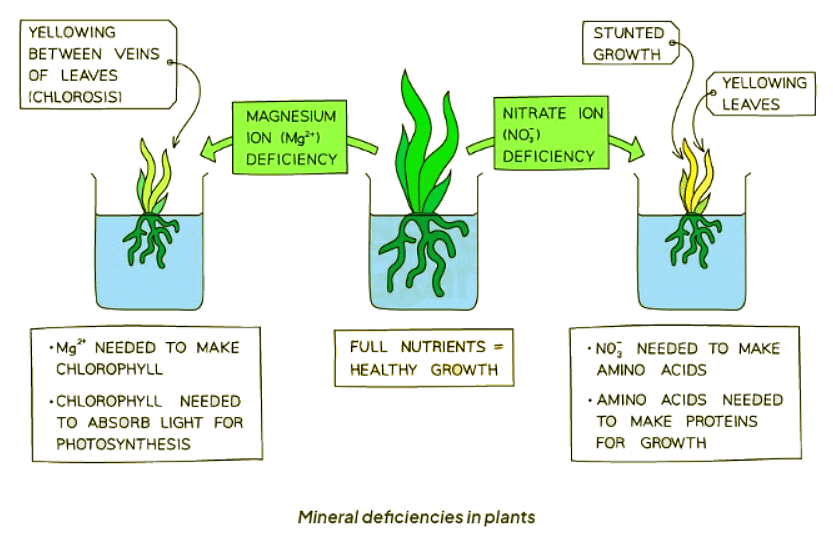
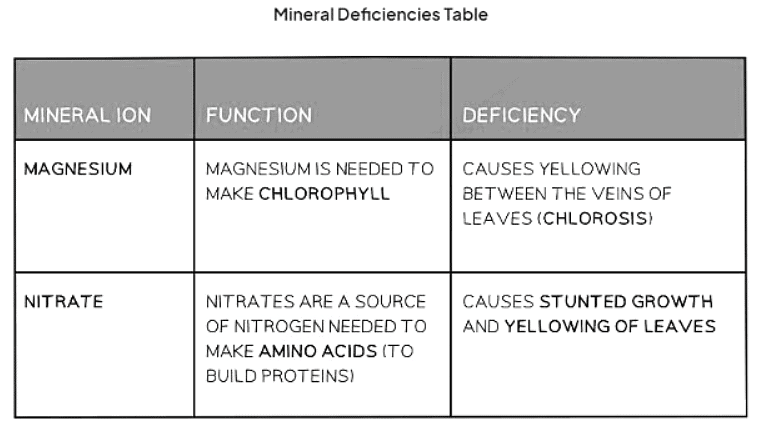
- Various chemicals within plants contain diverse elements; for instance, chlorophyll contains magnesium and nitrogen.
- Without a sufficient supply of these elements, plants are unable to undergo proper photosynthesis or grow effectively.
- Plants acquire necessary elements in the form of mineral ions actively absorbed by root hair cells from the soil.
- The term 'mineral' refers to any naturally occurring inorganic substance.
MULTIPLE CHOICE QUESTIONTry yourself: Which elements are primarily found in carbohydrates?
The document Minerals in Plants is a part of the Class 10 Course Biology for GCSE/IGCSE.
All you need of Class 10 at this link: Class 10
FAQs on Minerals in Plants
| 1. What are mineral deficiencies in plants? |  |
Ans. Mineral deficiencies in plants occur when essential minerals required for plant growth and development are lacking in the soil. This can lead to stunted growth, yellowing of leaves, and poor fruit or flower production.
| 2. How can mineral deficiencies in plants be identified? | |
Ans. Mineral deficiencies in plants can be identified through visual symptoms such as leaf discoloration, stunted growth, and abnormal leaf shapes. Soil testing can also help determine which minerals are lacking.
| 3. What are some common minerals essential for plant growth? | |
Ans. Some common minerals essential for plant growth include nitrogen, phosphorus, potassium, calcium, magnesium, and sulfur. These minerals play crucial roles in various physiological processes within the plant.
| 4. How can mineral deficiencies in plants be corrected? | |
Ans. Mineral deficiencies in plants can be corrected by adding fertilizers containing the lacking minerals to the soil. This helps provide the plants with the necessary nutrients for healthy growth and development.
| 5. Can mineral deficiencies in plants affect crop yield? | |
Ans. Yes, mineral deficiencies in plants can significantly impact crop yield. Without adequate minerals, plants may not be able to reach their full potential in terms of growth and productivity, leading to reduced crop yields.
About this Document

4.60/5 Rating

Apr 29, 2026 Last updated
Related Exams
Document Description: Minerals in Plants for Class 10 2026 is part of Biology for GCSE/IGCSE preparation. The notes and questions for Minerals in Plants have been prepared according to the Class 10 exam syllabus. Information about Minerals in Plants covers topics like and Minerals in Plants Example, for Class 10 2026 Exam. Find important definitions, questions, notes, meanings, examples, exercises and tests below for Minerals in Plants.
Introduction of Minerals in Plants in English is available as part of our Biology for GCSE/IGCSE for Class 10 & Minerals in Plants in Hindi for Biology for GCSE/IGCSE course. Download more important topics related with notes, lectures and mock test series for Class 10 Exam by signing up for free. Class 10: Minerals in Plants
Description
Minerals in Plants of Biology covers all the important topics, helping you prepare for the Class 10 exam on EduRev. Start for free!
Information about Minerals in Plants
In this doc you can find the meaning of Minerals in Plants defined & explained in the simplest way possible. Besides explaining types of Minerals in Plants theory, EduRev gives you an ample number of questions to practice Minerals in Plants tests, examples and also practice Class 10 tests



Related Searches
study material, Free, pdf , Objective type Questions, Extra Questions, Summary, mock tests for examination, Exam, Semester Notes, practice quizzes, MCQs, Viva Questions, ppt, Important questions, past year papers, Sample Paper, Previous Year Questions with Solutions, video lectures, shortcuts and tricks, Minerals in Plants, Minerals in Plants, Minerals in Plants;