IGCSE Class 10 > Class 10 Notes > Biology for GCSE/ > Effects of Temperature, Wind Speed & Humidity
Effects of Temperature, Wind Speed & Humidity

Explaining the Effects of Temperature, Wind Speed & Humidity: Extended
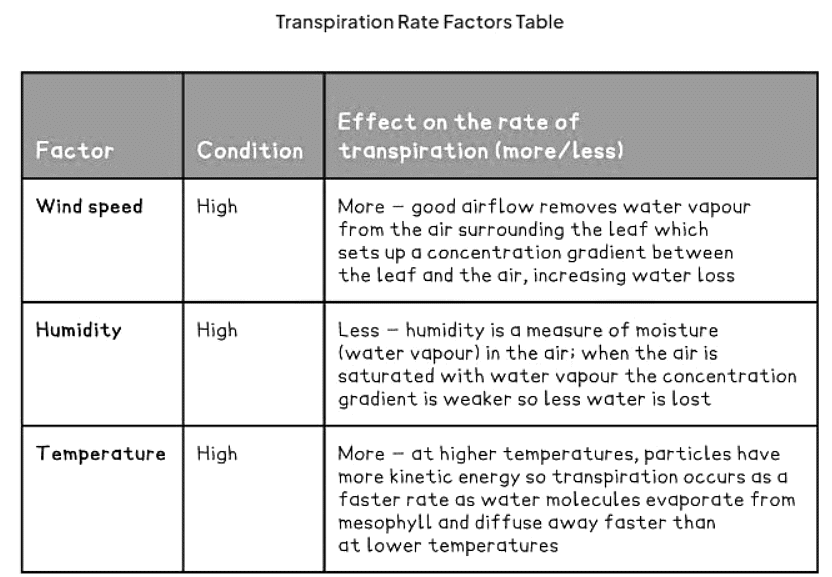
- Wind speed, humidity, and temperature exert influence on transpiration rates.
- The provided table delineates their impact on transpiration when they are all elevated; conversely, reduced levels of these factors would yield opposite effects.
- Utilizing a potometer allows for the examination of how environmental variables affect transpiration rates.
Wilting: Extended
- If a plant loses more water from its leaves than the soil can provide through osmosis, it results in wilting. This occurs when the plant cells lack sufficient water, causing the cell walls to lose strength and the plant to collapse.
- Wilting: This happens when the plant cells do not have enough water, leading to weakened cell walls and the plant's collapse.
 A wilted plant cannot support itself and starts to collapse
MULTIPLE CHOICE QUESTIONTry yourself: What is the result of a plant losing more water from its leaves than the soil can provide through osmosis?
The document Effects of Temperature, Wind Speed & Humidity is a part of the Class 10 Course Biology for GCSE/IGCSE.
All you need of Class 10 at this link: Class 10
FAQs on Effects of Temperature, Wind Speed & Humidity
| 1. How does temperature affect wilting in plants? |  |
Ans. Temperature can affect plant wilting by increasing the rate of transpiration, causing the plant to lose water faster than it can absorb it, leading to wilting.
| 2. How does wind speed impact wilting in plants? | |
Ans. High wind speeds can increase the rate of transpiration in plants, causing them to lose water quickly and potentially leading to wilting if the plant is unable to replace the lost water.
| 3. What role does humidity play in the wilting process of plants? | |
Ans. Low humidity levels can increase the rate of transpiration in plants, leading to wilting as the plant loses water faster than it can absorb it. High humidity levels, on the other hand, can help reduce transpiration and prevent wilting.
| 4. Can plants recover from extended wilting caused by temperature, wind speed, and humidity? | |
Ans. In some cases, plants can recover from extended wilting if they are provided with sufficient water and the environmental conditions are improved to reduce stress on the plant. However, prolonged wilting can cause irreversible damage to the plant.
| 5. How can gardeners mitigate the effects of temperature, wind speed, and humidity on plant wilting? | |
Ans. Gardeners can protect plants from extreme temperatures by providing shade or shelter, reducing wind exposure by using windbreaks, and maintaining optimal soil moisture levels to counteract the effects of high temperatures and low humidity on plant wilting.
About this Document

4.97/5 Rating

Apr 29, 2026 Last updated
Related Exams
Document Description: Effects of Temperature, Wind Speed & Humidity for Class 10 2026 is part of Biology for GCSE/IGCSE preparation. The notes and questions for Effects of Temperature, Wind Speed & Humidity have been prepared according to the Class 10 exam syllabus. Information about Effects of Temperature, Wind Speed & Humidity covers topics like and Effects of Temperature, Wind Speed & Humidity Example, for Class 10 2026 Exam. Find important definitions, questions, notes, meanings, examples, exercises and tests below for Effects of Temperature, Wind Speed & Humidity.
Introduction of Effects of Temperature, Wind Speed & Humidity in English is available as part of our Biology for GCSE/IGCSE for Class 10 & Effects of Temperature, Wind Speed & Humidity in Hindi for Biology for GCSE/IGCSE course. Download more important topics related with notes, lectures and mock test series for Class 10 Exam by signing up for free. Class 10: Effects of Temperature, Wind Speed & Humidity
Description
Effects of Temperature, Wind Speed & Humidity of Biology covers all the important topics, helping you prepare for the Class 10 exam on EduRev. Start for free!
Information about Effects of Temperature, Wind Speed & Humidity
In this doc you can find the meaning of Effects of Temperature, Wind Speed & Humidity defined & explained in the simplest way possible. Besides explaining types of Effects of Temperature, Wind Speed & Humidity theory, EduRev gives you an ample number of questions to practice Effects of Temperature, Wind Speed & Humidity tests, examples and also practice Class 10 tests



Related Searches
Viva Questions, Wind Speed & Humidity, practice quizzes, Semester Notes, Effects of Temperature, Summary, video lectures, Free, Wind Speed & Humidity, study material, Effects of Temperature, Extra Questions, Important questions, Exam, Sample Paper, Effects of Temperature, MCQs, Objective type Questions, pdf , shortcuts and tricks, Previous Year Questions with Solutions, Wind Speed & Humidity, past year papers, ppt, mock tests for examination;