IGCSE Class 10 > Class 10 Notes > Biology for GCSE/ > The Mammalian Heart
The Mammalian Heart

The Mammalian Heart
- The heart's orientation in diagrams can be misleading, where what appears as the left side is actually the right, and vice versa.
- Deoxygenated blood from the body is received by the right side of the heart, which then pumps it to the lungs for oxygenation.
- Oxygenated blood from the lungs is received by the left side of the heart, which then pumps it out to the body to supply tissues with oxygen.
- Veins carry blood towards the heart, while arteries carry blood away from the heart to various body parts.
- The two sides of the heart are separated by a muscular wall known as the septum, maintaining the segregation of oxygenated and deoxygenated blood.
- The heart is primarily composed of muscle tissue, which is nourished by the coronary arteries, ensuring its continuous function.
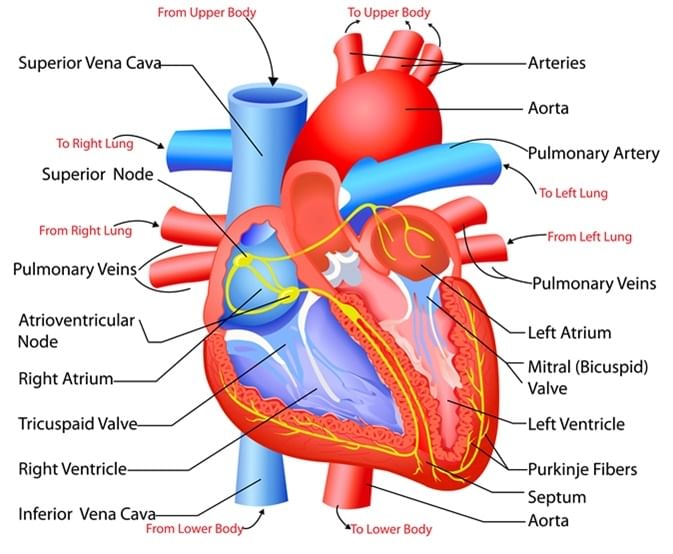 Structure of the heart
Structure of the Heart
- Overview of the Heart's Anatomy:
- The heart is a vital organ responsible for pumping blood throughout the body.
- It is composed of four chambers: two atria and two ventricles.
- Function of Arteries and Veins:
- Arteries carry oxygen-rich blood away from the heart to various parts of the body.
- Veins transport oxygen-depleted blood back to the heart.
- Cardiac Cycle Explanation:
- The cardiac cycle involves the contraction and relaxation of the heart muscle to pump blood.
- It includes systole (contraction) and diastole (relaxation) phases.
- Importance of Blood Circulation:
- Efficient blood circulation ensures delivery of oxygen and nutrients to tissues.
- It also aids in the removal of waste products from cells.
MULTIPLE CHOICE QUESTIONTry yourself: Which side of the heart receives deoxygenated blood from the body?
The document The Mammalian Heart is a part of the Class 10 Course Biology for GCSE/IGCSE.
All you need of Class 10 at this link: Class 10
FAQs on The Mammalian Heart
| 1. What is the main function of the mammalian heart? |  |
Ans. The main function of the mammalian heart is to pump blood throughout the body, delivering oxygen and nutrients to cells and removing waste products.
| 2. How is the mammalian heart structured? | |
Ans. The mammalian heart is composed of four chambers - two atria and two ventricles. The heart also has valves that ensure blood flows in the correct direction, as well as a network of blood vessels that supply the heart muscle itself.
| 3. What is the significance of the electrical conduction system in the mammalian heart? | |
Ans. The electrical conduction system in the mammalian heart regulates the heartbeat by coordinating the contraction and relaxation of the heart muscle. This system ensures that the heart beats in a coordinated and efficient manner.
| 4. How does the mammalian heart maintain its own blood supply? | |
Ans. The mammalian heart maintains its own blood supply through a network of coronary arteries that branch off from the aorta. These arteries deliver oxygenated blood to the heart muscle, ensuring that it has the energy it needs to pump blood effectively.
| 5. How does the structure of the mammalian heart contribute to its function? | |
Ans. The structure of the mammalian heart, with its four chambers, valves, and electrical conduction system, allows it to efficiently pump blood throughout the body. The coordinated contraction and relaxation of the heart muscle ensure that blood is circulated effectively, supporting the body's metabolic needs.
About this Document

4.95/5 Rating

Apr 29, 2026 Last updated
Related Exams
Document Description: The Mammalian Heart for Class 10 2026 is part of Biology for GCSE/IGCSE preparation. The notes and questions for The Mammalian Heart have been prepared according to the Class 10 exam syllabus. Information about The Mammalian Heart covers topics like and The Mammalian Heart Example, for Class 10 2026 Exam. Find important definitions, questions, notes, meanings, examples, exercises and tests below for The Mammalian Heart.
Introduction of The Mammalian Heart in English is available as part of our Biology for GCSE/IGCSE for Class 10 & The Mammalian Heart in Hindi for Biology for GCSE/IGCSE course. Download more important topics related with notes, lectures and mock test series for Class 10 Exam by signing up for free. Class 10: The Mammalian Heart
Description
The Mammalian Heart of Biology covers all the important topics, helping you prepare for the Class 10 exam on EduRev. Start for free!
Information about The Mammalian Heart
In this doc you can find the meaning of The Mammalian Heart defined & explained in the simplest way possible. Besides explaining types of The Mammalian Heart theory, EduRev gives you an ample number of questions to practice The Mammalian Heart tests, examples and also practice Class 10 tests



Related Searches
Free, Sample Paper, The Mammalian Heart, shortcuts and tricks, Important questions, pdf , Previous Year Questions with Solutions, practice quizzes, Exam, study material, Extra Questions, mock tests for examination, MCQs, video lectures, past year papers, The Mammalian Heart, Objective type Questions, Semester Notes, ppt, Viva Questions, The Mammalian Heart, Summary;