IGCSE Class 10 > Class 10 Notes > Biology for GCSE/ > Identifying Intercostal Muscles
Identifying Intercostal Muscles

Identifying Intercostal Muscles
Intercostal muscles play a vital role in the mechanics of breathing, aiding in the expansion and contraction of the rib cage.
Muscles and Their Functions
- Intercostal muscles operate by pulling on bones rather than pushing them, facilitating the movement of the rib cage.
- Two sets of intercostal muscles are necessary: one set elevates the rib cage, while the other depresses it.
- External intercostal muscles are situated externally on the rib cage, assisting in lifting the rib cage during inhalation.
- Internal intercostal muscles are located internally within the rib cage, aiding in the lowering of the rib cage during exhalation.
For instance, when you inhale deeply, your external intercostal muscles contract, lifting the rib cage upwards, allowing the lungs to expand and fill with air. Conversely, during exhalation, the internal intercostal muscles contract, reducing the size of the rib cage to expel air from the lungs.
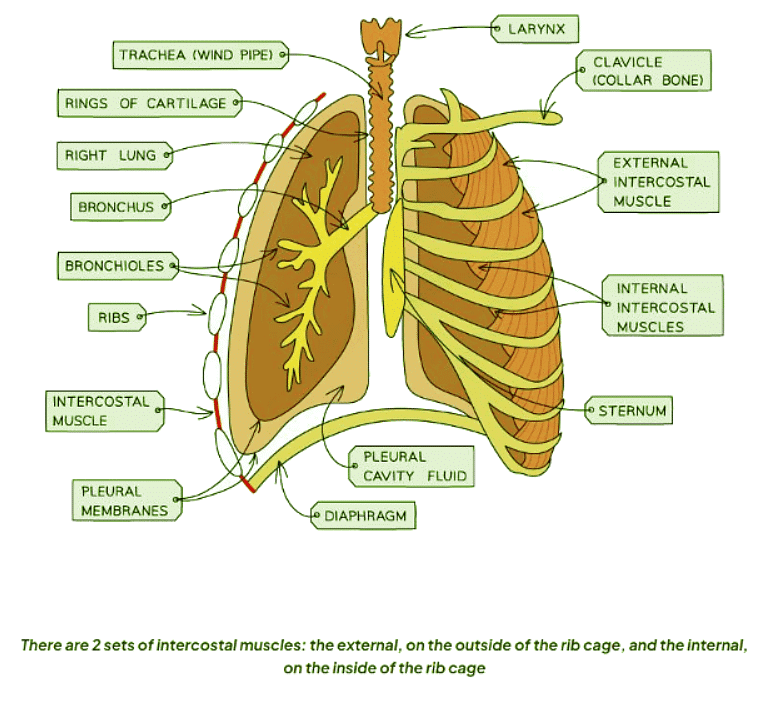
Intercostal Muscles
- External Intercostal Muscles: These muscles are positioned on the outer part of the rib cage. They play a crucial role in the process of inhalation by elevating the rib cage.
- Internal Intercostal Muscles: Situated on the inside of the rib cage, these muscles aid in the exhalation process by depressing the rib cage.
Examples:
- Example of External Intercostal Muscles: Imagine when you take a deep breath in, the action of these muscles helps expand your chest cavity, allowing more air into your lungs.
- Example of Internal Intercostal Muscles: When you forcefully exhale, such as when blowing out candles on a birthday cake, these muscles contract to reduce the space in the chest cavity, pushing the air out.
MULTIPLE CHOICE QUESTIONTry yourself: What is the function of the external intercostal muscles?
The document Identifying Intercostal Muscles is a part of the Class 10 Course Biology for GCSE/IGCSE.
All you need of Class 10 at this link: Class 10
FAQs on Identifying Intercostal Muscles
| 1. What are the functions of the intercostal muscles? |  |
Ans. The intercostal muscles help in expanding and contracting the rib cage during breathing, assist in stabilizing the chest wall, and aid in maintaining proper posture.
| 2. How many layers of intercostal muscles are there? | |
Ans. There are three layers of intercostal muscles - external intercostal muscles, internal intercostal muscles, and innermost intercostal muscles.
| 3. How can the intercostal muscles be strengthened? | |
Ans. Strengthening exercises such as deep breathing exercises, yoga, Pilates, and specific weight training exercises can help strengthen the intercostal muscles.
| 4. What are some common injuries associated with the intercostal muscles? | |
Ans. Common injuries include intercostal muscle strain or tear, which can result from sudden movements, overexertion, or repetitive motion.
| 5. Can intercostal muscle pain be a sign of a more serious condition? | |
Ans. Yes, severe or persistent intercostal muscle pain can sometimes be a symptom of a more serious condition such as a rib fracture, pneumonia, or pleurisy, and should be evaluated by a healthcare professional.
About this Document

4.76/5 Rating

Apr 29, 2026 Last updated
Related Exams
Document Description: Identifying Intercostal Muscles for Class 10 2026 is part of Biology for GCSE/IGCSE preparation. The notes and questions for Identifying Intercostal Muscles have been prepared according to the Class 10 exam syllabus. Information about Identifying Intercostal Muscles covers topics like and Identifying Intercostal Muscles Example, for Class 10 2026 Exam. Find important definitions, questions, notes, meanings, examples, exercises and tests below for Identifying Intercostal Muscles.
Introduction of Identifying Intercostal Muscles in English is available as part of our Biology for GCSE/IGCSE for Class 10 & Identifying Intercostal Muscles in Hindi for Biology for GCSE/IGCSE course. Download more important topics related with notes, lectures and mock test series for Class 10 Exam by signing up for free. Class 10: Identifying Intercostal Muscles
Description
Identifying Intercostal Muscles of Biology covers all the important topics, helping you prepare for the Class 10 exam on EduRev. Start for free!
Information about Identifying Intercostal Muscles
In this doc you can find the meaning of Identifying Intercostal Muscles defined & explained in the simplest way possible. Besides explaining types of Identifying Intercostal Muscles theory, EduRev gives you an ample number of questions to practice Identifying Intercostal Muscles tests, examples and also practice Class 10 tests



Related Searches
shortcuts and tricks, study material, Identifying Intercostal Muscles, video lectures, Exam, mock tests for examination, Extra Questions, MCQs, Summary, practice quizzes, Important questions, Objective type Questions, Semester Notes, Identifying Intercostal Muscles, past year papers, Free, Sample Paper, Identifying Intercostal Muscles, Viva Questions, ppt, pdf , Previous Year Questions with Solutions;