Learn at a Glance: Types of Eclipse


An eclipse is an event when one celestial body moves into the shadow of another. In everyday life on Earth we see two main kinds of eclipses: those that involve the Sun and the Moon. Eclipses are natural, predictable and can be explained using simple models of the Sun, Earth and Moon.
What is an eclipse?
An eclipse happens when three bodies - the Sun, the Earth and the Moon - line up in a straight or almost straight line so that one body blocks the light of another. Which body is blocked decides the name of the eclipse.
How an eclipse happens
- When the Moon comes between the Sun and the Earth, it can block sunlight from reaching parts of the Earth. This produces a solar eclipse.
- When the Earth comes between the Sun and the Moon, the Earth's shadow falls on the Moon. This produces a lunar eclipse.
Types of eclipse
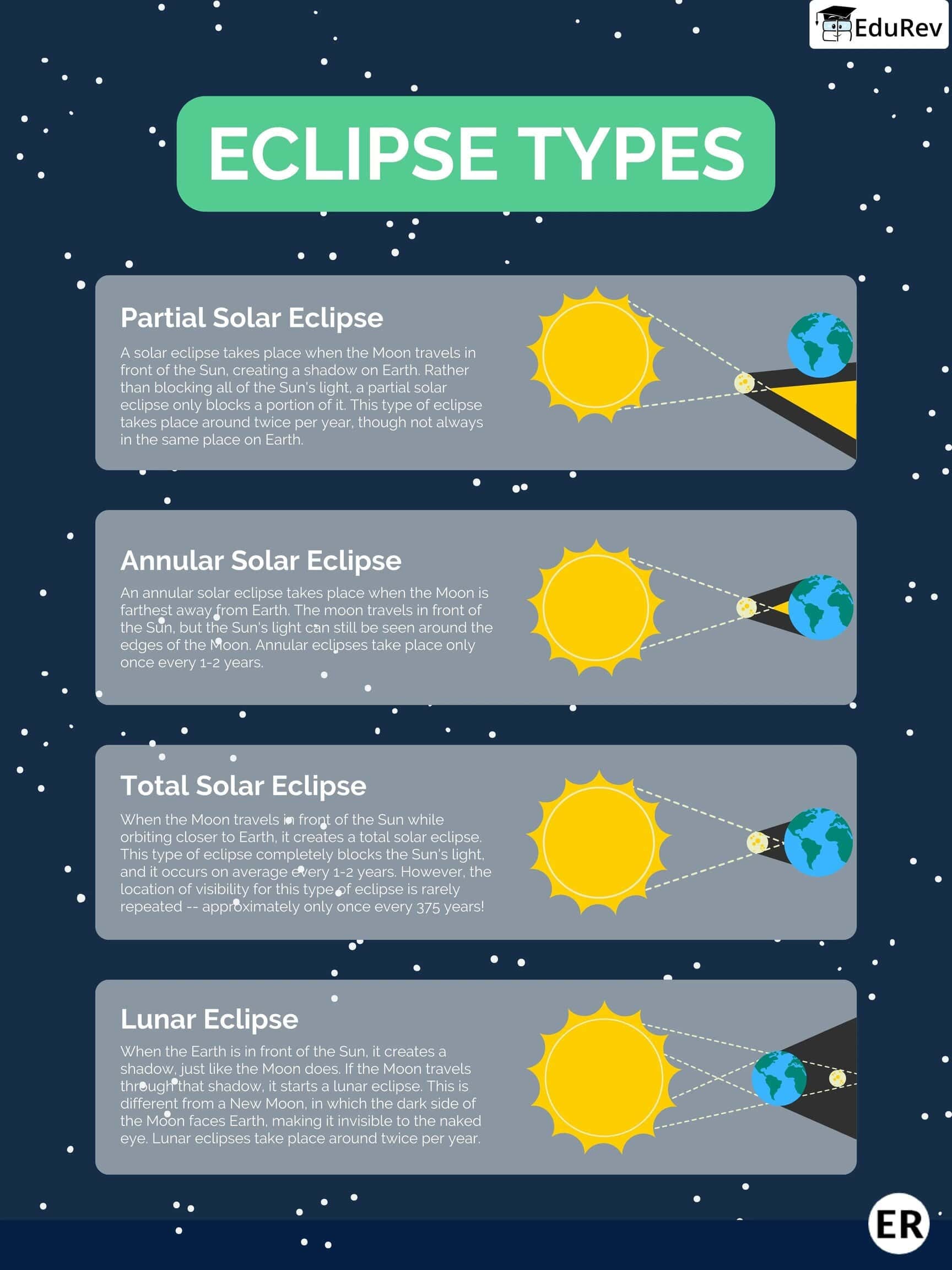
Solar eclipse
A solar eclipse occurs at new moon when the Moon passes between the Sun and the Earth. There are three main kinds of solar eclipse:
- Total solar eclipse - The Moon completely covers the Sun for a short time as seen from some places on Earth. The dark central part of the Moon's shadow, called the umbra, falls on Earth. The sky becomes much darker and the Sun's outer atmosphere (the corona) becomes visible.
- Partial solar eclipse - Only part of the Sun is covered by the Moon. This happens when the observer is inside the Moon's penumbra, the lighter outer part of the shadow. The Sun appears as if a bite has been taken out of it.
- Annular solar eclipse - The Moon is slightly farther from the Earth so it appears smaller than the Sun. It cannot cover the Sun completely and a bright ring of the Sun remains visible around the Moon. This ring is called an annulus.
Lunar eclipse
A lunar eclipse happens at full moon when the Earth comes between the Sun and the Moon. The Earth's shadow falls on the Moon. Lunar eclipses are safe to watch with the naked eye. There are three main kinds:
- Total lunar eclipse - The entire Moon passes into the Earth's umbra. The Moon often looks reddish during totality because sunlight scattered by the Earth's atmosphere reaches the Moon; this is sometimes called a "blood moon."
- Partial lunar eclipse - Only part of the Moon enters the Earth's umbra, so part of the Moon becomes dark while the rest stays bright.
- Penumbral lunar eclipse - The Moon passes through the Earth's penumbra only. The shading on the Moon is faint and sometimes hard to notice.
When and why eclipses do not happen every month
The Moon takes about one month to go around the Earth, so we have a new moon and a full moon every month. However, eclipses do not happen each month because the Moon's orbit is tilted by about 5° to the Earth's orbit around the Sun. Because of this tilt, most new and full moons pass a little above or below the direct line between the Sun and Earth. An eclipse occurs only when the Sun, Earth and Moon line up closely enough in the same plane.
Where and how often eclipses are visible
- Solar eclipses are visible only from a limited region on the Earth's surface. A total solar eclipse is visible along a narrow path called the path of totality. Outside that path people may see a partial eclipse.
- Lunar eclipses are visible from anywhere on the night side of the Earth when they happen, so they are seen by many more people than solar eclipses.
- On average, there are about two to five eclipses (solar or lunar) each year, but total solar eclipses at any particular place are rare.
Safety: how to watch eclipses
- Never look directly at the Sun without proper protection. Looking at the Sun can damage your eyes.
- For solar eclipses use special solar eclipse glasses that meet safety standards, or view the Sun through a proper solar filter attached to a telescope or binoculars.
- A safe and simple method is to make a pinhole projector: let sunlight pass through a small hole in a card and project the Sun's image on a white surface.
- Lunar eclipses are safe to watch with the naked eye; no special equipment is needed.
Interesting facts
- A total solar eclipse can turn day briefly into twilight and make bright stars and planets visible near the Sun.
- During a total lunar eclipse the Moon can look red because the Earth's atmosphere bends red sunlight into the shadow.
- Ancient people used eclipses to make calendars and to study the motions of the Sun and Moon.
Key terms to remember
- Umbra - The central, darkest part of a shadow where the light source is completely blocked.
- Penumba - The outer part of the shadow where the light source is only partly blocked.
- New moon - The Moon is between the Earth and the Sun; needed for solar eclipses.
- Full moon - The Earth is between the Sun and the Moon; needed for lunar eclipses.
FAQs on Learn at a Glance: Types of Eclipse
| 1. What is an eclipse? |  |
| 2. What are the types of eclipses? | |
| 3. Why do eclipses not happen every month? | |
| 4. How often are eclipses visible and where can they be seen? | |
| 5. What safety measures should be taken when watching an eclipse? | |