Learn at a Glance: Phases of Moon


The Moon changes its appearance from night to night. These changing shapes are called the phases of the Moon. By observing the Moon carefully over several nights, we notice that it sometimes appears as a thin sliver, sometimes as a half-circle and sometimes as a full bright disk. This chapter explains what causes these changes, names of the main phases, how long each phase lasts and simple activities to observe them yourself.
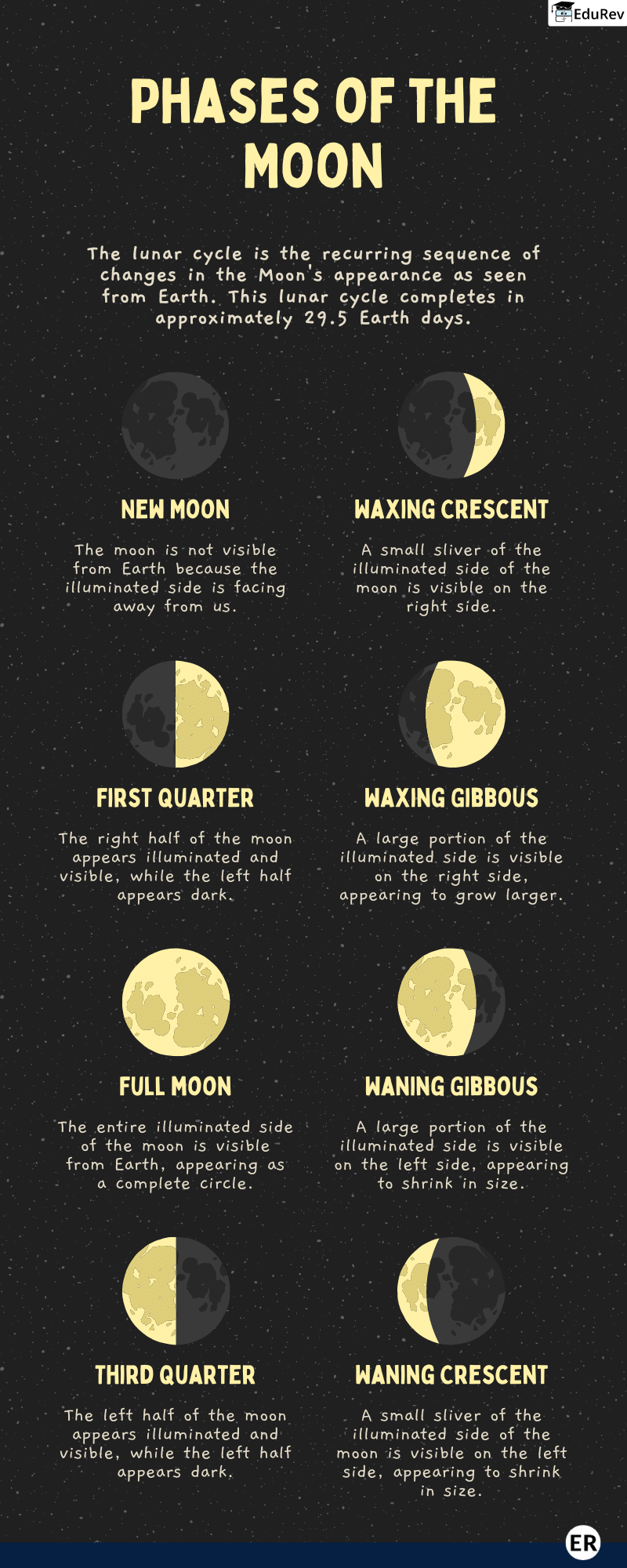
What are the phases of the Moon?
The phases of the Moon are the different shapes of the Moon that we see from Earth during one complete cycle of the Moon around Earth. Each phase depends on how much of the Moon's sunlit side faces the Earth at a particular time.
Why do phases occur?
Three bodies are involved: the Sun, the Earth and the Moon. The Sun lights up half of the Moon at any time. As the Moon moves around Earth, we see different parts of the sunlit half. The changing visible portion causes the phases.
- The Moon shines because it reflects sunlight; it does not make its own light.
- When the Moon is between the Sun and the Earth, we see very little or no sunlight on the side facing us: this is the New Moon.
- When the Earth is between the Sun and the Moon, the side facing us is fully lit: this is the Full Moon.
- At other positions, we see partly lit shapes - these are the different intermediate phases.
- The same side of the Moon generally faces Earth because the Moon rotates on its axis once in about the same time it takes to orbit Earth. This is why we always see roughly the same "face" of the Moon.
Names and order of the main phases
- New Moon - The Moon is between the Sun and Earth and the side facing Earth is dark. The Moon is not visible (or appears as a very thin line) at night.
- Waxing Crescent - A thin crescent of the Moon becomes visible after the New Moon. The visible part is increasing (waxing).
- First Quarter - Half of the Moon's disk is lit and half is dark. It is called a quarter because the Moon has completed about one quarter of its phase cycle.
- Waxing Gibbous - More than half of the Moon is lit and the lit area continues to increase toward full.
- Full Moon - The entire near side of the Moon is illuminated and appears as a full bright circle.
- Waning Gibbous - After full moon the visible bright part slowly decreases (wanes), but more than half is still lit.
- Last Quarter (or Third Quarter) - Again half of the Moon appears lit, but the opposite half compared with the First Quarter.
- Waning Crescent - A thin crescent of light remains just before returning to the New Moon.
How long does each phase last?
The complete cycle from one New Moon to the next (one synodic month) is about 29.5 days. The major phases appear roughly one week apart: New Moon → First Quarter → Full Moon → Last Quarter → New Moon. Each of these main phases occurs at about seven-day intervals, but the times are not exact because the Moon's orbit is slightly elliptical.
Simple model to understand phases (ball-and-torch activity)
This model shows why the Moon appears to change shape.
- Take a small ball (to represent the Moon) and a bright torch or a lamp (to represent the Sun).
- Hold the ball at arm's length so you can see the lit part and the dark part. Keep the torch fixed at one place, shining on the ball.
- Move slowly in a circle around your central position so that the ball moves around your head (which represents Earth). Observe how the lit part of the ball appears to change from your viewpoint.
- When the ball is between you and the lamp, the side facing you will be dark (New Moon). When it is on the opposite side of you from the lamp, the side facing you is fully lit (Full Moon). The positions in between show crescents and halves.
How to observe the Moon at home or in school
- Look at the Moon at the same time each evening for a month and draw its shape every night. You will see the sequence of phases clearly.
- Note the time you observe and the Moon's position in the sky (higher or lower). These notes help you understand how the Moon's rising and setting times change.
- Use a simple calendar or a smartphone Moon app to check the date of the next Full Moon or New Moon and compare with your observations.
- Try the ball-and-torch model in a dark room to see the light and shadow on the ball more clearly.
Why eclipses are not the same as phases
Phases are regular and happen because of how we see the sunlit part of the Moon. Eclipses are different events that happen only sometimes when the Sun, Earth and Moon line up very closely:
- Solar eclipse - occurs at New Moon when the Moon comes between the Sun and Earth and blocks the Sun's light for a short time from some places on Earth.
- Lunar eclipse - occurs at Full Moon when the Earth comes between the Sun and the Moon and Earth's shadow falls on the Moon.
- Eclipses are not monthly because the Moon's orbit is tilted slightly; perfect alignment happens only occasionally.
Key facts to remember
- The Moon does not produce light; it reflects sunlight.
- We always see the same general face of the Moon because it rotates once on its axis in the same time it takes to orbit Earth.
- Phases depend on the relative positions of the Sun, Earth and Moon.
- A synodic month (phase cycle) is about 29.5 days.
- Waxing = getting bigger (more lit) → moves from New Moon to Full Moon. Waning = getting smaller (less lit) → moves from Full Moon to New Moon.
Important terms
- Waxing - the part of the lunar cycle when the visible illuminated portion of the Moon is increasing from New Moon towards Full Moon.
- Waning - the part of the lunar cycle when the visible illuminated portion is decreasing from Full Moon towards New Moon.
- Synodic month - the average time the Moon takes to go through all its phases and return to the same phase; about 29.5 days.
- Sidereal period - the time the Moon takes to complete one orbit relative to distant stars; about 27.3 days. (For phases we use the synodic month ≈ 29.5 days.)
FAQs on Learn at a Glance: Phases of Moon
| 1. What are the phases of the Moon? |  |
| 2. What are the names and order of the main phases of the Moon? | |
| 3. How long does each phase of the Moon last? | |
| 4. What is a simple model to understand the phases of the Moon? | |
| 5. Why are eclipses not the same as phases of the Moon? | |