IGCSE Year 10 > Year 10 Notes > Chemistry for GCSE/ > Preparation of Insoluble Salts
Preparation of Insoluble Salts

Preparing Insoluble Salts
- Insoluble salts are formed using a precipitation reaction.
- The solid salt obtained is known as the precipitate. To ensure success, the solid salt formed must be insoluble in water, and the reactants must be soluble.
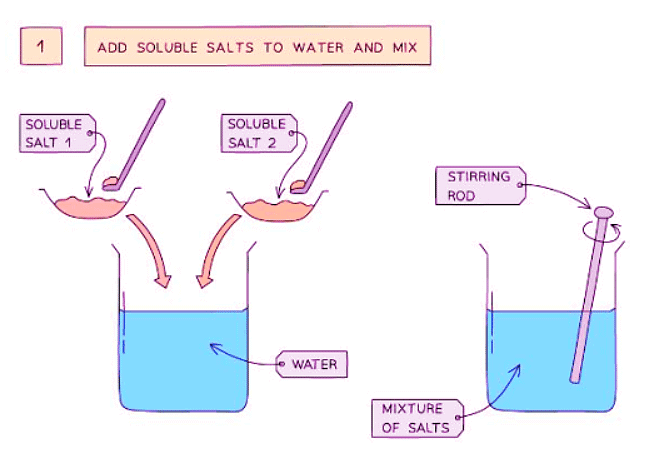
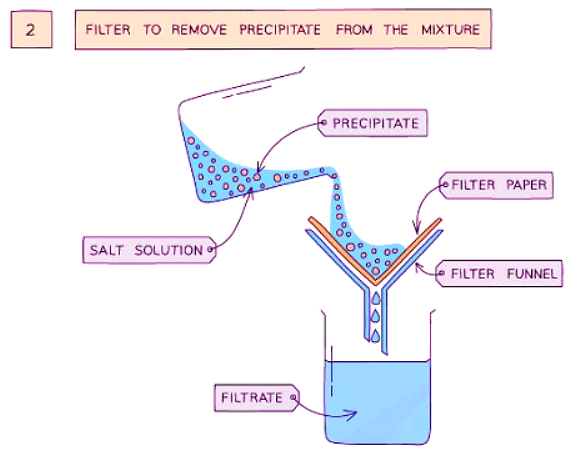
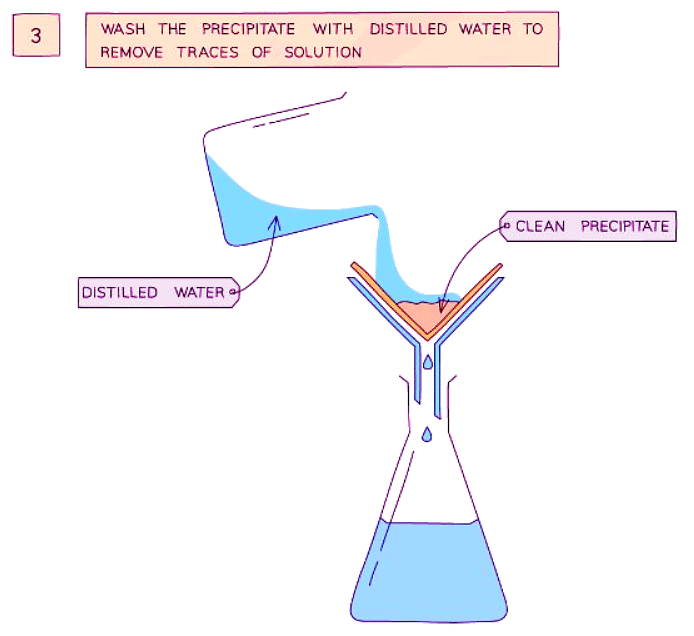
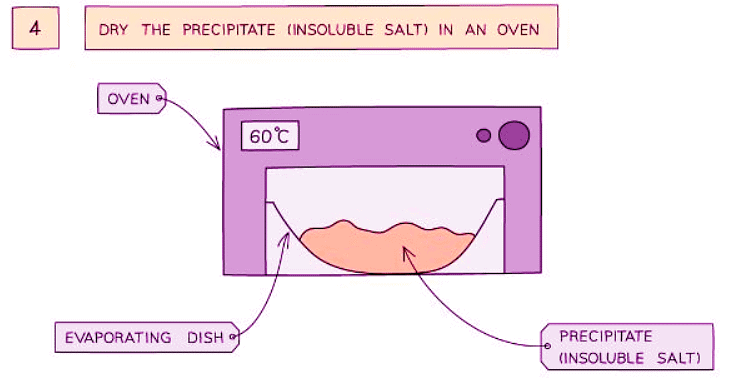
When two soluble reactants are used, a precipitation reaction occurs. The diagram below illustrates the filtration process to separate the precipitate:
Method
Follow these steps to prepare insoluble salts:
- Mix two soluble reactants in a solution.
- A precipitation reaction will occur, forming an insoluble salt as a solid.
- Filter the mixture to separate the precipitate from the solution.
- Collect and dry the precipitate to obtain the insoluble salt.
MULTIPLE CHOICE QUESTIONTry yourself: What is the purpose of the filtration process in preparing insoluble salts?
Example: Preparation of pure, dry lead(II) sulfate crystals using a precipitation reaction
Soluble Salts Used
- Soluble Salt 1: lead(II) nitrate
- Soluble Salt 2: potassium sulfate
Method
- Dissolve lead(II) nitrate and potassium sulfate in water. Mix them well in a beaker using a stirring rod.
- Filter the mixture to separate the precipitate.
- Wash the precipitate with distilled water to remove any traces of potassium nitrate solution.
- Allow the washed precipitate to dry in an oven.
Equation of reaction
lead(II) nitrate + potassium sulfate → lead(II) sulfate + potassium nitrate
Pb(NO3)2(aq) + K2SO4(aq) → PbSO4(s) + 2KNO3(aq)
The document Preparation of Insoluble Salts is a part of the Year 10 Course Chemistry for GCSE/IGCSE.
All you need of Year 10 at this link: Year 10
FAQs on Preparation of Insoluble Salts
| 1. What are insoluble salts? |  |
Ans. Insoluble salts are salts that do not dissolve in water or any other solvent to a significant extent.
| 2. How can insoluble salts be prepared? | |
Ans. Insoluble salts can be prepared by mixing two solutions of soluble salts that react to form an insoluble salt, which can then be precipitated out.
| 3. Can insoluble salts be separated from a solution? | |
Ans. Yes, insoluble salts can be separated from a solution through a process called precipitation, where the insoluble salt forms a solid that can be filtered out.
| 4. What are some common examples of insoluble salts? | |
Ans. Some common examples of insoluble salts include silver chloride (AgCl), lead(II) sulfate (PbSO4), and calcium carbonate (CaCO3).
| 5. Why are insoluble salts useful in chemistry? | |
Ans. Insoluble salts are useful in chemistry for various purposes, such as forming precipitates for qualitative analysis, as catalysts, or as pigments in paints and dyes.
About this Document

4.86/5 Rating

Apr 18, 2026 Last updated
Related Exams
Document Description: Preparation of Insoluble Salts for Year 10 2026 is part of Chemistry for GCSE/IGCSE preparation. The notes and questions for Preparation of Insoluble Salts have been prepared according to the Year 10 exam syllabus. Information about Preparation of Insoluble Salts covers topics like and Preparation of Insoluble Salts Example, for Year 10 2026 Exam. Find important definitions, questions, notes, meanings, examples, exercises and tests below for Preparation of Insoluble Salts.
Introduction of Preparation of Insoluble Salts in English is available as part of our Chemistry for GCSE/IGCSE for Year 10 & Preparation of Insoluble Salts in Hindi for Chemistry for GCSE/IGCSE course. Download more important topics related with notes, lectures and mock test series for Year 10 Exam by signing up for free. Year 10: Preparation of Insoluble Salts
Description
Preparation of Insoluble Salts of Chemistry covers all the important topics, helping you prepare for the Year 10 exam on EduRev. Start for free!
Information about Preparation of Insoluble Salts
In this doc you can find the meaning of Preparation of Insoluble Salts defined & explained in the simplest way possible. Besides explaining types of Preparation of Insoluble Salts theory, EduRev gives you an ample number of questions to practice Preparation of Insoluble Salts tests, examples and also practice Year 10 tests



Related Searches
past year papers, video lectures, ppt, Viva Questions, Summary, Preparation of Insoluble Salts, Free, Extra Questions, Important questions, practice quizzes, Exam, pdf , MCQs, study material, Sample Paper, Previous Year Questions with Solutions, mock tests for examination, Preparation of Insoluble Salts, Semester Notes, shortcuts and tricks, Preparation of Insoluble Salts, Objective type Questions;