IGCSE Year 10 > Year 10 Notes > Chemistry for GCSE/ > Alcohols
Alcohols

Alcohols
- Alcohols are characterized by the presence of the hydroxyl (-OH) functional group, which is responsible for their distinctive chemical reactions.
- They constitute a homologous series of compounds with the general formula CnH2n+1OH.
- Each member of this series differs from the next by one -CH2 unit in its molecular formula.
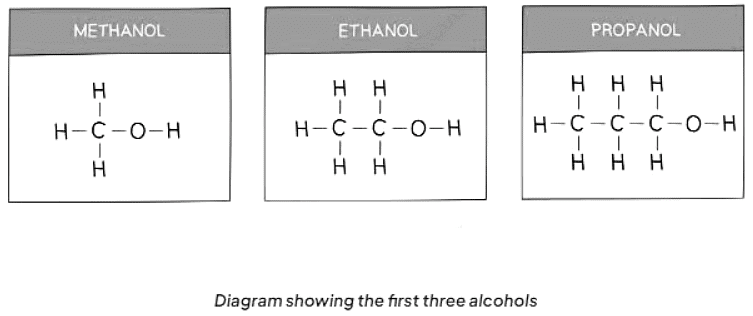
- Ethanol (C2H5OH) is a significant alcohol with various applications.
- Its structural formula, CH3CH2OH, is an alternative representation.
- Found in alcoholic beverages like wine and beer, ethanol is a prevalent type of alcohol.
- It serves as a fuel for automobiles and functions as a solvent in various applications.
- When alcohols undergo combustion in excess oxygen, they generate carbon dioxide (CO2) and water (H2O).
- Ethanol, specifically, undergoes complete combustion according to the equation: C2H5OH (l) + 3O2 (g) → 2CO2 (g) + 3H2O (l).
The Manufacture of Ethanol
- Ethanol production involves two primary methods:
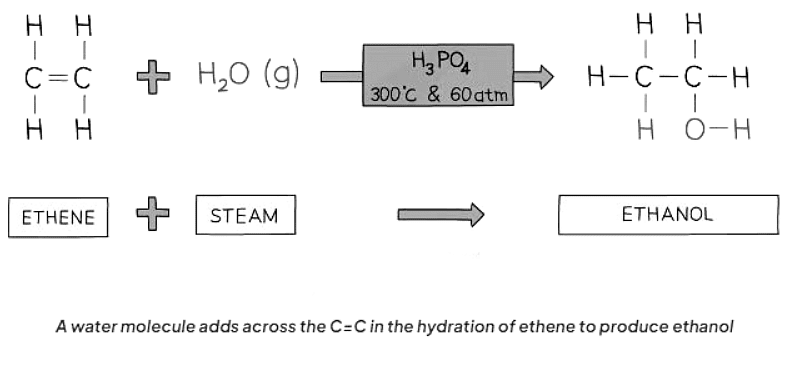
- One method is the hydration of ethene with steam.
- The other method involves the fermentation of glucose.
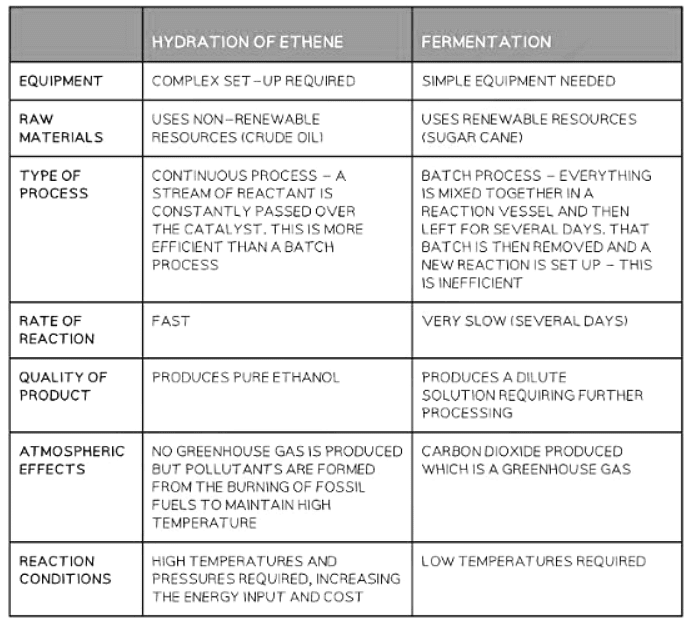
- Each approach carries its own set of pros and cons that are carefully evaluated.
Hydration of ethene
- A blend of ethene and steam undergoes a process where it's directed over a heated catalyst of phosphoric acid.
- This reaction typically occurs at temperatures around 300°C.
- The pressure applied is approximately 60 atmospheres, equivalent to 6000 kilopascals (kPa).
- The resulting gaseous ethanol is then cooled and condensed into a liquid state, ready for utilization.
Fermentation of Glucose
- Sugar or starch is dissolved in water, and yeast is introduced into the solution.
- The mixture is then subjected to fermentation, typically maintained at temperatures ranging between 25 and 35 °C, without the presence of oxygen, for several days.
- Yeast contains enzymes that facilitate the breakdown of starch or sugar into glucose.
- If the temperature is too low, the reaction rate will be sluggish; conversely, if it's too high, the enzymes may become denatured.
- The yeast undergo anaerobic respiration, utilizing glucose to produce ethanol and carbon dioxide.
C6H12O6 → 2CO2 + 2C2H5OH - Once the alcohol concentration reaches approximately 15%, the yeast are deactivated, prompting the emptying of the reaction vessel and the initiation of the process anew.
- This characteristic defines ethanol production through fermentation as a batch process.
MULTIPLE CHOICE QUESTIONTry yourself: Which method is used for the manufacture of ethanol?
Comparing Methods of Ethanol Production
The document Alcohols is a part of the Year 10 Course Chemistry for GCSE/IGCSE.
All you need of Year 10 at this link: Year 10
FAQs on Alcohols
| 1. How is ethanol produced through the hydration of ethene? |  |
Ans. Ethanol can be produced by the hydration of ethene, where ethene reacts with steam in the presence of a catalyst such as phosphoric acid to form ethanol.
| 2. What is the process of fermentation of glucose to produce ethanol? | |
Ans. In the fermentation process, glucose is converted into ethanol and carbon dioxide by yeast in the absence of oxygen. This process is commonly used in the production of alcoholic beverages.
| 3. How does anaerobic respiration in yeast contribute to ethanol production? | |
Ans. Anaerobic respiration in yeast involves the breakdown of glucose into ethanol and carbon dioxide, with ethanol being the main byproduct. This process is used in industries for the production of ethanol.
| 4. What are the key differences between the hydration of ethene and fermentation of glucose in terms of ethanol production? | |
Ans. The hydration of ethene is a chemical process that requires specific conditions and catalysts, while fermentation of glucose is a biological process carried out by microorganisms such as yeast. Additionally, the hydration of ethene produces ethanol directly, while fermentation involves the conversion of glucose into ethanol.
| 5. Which method of ethanol production is more commonly used on an industrial scale, and why? | |
Ans. The fermentation of glucose is more commonly used on an industrial scale for ethanol production due to its cost-effectiveness, simplicity, and ability to utilize renewable resources such as sugar or starch-containing raw materials.
About this Document

4.87/5 Rating

Apr 29, 2026 Last updated
Related Exams
Document Description: Alcohols for Year 10 2026 is part of Chemistry for GCSE/IGCSE preparation. The notes and questions for Alcohols have been prepared according to the Year 10 exam syllabus. Information about Alcohols covers topics like and Alcohols Example, for Year 10 2026 Exam. Find important definitions, questions, notes, meanings, examples, exercises and tests below for Alcohols.
Introduction of Alcohols in English is available as part of our Chemistry for GCSE/IGCSE for Year 10 & Alcohols in Hindi for Chemistry for GCSE/IGCSE course. Download more important topics related with notes, lectures and mock test series for Year 10 Exam by signing up for free. Year 10: Alcohols
Description
Alcohols of Chemistry covers all the important topics, helping you prepare for the Year 10 exam on EduRev. Start for free!
Information about Alcohols
In this doc you can find the meaning of Alcohols defined & explained in the simplest way possible. Besides explaining types of Alcohols theory, EduRev gives you an ample number of questions to practice Alcohols tests, examples and also practice Year 10 tests



Related Searches
Semester Notes, Viva Questions, Alcohols, Objective type Questions, MCQs, Alcohols, Exam, past year papers, Extra Questions, Alcohols, practice quizzes, study material, Summary, pdf , Important questions, Sample Paper, Previous Year Questions with Solutions, mock tests for examination, shortcuts and tricks, Free, ppt, video lectures;