IGCSE Year 10 > Year 10 Notes > Geography for GCSE/ > River Landforms
River Landforms

River landscape characteristics
- The changes in river channel characteristics lead to alterations in the river landscape.
- Upland and lowland regions of rivers exhibit distinct landforms.
- Upland Features:
- Waterfalls
- Gorges
- V-shaped valleys
- Interlocking spurs
Waterfalls and gorges
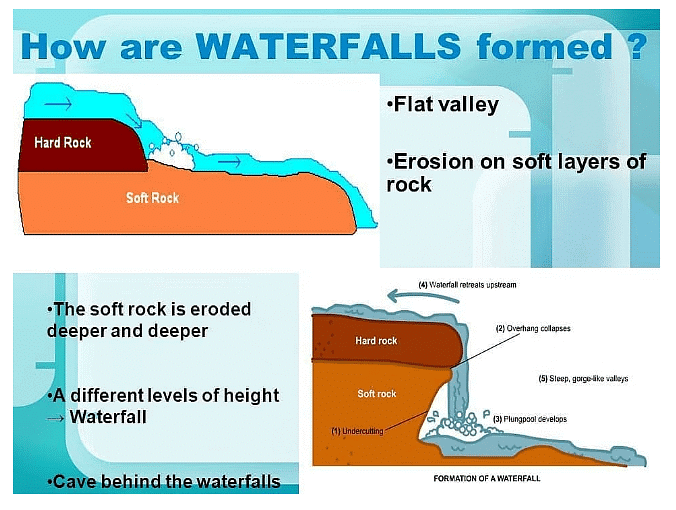
- Waterfalls form when there's a descent in the river bed from one level to another.
- This descent often occurs due to variations in rock hardness, where hard rock overlays softer rock.
- The primary erosional processes involved are hydraulic action and abrasion.
- Soft rock erodes more rapidly, creating an undercut beneath the hard rock, resulting in a plunge pool.
- Subsequently, an overhang of hard rock develops, eventually collapsing over time.
- The collapse contributes to the deepening of the plunge pool through increased abrasion.
- The cycle repeats, causing the waterfall to retreat upstream, leaving behind a steep-sided gorge.
MULTIPLE CHOICE QUESTIONTry yourself: Which erosional processes are primarily involved in the formation of waterfalls and gorges in river landscapes?
V-shaped valleys
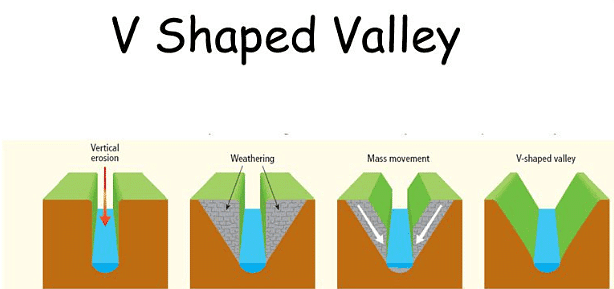
- Vertical erosion is the primary force shaping the upper course of a river. It involves the downward cutting into the riverbed, gradually deepening the river channel.
- Weathering and mass movement processes contribute to the collapse of materials from the valley sides into the river, leading to the formation of a steep, V-shaped valley.
Interlocking spurs
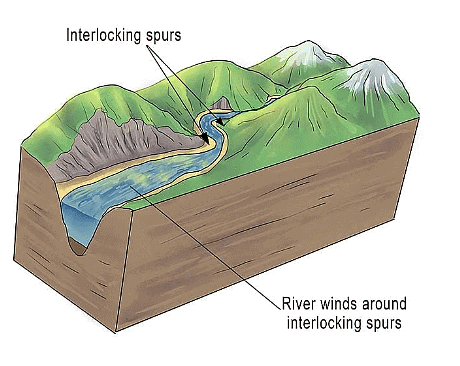
- Meandering of the river channel begins in the upper course.
- Erosion occurs primarily on the outer side of the bends.
- In upland regions, this erosion process shapes interlocking spurs.
Lowland features
- Meanders
- Ox-bow lakes
- Floodplains
- Levees
Meanders
- In lowland regions, lateral erosion prevails.
- Meanders expand in size over time.
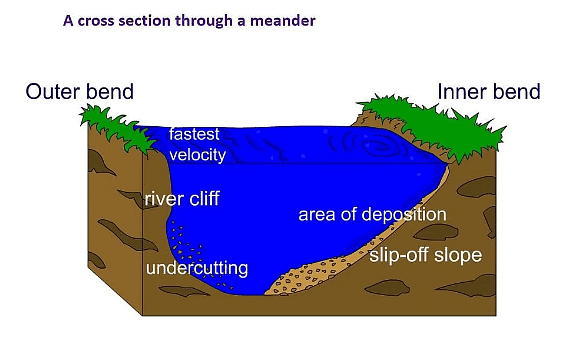
- The swiftest water flow, known as the thalweg, occurs on the outer side of the river bends, promoting erosion:
- This erosion creates an undercut along the riverbank, resulting in a river cliff.
- Subsequently, the riverbank collapses, causing the meander's edge to advance outward.
- Conversely, the slowest flow occurs on the inner side of the river bends, leading to deposition:
- Deposits accumulate, forming a slip-off slope.
- The interplay of deposition and erosion causes the meander to migrate across the valley.
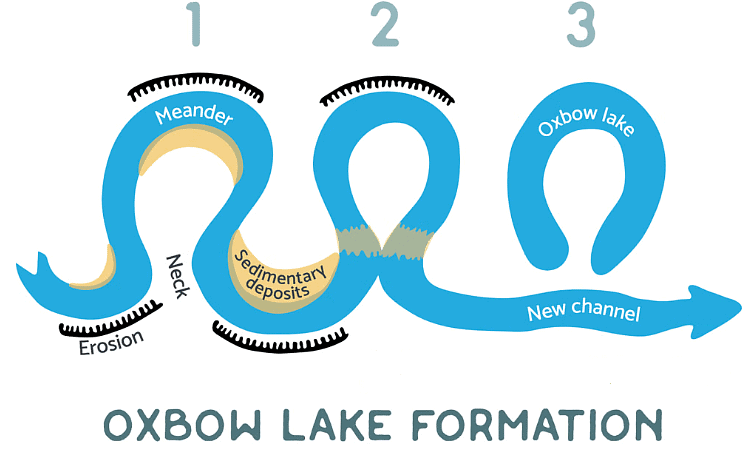
Oxbow lakes
- Meander size typically enlarges as distance downstream increases.
- Erosion along the outer bends can eventually create a meander neck.
- During floods, the river may breach the meander neck, creating a straighter path for water.
- Reduced water flow at the entry and exit points of the meander results in deposition.
- Eventually, the meander may become isolated from the main river channel, forming an oxbow lake.
Floodplains and Levees
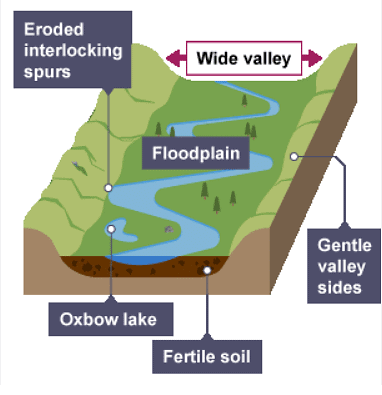
- Floodplains are level areas of land situated on both sides of a river.
- The movement of meanders contributes to the creation of floodplains.
- Elevated discharge can result in the river overflowing its banks.
- As water spreads over the floodplain, a larger portion comes into contact with the land surface.
- Enhanced friction slows down the water's velocity, leading to gradual deposition of material across the floodplain, thereby elevating its height.
- Initially, the heaviest materials are deposited nearest to the river channel, forming natural embankments known as levees.
MULTIPLE CHOICE QUESTIONTry yourself: What is the primary force shaping the upper course of a river?
The document River Landforms is a part of the Year 10 Course Geography for GCSE/IGCSE.
All you need of Year 10 at this link: Year 10
FAQs on River Landforms
| 1. What are some common lowland features found in river landscapes? |  |
Ans. Some common lowland features found in river landscapes include floodplains, meanders, oxbow lakes, and levees.
| 2. How do meanders form in river landscapes? | |
Ans. Meanders form in river landscapes due to the erosion on the outer bank of a river bend and deposition on the inner bank, causing the river to curve and form loops.
| 3. What is the significance of levees in river landscapes? | |
Ans. Levees in river landscapes are natural embankments that form along the banks of rivers during flooding, helping to contain the water within the river channel and protecting surrounding areas from flooding.
| 4. How do oxbow lakes form in river landscapes? | |
Ans. Oxbow lakes form in river landscapes when a meander loop is cut off from the main river channel due to erosion and sediment deposition, creating a curved lake.
| 5. What role do floodplains play in river landscapes? | |
Ans. Floodplains in river landscapes are flat, fertile areas that are periodically inundated by river flooding, providing important habitats for wildlife and allowing for the deposition of nutrient-rich sediments.
About this Document

4.68/5 Rating

Apr 29, 2026 Last updated
Related Exams
Document Description: River Landforms for Year 10 2026 is part of Geography for GCSE/IGCSE preparation. The notes and questions for River Landforms have been prepared according to the Year 10 exam syllabus. Information about River Landforms covers topics like and River Landforms Example, for Year 10 2026 Exam. Find important definitions, questions, notes, meanings, examples, exercises and tests below for River Landforms.
Introduction of River Landforms in English is available as part of our Geography for GCSE/IGCSE for Year 10 & River Landforms in Hindi for Geography for GCSE/IGCSE course. Download more important topics related with notes, lectures and mock test series for Year 10 Exam by signing up for free. Year 10: River Landforms
Description
River Landforms of Geography covers all the important topics, helping you prepare for the Year 10 exam on EduRev. Start for free!
Information about River Landforms
In this doc you can find the meaning of River Landforms defined & explained in the simplest way possible. Besides explaining types of River Landforms theory, EduRev gives you an ample number of questions to practice River Landforms tests, examples and also practice Year 10 tests



Related Searches
pdf , Exam, video lectures, past year papers, mock tests for examination, MCQs, Sample Paper, River Landforms, River Landforms, Important questions, ppt, Extra Questions, shortcuts and tricks, Summary, Semester Notes, Previous Year Questions with Solutions, Objective type Questions, practice quizzes, River Landforms, Free, Viva Questions, study material;