Circle Theorems


CIE IGCSE Maths: Extended
Revision Notes
IGCSE Maths: Extended CIE Revision Notes Geometry Circle Theorems Angles at Centre & Semicircles Angles at Centre & Semicircles- Syllabus Edition
- First teaching 2023
- First exams 2025
Angles at Centre & Semicircles
Test Yourself What are circle theorems?- Circle Theorems involve angle facts when lines are drawn within and connected to a circle
- These theorems complement your understanding of angles in polygons and angles with parallel lines
- Important circle parts include radius, diameter, arc, sector, chord, segment, and tangent
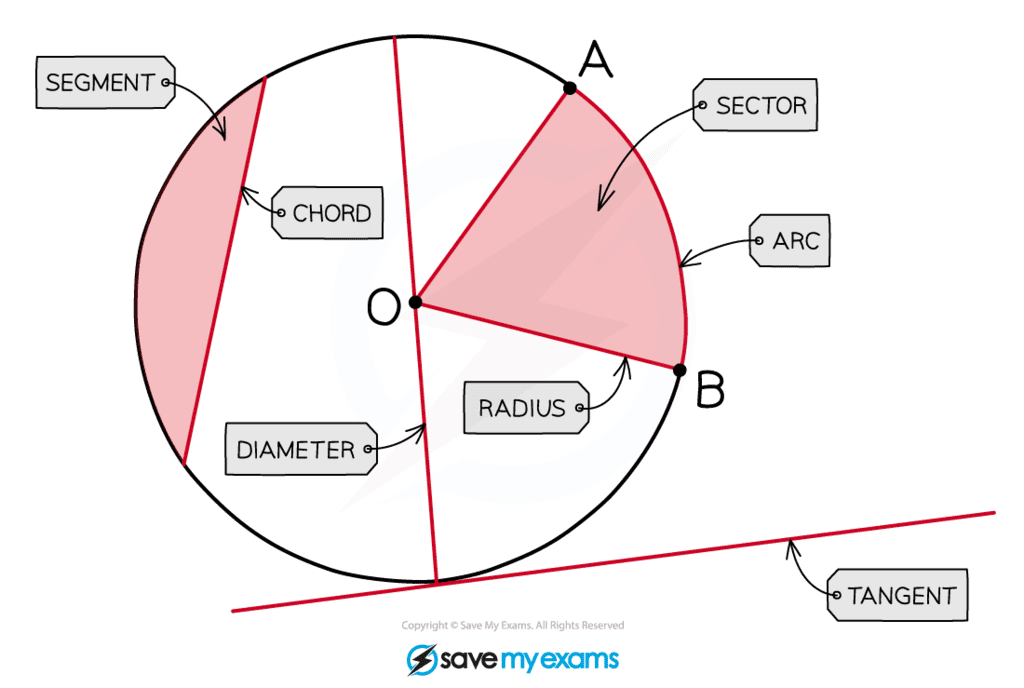
Angle Facts, Circumference, and Area
- To solve various problems, it is essential to apply angle facts from triangles, polygons, and parallel lines.
- Familiarize yourself with the formulas for circumference (C = πd) and area (A = πr2).
Circumference and Area Formulas
- The formula for circumference of a circle is C = πd.
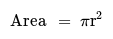
- The formula for area of a circle is A = πr2.

Angles at Centre & Circumference
Circle Theorem: The angle formed by an arc at the center of a circle is twice the angle at the circumference.
- This fundamental circle theorem serves as the basis for many angle properties within circles.
- When considering this theorem, both the radii drawn to the center and to the circumference originate from the ends of the same arc.
- Identifying this theorem on a diagram is relatively straightforward:
- Identify two radii in the circle and trace them to the circumference.
- Look for lines connecting those points to other points on the circumference.
- When using this theorem during examinations, remember to emphasize the key concept: "The angle at the center is twice the angle at the circumference."
Angle Theorems in Circles
- The angle at the center of a circle is twice the angle at the circumference.
- This relationship holds true even when parts of triangles overlap within the circle.
Angle at the Center vs. Angle at the Circumference
The angle at the center of a circle is double the angle at the circumference. This means that if an angle at the center is x degrees, the angle at the circumference opposite to it will be x/2 degrees.
Example: Angle Relationships in Circles
Imagine an angle of 60 degrees at the center of a circle. According to the theorem, the angle at the circumference, directly opposite to it, would be half of 60 degrees, which is 30 degrees.
Circle Theorem: Angle in a Semicircle
One noteworthy circle theorem states that the angle in a semicircle always measures 90 degrees, making it a right angle.
Key Points of the Semicircle Theorem
- This theorem is a specific case of the angle at the center theorem.
- The angle on the diameter of a circle is 180 degrees while the angle at the circumference is 90 degrees.
- Identifying a diameter in a circle is crucial to applying this theorem correctly.
- Any angle at the circumference originating from the ends of a diameter will always measure 90 degrees.
Application of the Semicircle Theorem
When encountering semicircles or portions of circles in geometry problems, remember that any angle formed by the ends of a diameter will be a right angle, measuring 90 degrees.
 |

Understanding Circle Theorems
- Ensure you are dealing with a diameter by confirming it passes through the center of the circle.
- Questions may involve only half of the circle, presenting themselves in either whole circles or semicircles.
- Any angle formed at the circumference from each end of a diameter will measure 90 degrees.
- Commonly referred to as the angle in a semicircle theorem, remember to state "The angle in a semicircle is 90 degrees" during exams.
The Angle in a Semicircle
- The angle in a semicircle always measures 90 degrees.
- Remember to identify triangles that might be concealed among other lines or shapes within the circle.
Enhancing Diagrams for Circle Problems
- When given a diagram, add relevant details such as equal radii, angles, and lengths you can deduce.
- Even seemingly insignificant information could be crucial for solving the question.
- Assign an angle fact or circle theorem to each angle you calculate, especially when asked for reasons in your solutions.
Strategies for Solving Geometry Problems
- Identify and Mark Equal Radii and Angles
- Assign Angle Facts or Circle Theorems to Worked Out Angles
- Provide Reasons for Each Angle Found
Illustrative Explanation with Diagrams
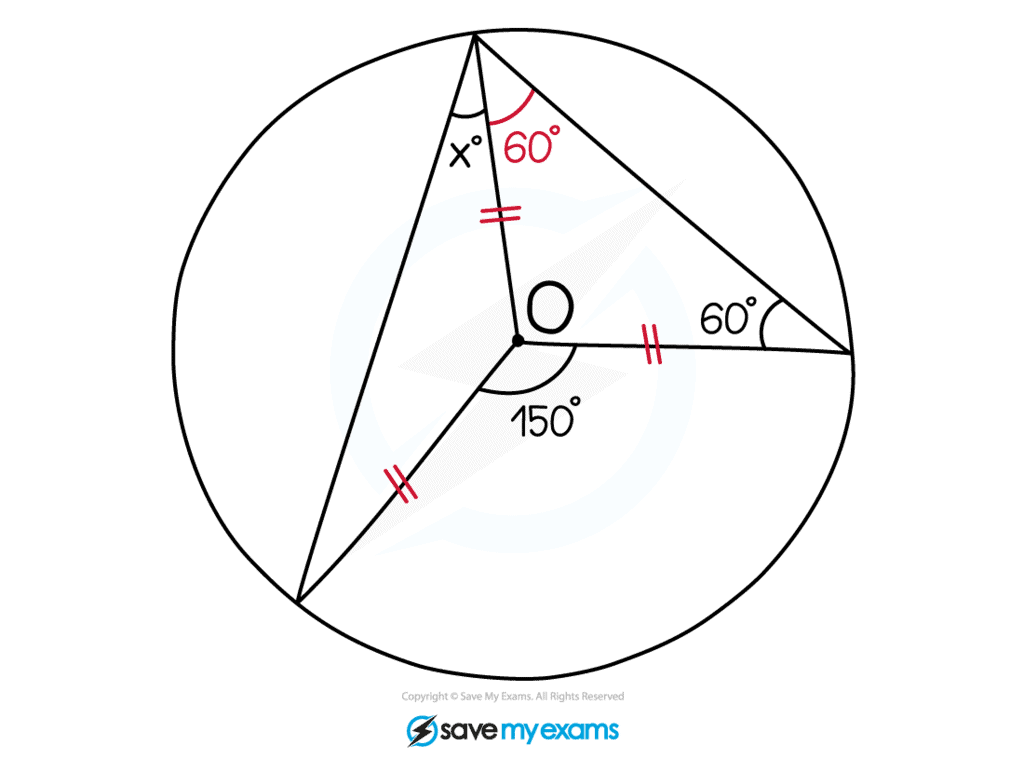
Find the value of \( x \) in the diagram below:

There are three radii in the diagram, mark these as equal length lines. Notice how they create two isosceles triangles. Base angles in isosceles triangles are equal, so this means that the angle next to \( x \) must be 60°.

Circle Theorems
Angle Relationship in Circles:
The angle at the center subtended by an arc is twice the angle at the circumference.
Equation:Let the angle at the center be \( x \) and the angle at the circumference be \( y \).According to the theorem, \( x = 2y \).
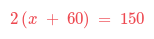
Expanding Brackets and Solving Equations:
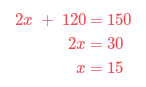
To expand brackets and solve equations, distribute the term outside the brackets to each term inside the brackets and then simplify the equation.


Test Yourself
Test your understanding of the circle theorems by attempting practice questions.
Next Topic: Continue your learning journey by exploring the next topic.
Download notes on Angles at Centre & Semicircles for further study.
