IGCSE Year 10 > Year 10 Notes > Economics for GCSE/ > Economies & Diseconomies of Scale
Economies & Diseconomies of Scale

An Introduction to Economies & Diseconomies of Scale
- As firms expand, they can increase production scale, leading to efficiencies that reduce average production costs known as economies of scale. This enables large firms to decrease production costs more than smaller firms can achieve.
- When a firm grows, it can enhance its scale of production, which brings cost-saving efficiencies termed as economies of scale. These efficiencies allow larger companies to reduce production costs significantly compared to smaller counterparts.
- However, as a firm further escalates its production scale, there comes a point where average costs start rising. This increase in costs is referred to as diseconomies of scale.
- Internal economies of scale emerge due to the expansion in production scale within the firm, leading to improved efficiency and cost reduction.
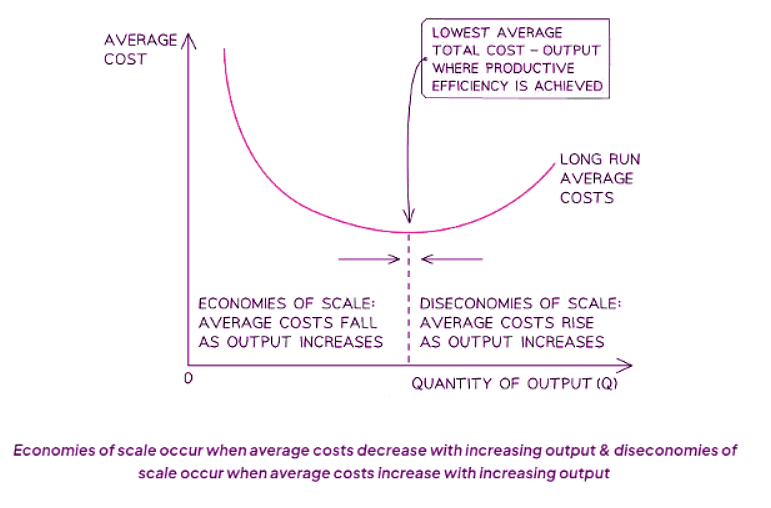
Diagram Analysis:
- With relatively low levels of production, companies face high average costs.
- Increasing production leads to the benefit of economies of scale, which in turn reduces the average cost per unit.
- At a certain production level, a company reaches productive efficiency, where it cannot further decrease costs.
- Beyond this point, the average cost starts to increase due to diseconomies of scale.
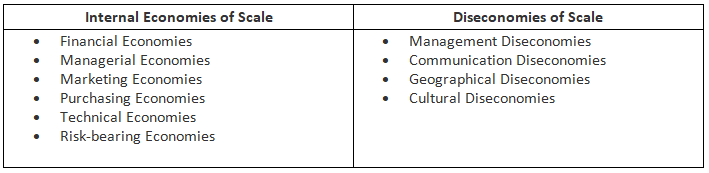
Types of Internal Economies & Diseconomies
MULTIPLE CHOICE QUESTIONTry yourself: What are economies of scale?
External Economies of Scale
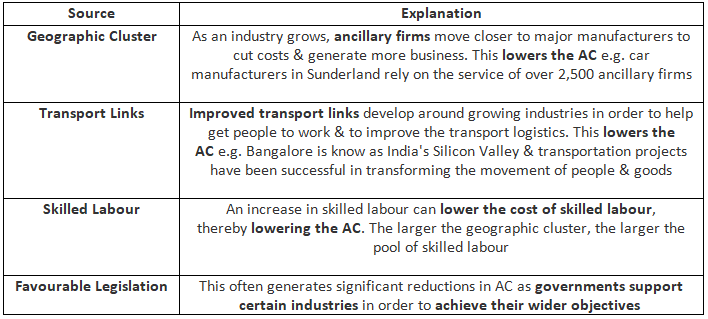
- External economies of scale emerge as the industry in which the firm operates expands, enabling the firm to enjoy reduced average costs (AC) originating from factors external to the firm.
Sources Of External Economies Of Scale
The document Economies & Diseconomies of Scale is a part of the Year 10 Course Economics for GCSE/IGCSE.
All you need of Year 10 at this link: Year 10
FAQs on Economies & Diseconomies of Scale
| 1. What are economies of scale? |  |
Ans. Economies of scale refer to the cost advantage that arises when a company produces goods or services in large quantities, leading to lower average costs per unit.
| 2. How do internal economies of scale differ from external economies of scale? | |
Ans. Internal economies of scale are cost advantages that a company can achieve due to its own size and output, while external economies of scale are cost advantages that result from the overall growth of an industry or region.
| 3. What are some examples of internal economies of scale? | |
Ans. Examples of internal economies of scale include technological advancements, specialization of labor, bulk purchasing discounts, and efficient production processes.
| 4. How can a company experience diseconomies of scale? | |
Ans. A company may experience diseconomies of scale when it grows too large, causing inefficiencies, communication breakdowns, and coordination problems that lead to higher average costs per unit.
| 5. How can external economies of scale benefit a company? | |
Ans. External economies of scale can benefit a company by providing access to a skilled labor force, improved infrastructure, and a supportive business environment, leading to lower production costs and increased competitiveness.
About this Document

4.91/5 Rating

Apr 29, 2026 Last updated
Related Exams
Document Description: Economies & Diseconomies of Scale for Year 10 2026 is part of Economics for GCSE/IGCSE preparation. The notes and questions for Economies & Diseconomies of Scale have been prepared according to the Year 10 exam syllabus. Information about Economies & Diseconomies of Scale covers topics like and Economies & Diseconomies of Scale Example, for Year 10 2026 Exam. Find important definitions, questions, notes, meanings, examples, exercises and tests below for Economies & Diseconomies of Scale.
Introduction of Economies & Diseconomies of Scale in English is available as part of our Economics for GCSE/IGCSE for Year 10 & Economies & Diseconomies of Scale in Hindi for Economics for GCSE/IGCSE course. Download more important topics related with notes, lectures and mock test series for Year 10 Exam by signing up for free. Year 10: Economies & Diseconomies of Scale
Description
Economies & Diseconomies of Scale of Economics covers all the important topics, helping you prepare for the Year 10 exam on EduRev. Start for free!
Information about Economies & Diseconomies of Scale
In this doc you can find the meaning of Economies & Diseconomies of Scale defined & explained in the simplest way possible. Besides explaining types of Economies & Diseconomies of Scale theory, EduRev gives you an ample number of questions to practice Economies & Diseconomies of Scale tests, examples and also practice Year 10 tests



Related Searches
Free, practice quizzes, Economies & Diseconomies of Scale, shortcuts and tricks, Summary, Economies & Diseconomies of Scale, Viva Questions, Economies & Diseconomies of Scale, past year papers, ppt, mock tests for examination, Extra Questions, pdf , Objective type Questions, Previous Year Questions with Solutions, video lectures, Important questions, study material, Exam, Semester Notes, Sample Paper, MCQs;