IGCSE Year 10 > Year 10 Notes > Economics for GCSE/ > Supply-side Policy Measures
Supply-side Policy Measures

Supply-side Policy Defined
- Supply-side policies target enhancing the overall supply, or productive potential, of the economy.
- This goal is accomplished by augmenting the quality or quantity of the factors of production.
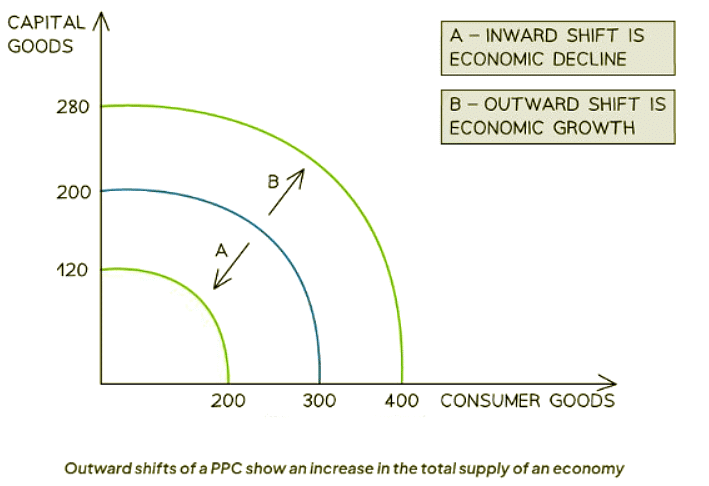
- It is often visualized as an outward shift of the production possibility curve.
- With this shift, more consumer goods and capital goods can be produced utilizing all available resources.
- Strategies employed to bolster total supply encompass various approaches:
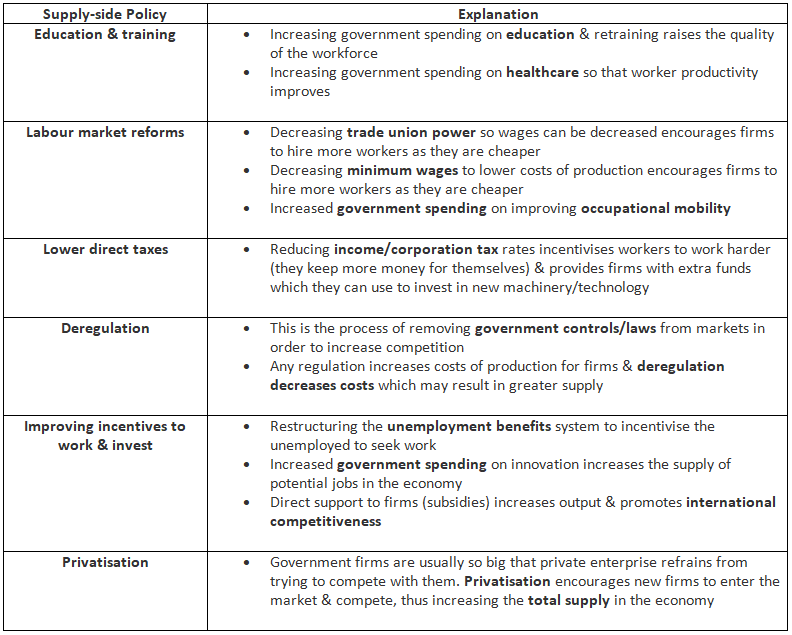
- Investing in education and training initiatives.
- Implementing reforms in the labor market.
- Decreasing direct taxes.
- Deregulating certain sectors.
- Enhancing incentives for employment and investment.
- Pursuing privatization efforts.
Supply-side Policy Measures
When supply-side policies succeed, they impact the government's macroeconomic objectives in the following ways:
- Economic Growth: Successful implementation leads to an expansion in the potential national output, consequently boosting real Gross Domestic Product (rGDP).
- Inflation: A surge in the economy's supply often drives down prices of goods and services, contributing to a slowdown in inflation, known as disinflation.
- Unemployment: Effective supply-side policies typically result in a reduction in unemployment rates as increased output demands more labor.
- Current Account Balance: Enhanced supply tends to reduce the prices of goods and services, rendering them more attractive to foreign consumers. This stimulates exports, thereby improving the current account balance.
- Redistribution of Income: Despite their overall benefits, supply-side policies can exacerbate income inequality by potentially lowering wages and reducing government tax revenue.
Specific Types of Supply-side Policies
Strengths of Supply-side Policies
- They accelerate the pace of economic growth.
- They mitigate inflationary pressures.
- They frequently lower unemployment rates.
- They often enhance the value of net exports, as expanded total supply typically drives prices lower, consequently boosting exports.
Weaknesses of Supply-side Policy
- Income distribution worsens due to reduced worker wages resulting from labor market reforms and wage policies.
- Implementation of supply-side policies can be costly.
- Significant time lags exist between government expenditure and realizing benefits; for instance, education and training initiatives often yield results over an extended period.
- The long-term nature of these policies means that changes in government often lead to alterations in budgets and project scopes.
- Vested interests may lead to less effective outcomes; for example, privatization processes sometimes favor certain bidders, enabling them to acquire assets at significantly reduced prices.
MULTIPLE CHOICE QUESTIONTry yourself: Which of the following is NOT a strategy employed in supply-side policies?
The document Supply-side Policy Measures is a part of the Year 10 Course Economics for GCSE/IGCSE.
All you need of Year 10 at this link: Year 10
About this Document

4.86/5 Rating

Apr 29, 2026 Last updated
Related Exams
Document Description: Supply-side Policy Measures for Year 10 2026 is part of Economics for GCSE/IGCSE preparation. The notes and questions for Supply-side Policy Measures have been prepared according to the Year 10 exam syllabus. Information about Supply-side Policy Measures covers topics like and Supply-side Policy Measures Example, for Year 10 2026 Exam. Find important definitions, questions, notes, meanings, examples, exercises and tests below for Supply-side Policy Measures.
Introduction of Supply-side Policy Measures in English is available as part of our Economics for GCSE/IGCSE for Year 10 & Supply-side Policy Measures in Hindi for Economics for GCSE/IGCSE course. Download more important topics related with notes, lectures and mock test series for Year 10 Exam by signing up for free. Year 10: Supply-side Policy Measures
Description
Supply of Economics covers all the important topics, helping you prepare for the Year 10 exam on EduRev. Start for free!
Information about Supply-side Policy Measures
In this doc you can find the meaning of Supply-side Policy Measures defined & explained in the simplest way possible. Besides explaining types of Supply-side Policy Measures theory, EduRev gives you an ample number of questions to practice Supply-side Policy Measures tests, examples and also practice Year 10 tests



Related Searches
Free, Supply-side Policy Measures, Semester Notes, MCQs, Exam, study material, Important questions, Extra Questions, Supply-side Policy Measures, pdf , practice quizzes, Summary, Sample Paper, Previous Year Questions with Solutions, mock tests for examination, video lectures, Supply-side Policy Measures, ppt, past year papers, shortcuts and tricks, Objective type Questions, Viva Questions;