IGCSE Year 10 > Year 10 Notes > Economics for GCSE/ > Reasons for Differences in Development
Reasons for Differences in Development

Causes of Differences in Development
- Economic development refers to the sustainable enhancement of living standards within a country, usually characterized by improvements in life expectancy, educational attainment, and income levels.
- Two key metrics employed to assess development are the real Gross Domestic Product (GDP) and the Human Development Index (HDI). These measures help in evaluating the well-being of a population.
- Nations exist at various stages of development, with economists utilizing diverse criteria to differentiate between them.
- For instance, the HDI classifies development into five categories based on HDI scores:
- Low human development (<0.550)>
- Medium human development (0.550-0.699)
- High human development (0.700-0.799)
- Very high human development (>0.800)
- For instance, the HDI classifies development into five categories based on HDI scores:
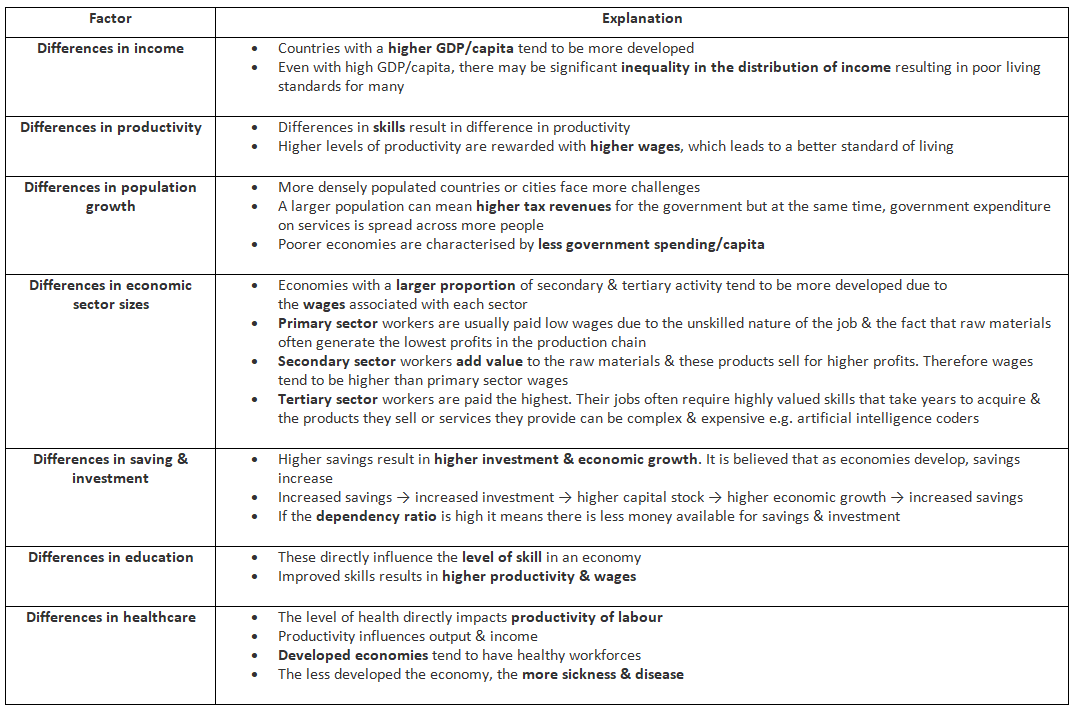
- Discrepancies in development arise due to a multitude of factors, including disparities in income levels, productivity rates, population growth dynamics, the proportions of the primary, secondary, and tertiary sectors, levels of saving and investment, as well as the quality of education and healthcare systems.
MULTIPLE CHOICE QUESTIONTry yourself: What are some factors that can cause discrepancies in development between nations?
Causes of Differences in Development
The document Reasons for Differences in Development is a part of the Year 10 Course Economics for GCSE/IGCSE.
All you need of Year 10 at this link: Year 10
FAQs on Reasons for Differences in Development
| 1. What are some common causes of differences in development between countries? |  |
Ans. Some common causes of differences in development between countries include unequal distribution of resources, political instability, corruption, lack of infrastructure, and inadequate education and healthcare systems.
| 2. How do historical factors contribute to differences in development? | |
Ans. Historical factors such as colonization, wars, and past economic policies can impact a country's development by affecting its infrastructure, economy, and social systems, leading to disparities in development outcomes.
| 3. What role does geography play in influencing development disparities among countries? | |
Ans. Geography can influence development disparities among countries by affecting factors such as access to natural resources, climate conditions, and geographical barriers that can hinder trade and infrastructure development.
| 4. How does globalization impact differences in development between nations? | |
Ans. Globalization can both exacerbate and alleviate differences in development between nations by facilitating international trade, technology transfer, and investment, but it can also lead to economic inequalities and cultural homogenization.
| 5. How do social and cultural factors contribute to disparities in development outcomes worldwide? | |
Ans. Social and cultural factors such as gender inequality, ethnicity, religious beliefs, and social norms can influence development outcomes by affecting access to education, healthcare, and economic opportunities, leading to disparities in development between countries.
About this Document

4.70/5 Rating

Apr 29, 2026 Last updated
Related Exams
Document Description: Reasons for Differences in Development for Year 10 2026 is part of Economics for GCSE/IGCSE preparation. The notes and questions for Reasons for Differences in Development have been prepared according to the Year 10 exam syllabus. Information about Reasons for Differences in Development covers topics like and Reasons for Differences in Development Example, for Year 10 2026 Exam. Find important definitions, questions, notes, meanings, examples, exercises and tests below for Reasons for Differences in Development.
Introduction of Reasons for Differences in Development in English is available as part of our Economics for GCSE/IGCSE for Year 10 & Reasons for Differences in Development in Hindi for Economics for GCSE/IGCSE course. Download more important topics related with notes, lectures and mock test series for Year 10 Exam by signing up for free. Year 10: Reasons for Differences in Development
Description
Reasons for Differences in Development of Economics covers all the important topics, helping you prepare for the Year 10 exam on EduRev. Start for free!
Information about Reasons for Differences in Development
In this doc you can find the meaning of Reasons for Differences in Development defined & explained in the simplest way possible. Besides explaining types of Reasons for Differences in Development theory, EduRev gives you an ample number of questions to practice Reasons for Differences in Development tests, examples and also practice Year 10 tests



Related Searches
Reasons for Differences in Development, mock tests for examination, Previous Year Questions with Solutions, Objective type Questions, Exam, MCQs, Sample Paper, Summary, practice quizzes, ppt, video lectures, past year papers, Extra Questions, shortcuts and tricks, study material, Reasons for Differences in Development, Free, pdf , Semester Notes, Reasons for Differences in Development, Important questions, Viva Questions;