NCERT Solutions: Colours

Fun With Friends
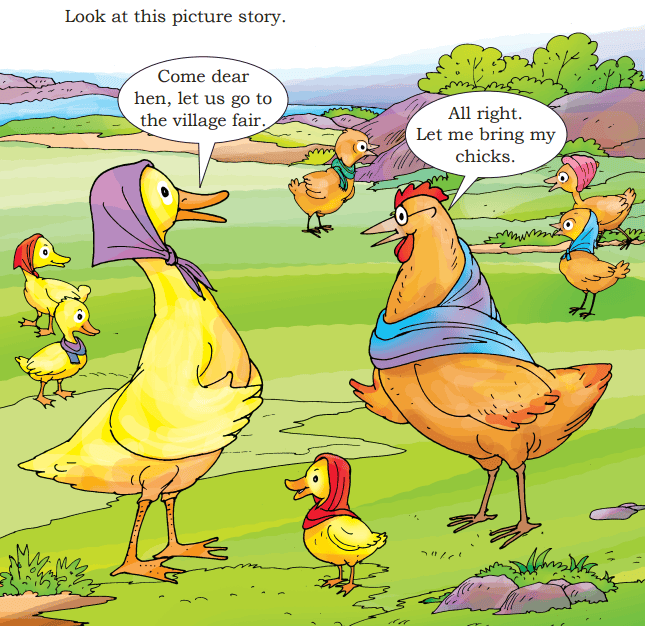
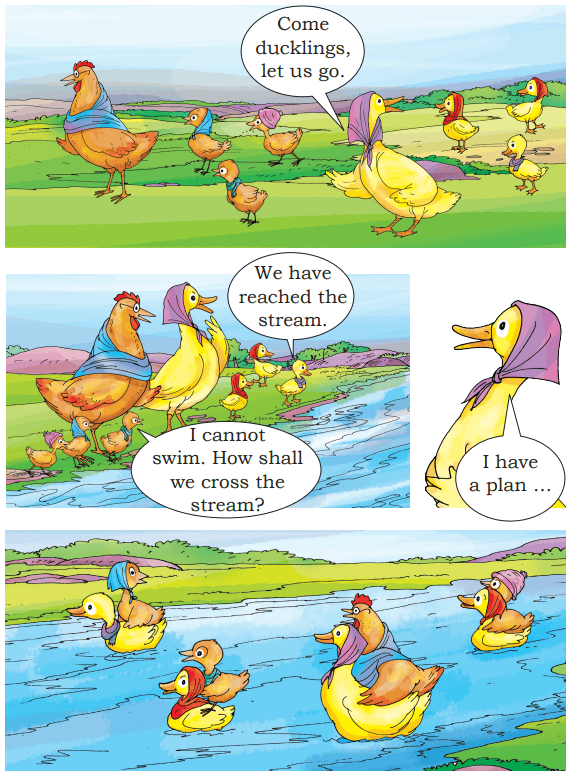
[Page No. 3]
Now discuss with your friends.
1. How many ducklings and chicks can you see in the picture?
Ans: There are 3 ducklings and 3 chicks in the picture.
2. The duck and the hen - are they friends? How do you know?
Ans: Yes, the duck and the hen are friends. I know this because the duck invites the hen to the village fair, and they go together.
3. How did the hen and the chicks cross the stream?
Ans: The hen and the chicks crossed the stream by riding on the back of the duck and the ducklings.
4. Have you ever helped your friend? How did you help?
Ans: Yes, I have helped my friend by sharing my toys when they needed something to play with. (Your answer may vary)
5. Did you feel happy to help your friend?
Ans: Yes, I felt very happy to help my friend. (Your answer may vary)
6. Match the following animals with their young ones: ![[Page No. 3]](https://cn.edurev.in/ApplicationImages/Temp/22710576_00fb1b4b-75f2-46ed-b7df-44b514316006_lg.png)
Ans:
![[Page No. 3]](https://cn.edurev.in/ApplicationImages/Temp/22710576_e3ec1d04-d07b-4244-a979-a2b125a458c3_lg.png)
Let us Think
[Page No. 5]
A. Answer the questions. Write your answer in the given space.
1. How many children are there in the poem?
Ans: There are two children in the poem.
2. Why did the children want to share the crayons?
Ans: The children wanted to share the crayons so that they could have a full pack together.
3. How can the children in the poem have a full pack?
Ans: The children in the poem can have a full pack if they share their crayons.
B. Think and say.
1. The children in the poem shared their crayons. Do you share anything with your friends? What do you share?
Ans: Yes, I share my toys and books with my friends. We also share our snacks during lunchtime. (Your answer may vary)
2. You have only green, blue and red crayons. Talk in pairs what you would want to draw.
Ans: I want to use red and green crayons to draw light. I want to use blue and green to draw a cap. (Your answer may vary)
3. Now you have blue, green, red, yellow, brown and orange crayons. What can you draw? Draw here:
Ans: ![[Page No. 5]](https://cn.edurev.in/ApplicationImages/Temp/4794054_5dde5a7d-3b4a-40a0-931c-76bf2b7ac548_lg.png)
(Your answer may vary)
4. Rearrange the letters to find the hidden colour.
a) LEBU ___________
b) LYLEWO ___________
c) RENEG ___________
d) RUPPEL ___________
e) NROBW ___________
Ans:
a) LEBU - Blue
b) LYLEWO - Yellow
c) RENEG - Green
d) RUPPEL - Purple
e) NROBW - Brown
Let us speak
[Page No. 6]
A. Say aloud.
![[Page No. 6]](https://cn.edurev.in/ApplicationImages/Temp/4794054_348b705a-c65c-435e-86bc-e5b949b973e8_lg.png) This is a green crayon.
This is a green crayon.
The word green begins with 'gr'.
The word crayon begins with 'cr'.
Now say these words aloud:![[Page No. 6]](https://cn.edurev.in/ApplicationImages/Temp/4794054_09cc21c2-2fd9-4ab8-9252-0f97fdc9c719_lg.png) Form a sentence using each of these words and say it aloud.
Form a sentence using each of these words and say it aloud.
Ans:
- Green: Green is one of the seven colours of the rainbow.
- Grey: The couch is grey.
- Grass: The cows are eating grass.
- Grapes: Grapes vines need a trellis or support to grow properly.
- Grandmother: Grandmother has a caring and loving nature.
- Crayon: The drawing is done with crayons.
- Crab: The crab is sitting in the shade of a palm tree.
- Crane: Cranes are tall birds with long legs.
- Crow: Crows are extremely intelligent birds.
- Cradle: She placed the phone back on its cradle.
- Draw: She sat down and began to draw.
- Drum: He had found a drum of electric cable.
- Dress: She was wearing a black dress.
- Drop: He dropped the bag and all the apples fell out.
- Dragon: His face slowly changed into the shape of a dragon.
- Prince: The prince was the king of these islands.
- Princess: She got to dress up in a princess dress and look amazing.
- Prize: She won the prize in the competition.
- Pray: She knelt and prayed silently.
- Present: I want to give you a little present.
Let us Learn
[Page No. 7]
A. Words used to show actions are called action words. Read the words given below. Circle the action words.
![[Page No. 7]](https://cn.edurev.in/ApplicationImages/Temp/4794054_2419b05b-e29c-4664-bf3e-78a35d8e9935_lg.png)
Ans: ![[Page No. 7]](https://cn.edurev.in/ApplicationImages/Temp/4794054_b8862512-12ad-4d48-a933-85d962ee3299_lg.png)
[Page No. 8]
B. Find the action words in the grid below. One is done for you.
![[Page No. 8]](https://cn.edurev.in/ApplicationImages/Temp/4794054_c14e97d2-6309-4d3d-923b-ad041ddccae4_lg.png)
Ans:
![[Page No. 8]](https://cn.edurev.in/ApplicationImages/Temp/4794054_f5cee538-ab94-489f-9d71-5272be912e1a_lg.png)
C. There are 26 letters in the English alphabet. They are:
![[Page No. 8]](https://cn.edurev.in/ApplicationImages/Temp/4794054_5e558207-ae2c-48ff-973c-b7e0614f0da8_lg.png)
![[Page No. 8]](https://cn.edurev.in/ApplicationImages/Temp/22710576_140484c0-4292-4a21-abf3-a8afe9d9cb73_lg.png)
![[Page No. 8]](https://cn.edurev.in/ApplicationImages/Temp/22710576_f2e5f2e4-e2e8-414d-81db-72f799210d59_lg.png)
![[Page No. 8]](https://cn.edurev.in/ApplicationImages/Temp/22710576_7e2e72a9-4aac-4deb-add3-98b98d3d368b_lg.png)
![[Page No. 8]](https://cn.edurev.in/ApplicationImages/Temp/22710576_12a858ae-f388-4b47-9420-b790943a3585_lg.png)
![[Page No. 8]](https://cn.edurev.in/ApplicationImages/Temp/22710576_499ba374-f62a-4c68-9bbb-a1ff4e768026_lg.png) Let us arrange some words in alphabetical order.
Let us arrange some words in alphabetical order.
Let us take names of five fruits to begin with: ![[Page No. 8]](https://cn.edurev.in/ApplicationImages/Temp/22710576_0e02498c-a2fd-461b-a54e-3560d2d8bd0a_lg.png) Now arrange these words in alphabetical order.
Now arrange these words in alphabetical order.
Look at the first letter of each word. Put them in the order of the alphabet.
Write down the word that begins with A first, B next and so on ... So, the names of these fruits in alphabetical order would be ![[Page No. 8]](https://cn.edurev.in/ApplicationImages/Temp/22710576_4dab98d7-a0d9-4c7e-a2d1-5bb7e4fcedbb_lg.png)
Now, write these colours in alphabetical order:
![[Page No. 8]](https://cn.edurev.in/ApplicationImages/Temp/4794054_ec88489e-fac2-4cce-86e7-7e1c81746ed1_lg.png)
![[Page No. 8]](https://cn.edurev.in/ApplicationImages/Temp/22710576_9832d067-22a2-4743-83b9-0e2e7db0f68f_lg.png)
Ans:
![[Page No. 8]](https://cn.edurev.in/ApplicationImages/Temp/4794054_57b7999d-694d-49ef-ad4e-f05b8da83beb_lg.png)
Let us Do
[Page No. 14]
You all have friends, don't you? Like you, words also have friends.
Look at these words. Match each word with its friend-word. Write the new word in the space given. The picture clue will help you. One has been done for you:
![[Page No. 14]](https://cn.edurev.in/ApplicationImages/Temp/4794054_55446061-34f0-4625-a068-85a44564f5f8_lg.png)
Ans:
![[Page No. 14]](https://cn.edurev.in/ApplicationImages/Temp/4794054_12bd3878-d3ab-4b71-8e98-dd0b960c0110_lg.png)
FAQs on NCERT Solutions: Colours
| 1. What are the different colour names and how do I identify them in Class 3 English? |  |
| 2. How do I describe colours using adjectives in English sentences? | |
| 3. What activities and examples are covered in the NCERT Colours chapter for Class 3? | |
| 4. Why is learning colour vocabulary important for Class 3 English? | |
| 5. What's the best way to practise colour recognition and naming for my Class 3 exams? | |