NCERT Summary: Land, Soil, Water, Natural Vegetation and Wildlife


Land
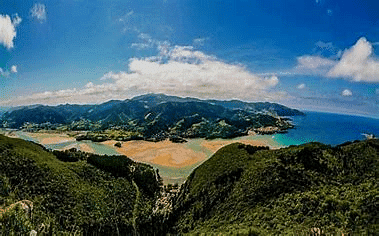
Land is a crucial natural resource, constituting about 30% of the Earth's surface. Not all land is suitable for human habitation or productive use; suitability depends on a combination of physical and climatic factors. The global population is unevenly distributed because of differences in land quality and climate. Areas with steep mountains, very cold climates, recurrent flooding, deserts, or dense forests tend to be sparsely populated, while plains and river valleys with fertile soils and favourable climates support higher population densities and intensive agriculture.
Land Use
Land use denotes the ways in which people utilise land for economic and social activities. Land use categories include agriculture, forestry, mining, and the built environment (houses, roads, industries).
- Physical factors affecting land use: topography, soil quality, climate, mineral resources, and water availability.
- Human factors affecting land use: population density, technology, policies, and cultural practices.
- Ownership and access categories: private land (owned by individuals), community land or common property resources (used collectively for activities such as grazing, collecting fodder, fruits, nuts, or medicinal herbs).
- The total quantity of available land is limited and its quality varies widely between regions.
- Rising demand for land places pressure on common property resources and can lead to unequal access.
- Shifts in land use often reflect cultural and economic changes in society.
- Intensification and expansion of agriculture, urbanisation, and infrastructure construction pose environmental risks such as land degradation, landslides, soil erosion, and desertification.
Conservation of Land Resources
- The growing population and its increasing demands have caused significant harm to forests and farmland.
- This has raised concerns about the depletion of these vital natural resources.
- To address the current level of land degradation, which includes soil erosion, deforestation, and desertification, it is essential to take action.
Methods to Protect and Conserve Land Resources
- Afforestation: Planting trees on degraded or deforested land to stabilise soil, increase organic matter, improve infiltration and restore ecosystem services.
- Land reclamation: Rehabilitation of degraded or wasteland to make it productive again, for example converting saline or waterlogged land to arable land through drainage and soil amendments.
- Regulated use of chemical pesticides and fertilisers: Following recommended doses, adopting integrated pest management (IPM), and promoting organic alternatives to reduce soil and water contamination and maintain soil microbiological health.
- Checks on overgrazing: Controlling livestock numbers, implementing rotational grazing, and restoring grazing lands to prevent vegetation loss and soil erosion.
- Soil and water conservation engineering: Measures such as contour bunding, terrace construction, check dams and gully plugs to reduce runoff and soil loss on slopes.
- Promotion of sustainable agricultural practices: Crop rotation, intercropping, mulching and conservation tillage to maintain soil fertility and structure.
- Legal and institutional measures: Land-use planning, zoning, protected area designations and community-based management to balance development and conservation.
Soil
Soil is the thin, porous layer of weathered rock and organic matter that covers the Earth's surface and supports plant life. Soil properties vary with landforms and local environmental conditions. A fertile soil contains a balanced mixture of minerals, organic matter, air and water, and supports healthy root growth and soil organisms.
Composition and Profile
- Soil components: minerals (derived from parent rock), organic matter (decomposed plant and animal material), water, and air.
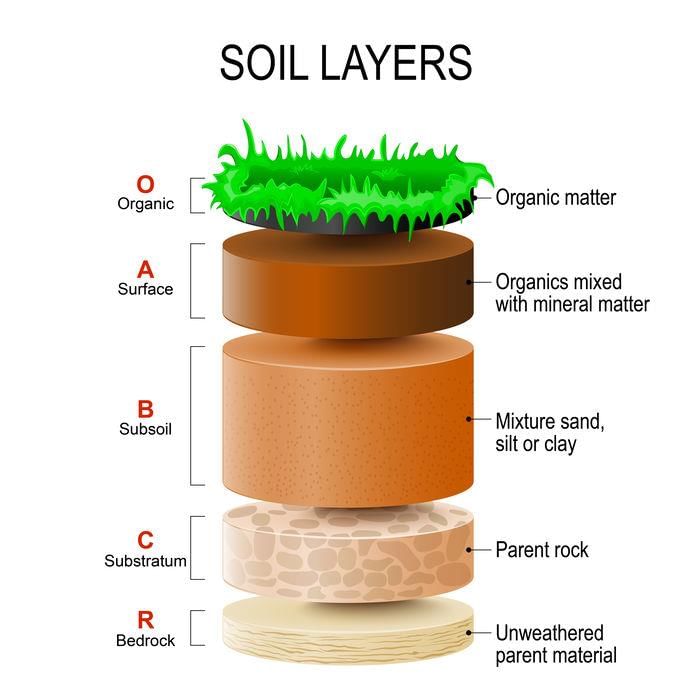
- Soil profile: soils typically show distinct layers or horizons-for example the organic-rich top layer (O/A), the zone of leaching or accumulation (B), partly weathered material (C), and unweathered parent rock (R).
- Soil texture and structure (sand, silt, clay proportions and the arrangement of particles) determine water-holding capacity, aeration and fertility.
Factors Influencing Soil Formation
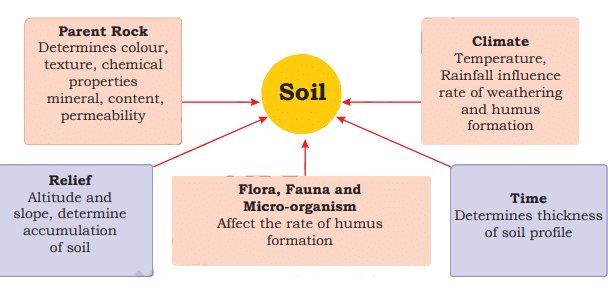
- Parent rock (lithology): determines the mineral composition available for soil formation.
- Climate: temperature and precipitation influence the rate of weathering, organic matter decomposition, leaching and horizon development.
- Topography: slope and aspect influence drainage, erosion and accumulation of materials.
- Organic material: vegetation and biological activity add humus and improve soil structure and fertility.
- Time: soil formation is slow; older soils typically show more developed profiles and distinct horizons.
Soil Degradation and Conservation Techniques
Soil degradation is the decline in soil quality caused by erosion, loss of organic matter, salinisation, nutrient depletion or contamination. It reduces agricultural productivity, damages ecosystems and threatens food security.
Factors Leading to Soil Degradation
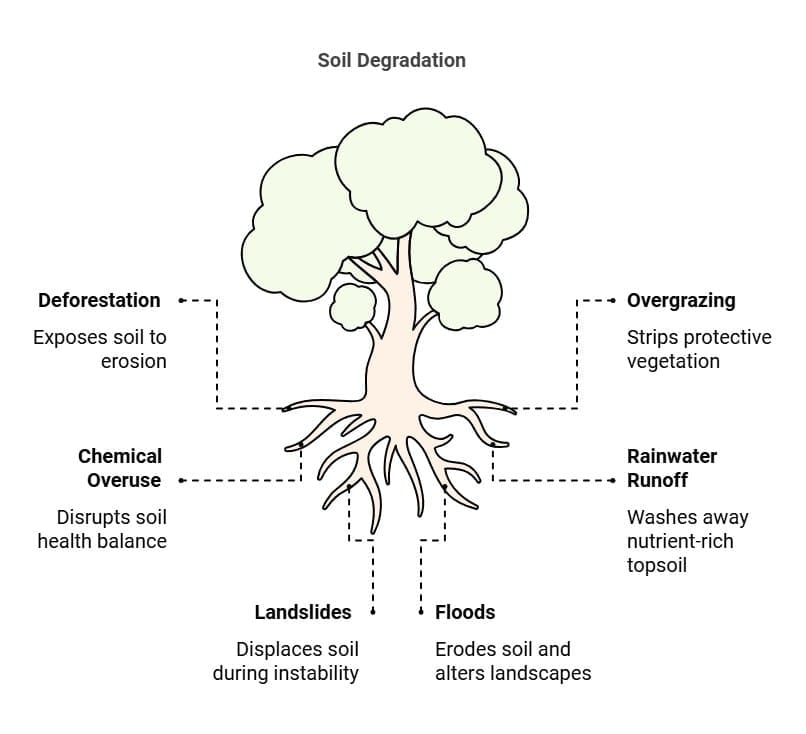
- Deforestation: Removal of tree cover exposes soil to erosion by wind and water and reduces organic inputs.
- Overgrazing: Excessive grazing removes protective vegetation cover, causing compaction and erosion.
- Excessive use of chemical fertilisers and pesticides: Can lead to nutrient imbalance, loss of soil biota and pollution of groundwater.
- Rainwater runoff: Intense rainfall on unprotected soils washes away fertile topsoil.
- Landslides: Slope instability can rapidly remove soil and vegetation from hillsides.
- Floods: Floodwaters can erode soils, deposit sand and silt, and alter soil chemistry.
Conservation Measures for Soil
- Afforestation and reforestation: Stabilise slopes, increase organic matter and reduce runoff.
- Mulching: Covering soil with organic residues (straw, leaves) to conserve moisture, reduce temperature extremes, and protect against erosion.
- Contour barriers and contour ploughing: Earth bunds, stone walls or furrows along contours slow water flow and promote infiltration.
- Rock dams and check dams: Small structures in gullies and streams reduce flow velocity, promote sediment deposition and reduce gully formation.
- Terrace farming: Creating stepped fields on slopes reduces slope length, surface runoff and soil loss while providing flat areas for cultivation.
- Intercropping and crop rotation: Growing different crops in succession or together improves biodiversity, breaks pest cycles and conserves soil nutrients.
- Shelter belts and windbreaks: Rows of trees or shrubs reduce wind speed and protect soil from wind erosion, especially in dry and coastal areas.
- Adoption of sustainable agricultural practices: Reduced tillage, organic amendments, and integrated nutrient management to maintain soil health.
Water
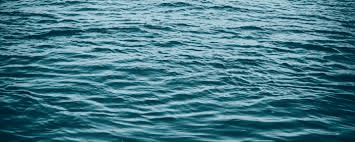
Water is a vital renewable resource that covers about three-quarters of the Earth's surface. Most of this is saline ocean water and not directly usable for drinking or irrigation. Only a small fraction of global water is freshwater and readily accessible for human use.
- Freshwater comprises about 2.5% of the Earth's total water.
- Approximately 70% of this freshwater is locked in ice caps and glaciers (Antarctica, Greenland, mountain glaciers), making it difficult to access.
- Only about 0.3% of the Earth's freshwater is readily available in rivers, lakes, shallow groundwater and the atmosphere for direct human use.
- Freshwater continually cycles through the water cycle (evaporation, condensation, precipitation and runoff), which maintains the overall volume but redistributes and sometimes limits availability in space and time.
- Water is essential for drinking, washing, agriculture, industry and generating hydroelectricity.
- Factors contributing to freshwater shortages include rising population, increased demand for food and cash crops, urbanisation, higher living standards, depletion of sources and contamination of water.
Problems of Water Availability
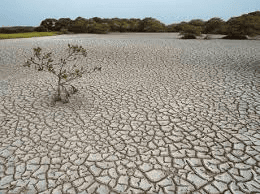
- Regions facing significant water scarcity include large parts of Africa, West Asia and South Asia, parts of the western USA and north-west Mexico, areas of South America, and the continent of Australia.
- Drought-prone countries experience acute scarcity due to variable seasonal or annual precipitation, over-exploitation of groundwater and contamination of water sources.
Conservation of Water Resources
Although water is renewable, misuse and pollution make large volumes unavailable for use. Conserving water requires integrated approaches addressing supply, demand, quality and reuse.
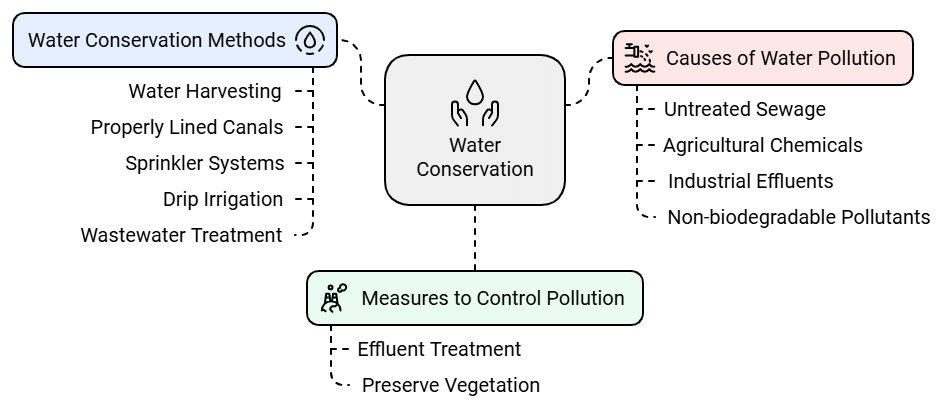
Major causes of water pollution
- Discharge of untreated or partially treated sewage into rivers, lakes and coastal waters.
- Runoff of agricultural chemicals (fertilisers, pesticides) into waterbodies.
- Industrial effluents discharged without adequate treatment.
- Entry of non-biodegradable and toxic substances such as heavy metals, nitrates and persistent pesticides into water, posing health risks.
Measures to control water pollution
- Treatment of municipal and industrial effluents to acceptable standards before discharge.
- Strict regulation and monitoring of pollutant sources and enforcement of environmental standards.
- Promotion of cleaner production technologies and reduction of toxic discharges.
- Protection and restoration of vegetative cover in catchments and along waterways to reduce runoff and filter pollutants.
Water conservation methods
- Rainwater harvesting and watershed management to capture and store surface runoff and recharge groundwater.
- Lining of canals to reduce seepage losses.
- Use of sprinkler irrigation to reduce surface and evaporation losses compared to open-channel methods.
- Adoption of drip/trickle irrigation in arid and semi-arid regions to apply water directly to the root zone and reduce evaporation.
- Wastewater treatment and reuse (treated sewage for agriculture and industry) to extend available freshwater supplies.
Natural Vegetation and Wildlife
A short classroom example illustrates how vegetation supports livelihoods and local crafts. Students visiting a handicrafts fair noticed items made from various plant fibres and products: a jute handbag, baskets, lamp shades and chairs made of cane and bamboo common in humid eastern and northeastern regions, and a silk scarf produced from silkworms reared on mulberry. This highlights how natural vegetation provides raw materials for many everyday products.
Ecosystem
- Natural vegetation and wildlife are integral parts of the biosphere, the global sum of all ecosystems where life exists.
- An ecosystem is a community of living organisms interacting with one another and with their physical environment, exchanging energy and matter.
Uses of Vegetation
- Timber: construction, furniture and fuelwood.
- Fruits: food and nutrition.
- Nuts: food and oil sources.
- Medicinal plants: raw materials for traditional and modern medicines.
- Latex: source of natural rubber.
- Gum: industrial and food uses.
- Turpentine oil: solvents and chemicals.
- Paper: made from wood pulp and used for writing and printing.
Uses of Wildlife
- Milk and other animal products for nutrition and livelihood.
- Meat as a food source where culturally appropriate.
- Hides and skins for leather goods.
- Wool for textiles.
- Bees produce honey, assist in pollination and contribute to ecosystem functioning.
- Birds help control insect pests and contribute to nutrient cycling.
- Vultures and scavengers clean the environment by consuming carcasses.
- Both plants and animals, from micro-organisms to large mammals, are essential for ecosystem balance and human well-being.
Distribution of Natural Vegetation
- Vegetation distribution primarily depends on temperature and moisture. Soil type, altitude and human activity also influence vegetation patterns.
- Main types of natural vegetation worldwide include:
- Forests: occur in regions with high rainfall and suitable temperatures; include tropical evergreen, tropical deciduous, temperate and boreal forests.
- Grasslands: develop where rainfall is moderate; dominated by grasses with scattered trees and shrubs (e.g., prairies, savannas, steppes).
- Scrublands (thorn forests): found in dry regions with low rainfall; vegetation adapted to conserve water (deep roots, small or waxy leaves).
- Tundra: occurs in polar and high-altitude regions; vegetation is limited to mosses, lichens and dwarf shrubs.
- Human activities such as deforestation, conversion to agriculture and urban expansion have significantly altered natural vegetation and reduced habitat areas.
Try yourself: Which of the following is NOT a product derived from vegetation?
Conservation of Natural Vegetation and Wildlife
- Importance: Forests and natural habitats provide shelter, food and breeding grounds for wildlife and maintain ecological interactions between species.
- Threats: Habitat loss from deforestation and land conversion, soil erosion, urban development, pollution, climate change and illegal hunting (poaching) threaten many species with vulnerability, endangerment or extinction.
- Factors contributing to extinction: Human-induced causes such as deforestation, habitat fragmentation, overexploitation and poaching; natural causes such as large fires, floods, tsunamis and landslides.
- Poaching: Illegal hunting affects species hunted for hides, horns, tusks, skins, bones, feathers and other body parts (examples include tigers, elephants, rhinoceroses and some large ungulates and birds).
- Conservation efforts: Establishment of national parks, wildlife sanctuaries, biosphere reserves and protected wetland areas; legal protection and international agreements such as the Convention on International Trade in Endangered Species (CITES) to regulate trade in endangered species; anti-poaching measures and habitat restoration.
- Community and educational measures: Awareness programmes (afforestation drives, Van Mahotsava), ecotourism, nature camps and citizen participation (birdwatching, conservation volunteering) to foster respect for biodiversity.
- In-situ and ex-situ conservation: Protecting species in their natural habitats and conserving genetic material or captive breeding in zoos, botanical gardens and seed banks where needed.
- Conserving plants and animals is an ethical and practical responsibility for maintaining environmental balance and sustaining livelihoods that depend on natural resources.
Summary: Land, soil, water, natural vegetation and wildlife are interlinked components of the environment. Sustainable use and active conservation-through scientific, engineering, policy and community actions-are essential to maintain ecosystem services, agricultural productivity and biodiversity for current and future generations.
FAQs on NCERT Summary: Land, Soil, Water, Natural Vegetation and Wildlife
| 1. What are the main factors leading to soil degradation? |  |
| 2. What are some effective conservation techniques for soil? | |
| 3. How does vegetation contribute to the ecosystem? | |
| 4. What are the uses of wildlife in natural ecosystems? | |
| 5. What measures can be taken to conserve land resources effectively? | |





